
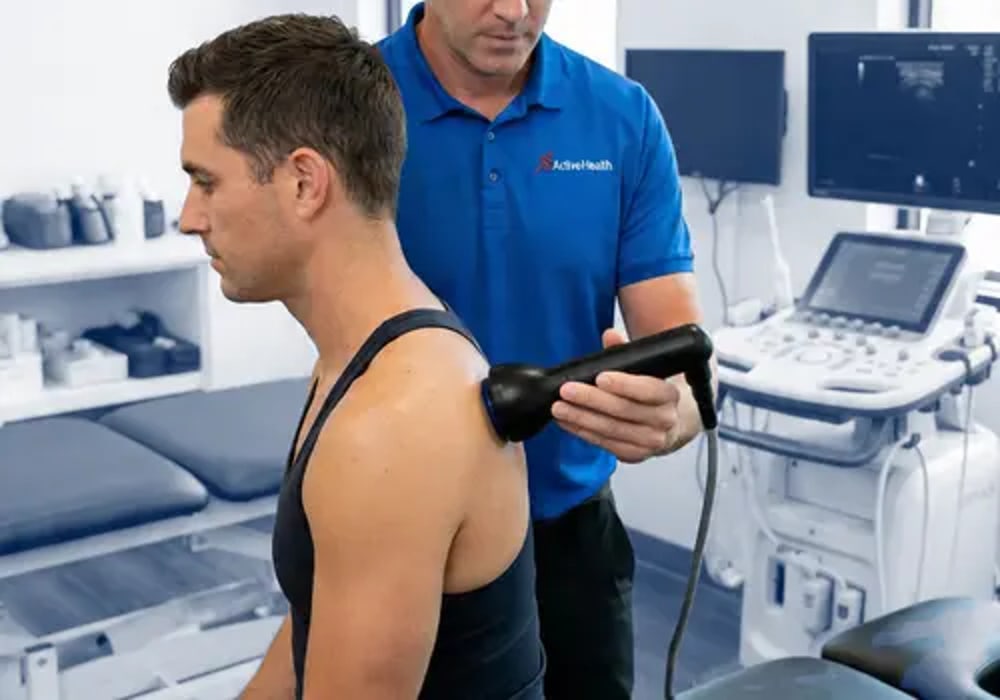
A hamstring injury is a strain or tear in one of the three muscles at the back of the thigh, usually from sprinting, kicking or a sudden stretch. Active Health treats it in Jacksonville, FL with staged sports injury rehab, eccentric strength training, compression for recovery and, for a stalled high hamstring tendon, focused shockwave. No referral is needed.
It usually happens at speed. You open up into a sprint, stretch for a ball or swing a leg through a kick, and something grabs at the back of your thigh.
A few weeks later it feels fine at a jog. Whether it holds at full speed is a separate question, and here that answer gets measured instead of guessed.
At our sports medicine clinic for injured athletes, the first visit grades the injury, finds where it sits and looks at what overloaded it. You leave knowing your starting stage and what has to happen before you sprint again.
Understanding Hamstring Injuries
The hamstrings are three muscles, the biceps femoris, semitendinosus and semimembranosus, that run from the sit bone to just below the knee. An injury to them ranges from a mild pull to a complete tear. In the most severe cases the tendon tears away from the bone.
- The muscle is loaded while it lengthens. In a sprint, the hamstring works hardest as it stretches to slow the swinging leg just before the foot lands.
- Fibers tear, often where muscle meets tendon. The long head of the biceps femoris is involved in about four out of five hamstring strains.
- Strength drops and stays down. Weakness can last for weeks after the pain fades, so a leg that feels normal at a walk may not be ready to sprint.
These signs help separate a strain from something else.
Usually a hamstring strain when
- The pain started suddenly, mid-sprint, mid-kick or mid-lunge.
- Stretching the muscle or bending the knee against resistance hurts.
- One spot at the back of the thigh is tender to press.
Points somewhere else when
- A direct blow started it, which suggests a bruised muscle, called a contusion.
- Vague pain crept in with numbness or tingling, which can come from the lower back or a nerve.
- A sit-bone ache built over weeks and is worse when you sit, which points to the upper tendon.
Signs of a Pulled or Torn Hamstring
Symptoms vary with the grade and location of the injury. These are the signs worth having checked before you run on it again.
- Sudden, sharp pain in the back of the thigh during a sprint, kick or lunge
- A pop or a tearing feeling at the moment it happened
- Swelling and tenderness at the back of the thigh within a few hours
- Bruising that spreads down the back of the leg over the next few days
- Weakness when you bend the knee or drive the leg back
- Pain when you stretch the hamstring or try to stride out
- Trouble standing or walking on the injured leg
- A deep ache at the sit bone that is worse with sitting or faster running
What Causes Hamstring Injuries
Telling these apart is the point of the first visit, because each one changes how the rehab is built.
Sprinting and High-Speed Running
Sprint strains happen late in the leg swing, when the hamstring is long and braking hard. They usually involve the biceps femoris, the outer hamstring. Track, soccer and American football carry some of the highest rates.
Kicking and Overstretching
A forceful stretch with the hip bent and the knee straight, as in a high kick, a dance move or a straight-legged lift, injures the hamstring higher up. These injuries usually involve the semimembranosus near the sit bone.
A Previous Hamstring Strain
An earlier strain is one of the clearest risk factors for the next one. A meta-analysis of more than 71,000 athletes, cited in the physical therapy clinical practice guideline on hamstring strain injury, found it raised the risk about 2.7 times. The guideline links repeat strains to rehab that ended early or a return that came too soon.
Fatigue, Imbalance and Pelvic Tilt
The quadriceps are usually stronger than the hamstrings, which can tire first at speed and then absorb less force. A pelvis that tips forward also holds them longer, and the guideline notes this may raise the risk.
Overload at the Upper Tendon
High hamstring tendinopathy builds gradually where the tendon attaches at the sit bone. An expert review of proximal hamstring tendinopathy describes lower buttock pain that is worse with faster running or long sitting, and more stretching tends to aggravate it.
How We Treat Hamstring Injuries in Jacksonville
Care begins with an evaluation that grades the injury, finds where it sits and checks for a tendon avulsion. The plan then rebuilds the hamstring in stages: settle the tissue, restore eccentric strength, then return to running, sprinting and sport, with each stage tested before the next one begins.
That order follows the same guideline, which recommends eccentric training to your tolerance alongside strengthening, stability work and a progressive running program, plus agility and trunk work to lower the chance of a repeat strain.
Sports Injury Treatment
Staged sports injury treatment for torn hamstrings frames the whole plan, from the protected first days through loading, running and sprint work. Clearance comes from testing, with your strength measured against the other leg.
Therapeutic Exercise
Eccentric strength sits at the center of hamstring rehab, because the muscle has to produce force while it lengthens. Therapeutic exercise progressed to your tolerance builds toward heavy, slow eccentric work and then speed, with hip and trunk control trained alongside.
Normatec Compression Therapy
Normatec sessions between hard training days inflate in sequence from the foot upward to move swelling out of the leg, so the next loading session can do more. Compression supports the rehab and does not heal the strain itself.
Shockwave Therapy
Shockwave is reserved for a high hamstring tendon that has stalled after a fair run of loading. Focused shockwave for a stalled high hamstring tendon may then join the plan; the same expert review lists it as an option when standard care has not worked. A course runs 6 to 12 sessions.
How Your Hamstring Treatment Options Compare
A hamstring injury has real alternatives, and surgery is the right call for one specific tear.
| Option | When it is the right call | The trade-off |
|---|---|---|
| Staged rehab at Active Health | Most strains and partial tears, a hamstring that keeps going, and high hamstring tendon pain. | It takes weeks, and the eccentric work between visits is yours to do. |
| Rest and stretching on your own | The first few days of a mild pull that improves each day. | Pain settles, but nothing rebuilds the eccentric strength the guideline ties to a safe return. |
| Surgical repair (not performed here) | A tendon pulled completely off the bone, most often at the sit bone. | Rehab after a repair at the pelvis typically takes at least 6 months, per the American Academy of Orthopaedic Surgeons. |
Surgery is not performed at Active Health. If your evaluation suggests an avulsion, we help you find an orthopedic surgeon, and the rehab after a repair can be done here.
Pulled Hamstring Recovery Time
- SettleProtect the tissue in the first days and keep walking as comfort allows.
- ReloadRebuild strength, moving toward eccentric work as the muscle tolerates it.
- RunA graded running program, from easy jogging up to full-speed sprints.
- ReturnSport-specific drills and side-to-side strength testing before clearance.
The guideline puts typical time lost from sport at 3 to 28 days or more, depending on how severe the strain is. A complete tear or a surgical repair takes months. Results vary with the grade, where the injury sits, your sport and how consistently the loading gets done.
Your first visit gives an early estimate. The guideline names four predictors: hamstring strength, pain at the time of injury, the days until you could walk without pain, and how much of the muscle is tender.
When a Hamstring Injury Needs Urgent Care
See a physician promptly
These can be signs of a tendon avulsion, where the hamstring tendon tears away from the bone. It needs imaging and a surgeon's opinion before any rehab begins.
- A pop high at the sit bone during a sudden, forceful stretch with the knee straight
- A lump or a hollow at the back of the thigh where the muscle has balled up
- Large bruising or swelling that keeps getting worse
- Pain so strong that standing or walking on the leg is hard
- A fever, or feeling hot and shivery, along with the leg pain
Do not wait for a rehab appointment with any of these.
Book an evaluation instead of waiting it out
- No real improvement after a few days of sensible self-care
- A second strain in the same hamstring
- A game, race or season coming up that depends on a sound return
Who Treats Your Hamstring in Jacksonville
Hamstrings are our jam. Hamstring injuries are some of the most common reasons athletes come to Active Health. Dr. Jeffrey Lipp, DC, DACBSP®, the founder and owner, and Dr. Christopher Brown, DPT, have worked together since 2013.
Patients who came in with torn and high hamstrings name both of them in their reviews. Both work at the Bowden Road practice Dr. Lipp founded in 2005, where the evaluation, the loading work and the recovery tools share one roof.