
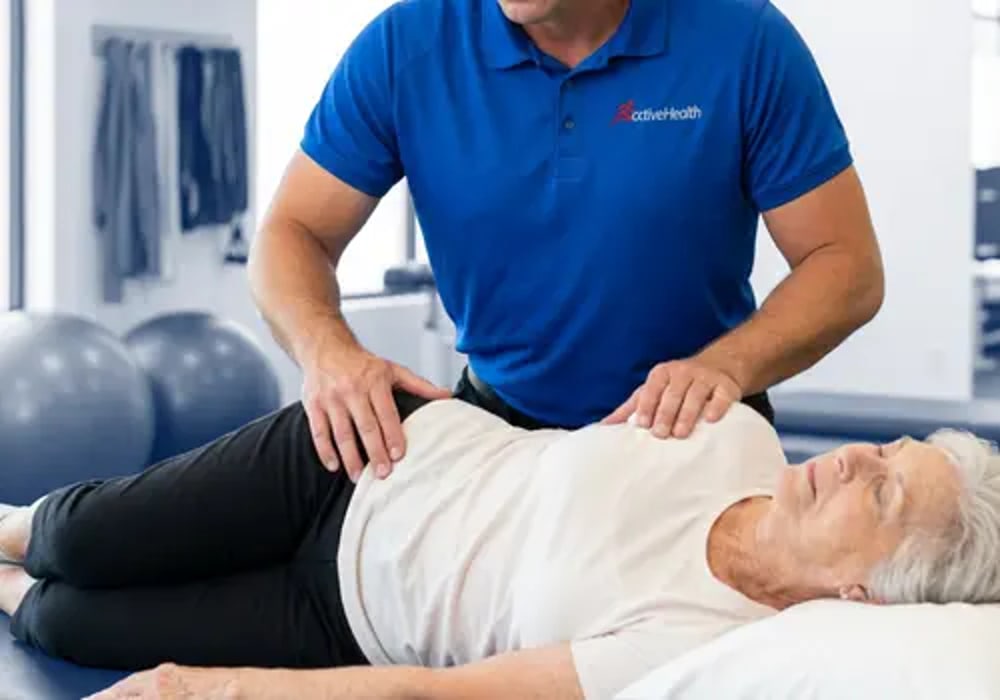
Manual soft tissue therapy is a category of skilled, hands-on clinical techniques that directly treat the quality, mobility, and function of the soft tissues through specific, targeted manual interventions.
It is distinct from general massage in its clinical precision: each technique is applied to a specific tissue structure for a specific reason, informed by assessment findings. At Active Health, manual soft tissue therapy is always coordinated with the broader rehabilitation plan.
Tissue work prepares the environment for mobility restoration and therapeutic exercise. Used in isolation, soft tissue work produces temporary change. Used within a coordinated plan, it produces structural improvement that holds.
What Is Manual Soft Tissue Therapy?
Manual soft tissue therapy encompasses a range of skilled, hands-on clinical techniques applied directly to muscles, fascia, tendons, and connective tissue to restore normal tissue quality, extensibility, and function. It targets the specific tissue structures that are restricted, adhered, or dysfunctional rather than applying general pressure over a broad area.
Different techniques address different tissue problems. Myofascial release works on fascial tension and restrictions across tissue planes. Trigger point therapy addresses hyperirritable nodules within muscle tissue that produce local and referred pain. Scar tissue mobilization breaks down adhesive cross-links that restrict mobility after surgery or injury. Instrument-assisted techniques introduce a controlled microtrauma that stimulates tissue remodeling in chronically affected areas.
At Active Health, technique selection is based on what the assessment reveals about the tissue. The goal is always to restore the tissue quality and mobility needed for the rehabilitation plan to progress effectively.
Conditions We Support With Manual Soft Tissue Therapy in Jacksonville
At Active Health, we treat a wide range of soft tissue and pain conditions throughout Jacksonville. Manual therapy is most impactful when tissue quality, fascial restriction, or scar tissue is creating a barrier to mobility, rehabilitation progress, or pain resolution.
Post-Surgical Rehab
Manual scar mobilization and myofascial techniques address these adhesions progressively, restoring tissue mobility and reducing the mechanical restriction that slows post-surgical rehabilitation and limits full functional recovery.
Mobility Restrictions
Targeted manual therapy addresses the specific tissue structure responsible for the restriction with the technique most appropriate for its depth and presentation.
Sciatica & Radiculopathy
Manual therapy targeting the specific tissue contributors can reduce the mechanical compression and sensitization driving radiating symptoms improving nerve mobility and reducing the pain burden during rehabilitation.
In neuropathy where a nerve is being squeezed rather than damaged, the same hands-on work frees the common compression points in the calf and the forearm and restores the glide that no medication can change. After whiplash, where the neck has been braced for weeks, releasing the guarded neck and upper back muscles restores the tissue quality that has to be there before retraining will hold.
Advantages of Manual Soft Tissue Therapy at Active Health
Manual therapy produces lasting results when it is clinically specific and integrated with the movement and loading work that reinforces the tissue change beyond the treatment table.
Directly Changes Tissue Quality
Unlike modalities that work on pain signaling or inflammation indirectly, manual soft tissue therapy physically alters tissue structure, breaking down adhesions, releasing fascial tension, and deactivating trigger points that no amount of stretching or exercise can reach.
Prepares Tissue for Rehabilitation
Attempting to load a tissue that is adhered, restricted, or guarded produces poor movement quality and a high risk of re-irritation. Manual therapy before exercise prepares the tissue environment.
Addresses Contributors Invisible on Imaging
Manual therapy identifies and treats these tissue-level contributors with hands-on precision, providing an explanation and solution for pain that imaging has not been able to account for and general exercise has not been able to resolve.
Manual Soft Tissue Therapy Compared With the Alternatives
Hands-on work is sold under a lot of names in Jacksonville, and the differences between them matter a great deal more than the price tags suggest.
| Option | What it delivers | The trade-off |
|---|---|---|
| Manual soft tissue therapy | Assessment-led work on the specific restricted or adhered structure, sequenced inside a rehabilitation plan so the change is loaded straight away. | It asks you to do the movement work afterward, or the tissue change does not hold. |
| Therapeutic massage | General pressure across a broad area to reduce muscle tension and improve local circulation, without a diagnostic step in front of it. | Cheaper and genuinely pleasant, though the relief tends not to outlast the session by much. |
| Active Release Techniques | A defined protocol combining specific manual contact with active movement through the restriction, aimed at adhesion and nerve glide. | A narrower tool than the manual category as a whole, so it suits fewer presentations. |
| Injection options | Medication placed into or around the painful structure to quiet the symptom for a period. | Not the first move for a tissue restriction, and it changes nothing about the tissue itself. |
The first two rows are the question people arrive with. The difference is not pressure or duration, it is whether an assessment decided what was being treated and why. A massage that feels excellent and a session that changes a restriction are not the same purchase, and the second one is usually the cheaper of the two over a year.
The last row matters for a different reason. Where pain is high enough to block sleep or to stop rehabilitation from starting, an injection can be the sensible step, and you will be told that rather than sold a course of table work. Where the restriction is the actual problem, quieting the symptom leaves it in place.
What the Research Shows About Hands-On Work
The National Center for Complementary and Integrative Health, reviewing the research on whether massage actually helps a painful back or neck, reports evidence that massage helped chronic low-back pain while rating the strength of that evidence low, and finds it more helpful for neck and shoulder pain than inactive treatment while no more effective than other active treatments.
That is an argument for assessment rather than against hands-on work. If general pressure buys short-term relief, the case for choosing which structure to treat, and for loading the change afterward, gets stronger, not weaker.
Schedule Your Appointment!
You should not have to live with unanswered questions or a plan that feels unclear. Schedule a visit with Active Health Jacksonville to review your symptoms, understand what may be contributing, and get practical recommendations you can follow.
Why Choose Active Health for Manual Soft Tissue Therapy?
Many patients have experienced massage or soft tissue work that felt good temporarily but never changed the underlying restriction. At Active Health, manual therapy is clinically directed informed by assessment, specific to the tissue structure involved, and integrated within a rehabilitation plan so the tissue changes produced in the session are immediately reinforced by movement and loading.
Post-surgical patients benefit from scar mobilization that begins as early as tissue healing allows. Chronic pain patients benefit from trigger point work that reduces the baseline pain burden making rehabilitation feel impossible. Athletes benefit from fascial and tendon tissue work that maintains tissue quality through high-load training cycles.