
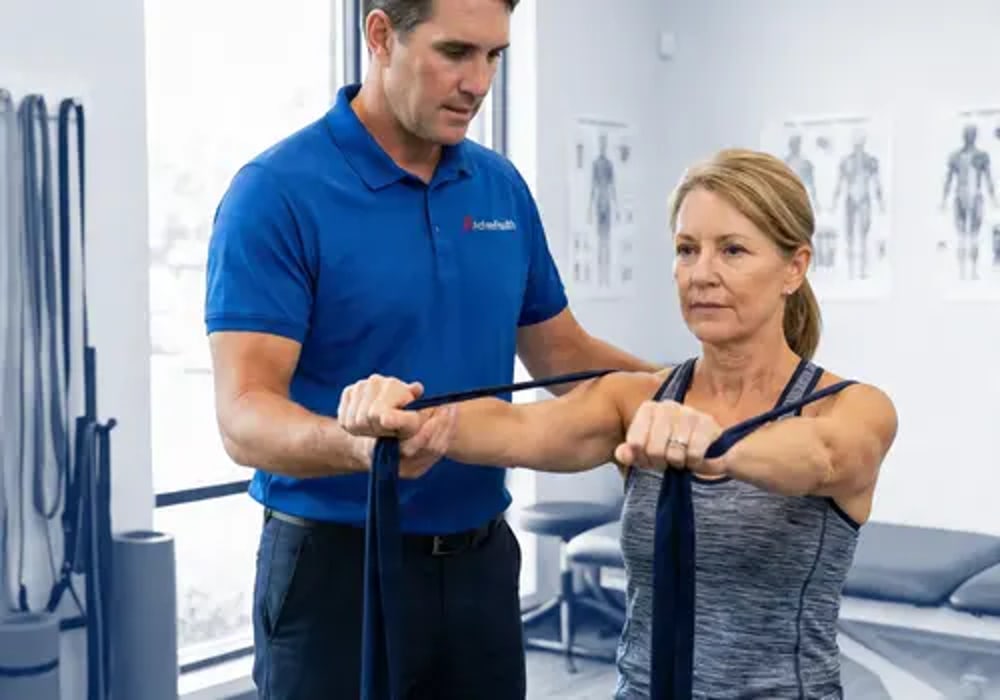
A rotator cuff injury is irritation, impingement or a tear in the four tendons that hold the shoulder in its socket. Active Health treats it in Jacksonville, FL with progressive strengthening, hands-on work, focused shockwave and a PRP option, and refers a sudden traumatic tear to a surgeon early. No referral is needed to book an evaluation.
It usually starts small. The shoulder aches after a round of golf or a day of overhead work, then it wakes you when you roll onto it. Reaching into the back seat starts to hurt.
Rest and ibuprofen are a fair start for a fresh flare. When the ache is still there months later, the cuff usually needs loading back to strength, and a shoulder that went weak after a fall needs a surgeon's opinion.
Shoulder care here runs through our evaluation-to-recovery physical therapy services on Bowden Rd. The first visit tests strength, range and the movements that hurt. You leave with a written plan and a clear view of whether a surgeon should see the shoulder.
Understanding Rotator Cuff Injuries and Impingement
The rotator cuff is four muscles whose tendons wrap the top of the upper arm bone and keep it centered in the shoulder socket as the arm lifts and turns. A rotator cuff injury covers three overlapping problems: an irritated tendon, impingement pain under the bony roof of the shoulder, and a partial or full-thickness tear.
Most cuff problems build in the same three steps.
- Load outruns the tendon. Overhead work, a jump in training or age-related wear asks more of the cuff than it can absorb, and the tendon frays.
- The space gets crowded. A sore, weaker cuff can let the ball of the shoulder ride higher as the arm lifts. That pinches the tendon and the bursa above it, which is the catch people feel partway up.
- The shoulder works around it. You start hiking the shoulder to lift the arm. The arm keeps working, the cuff stays under-loaded, and the pain outlasts the strain that started it.
Shoulder pain is not always the cuff. Pain running from the neck down the arm with tingling points to a nerve, and a shoulder that has lost movement in every direction suggests a stiff joint capsule.
Plenty of shoulders show a worn cuff on an MRI and never hurt, so the exam carries as much weight as the image.
Signs Your Shoulder Pain Is a Rotator Cuff Problem
Rotator cuff symptoms change with whether the tendon is irritated, worn or torn. If two or more of these sound familiar, the shoulder is worth an exam.
- A dull ache deep in the shoulder that spreads down the outside of the upper arm
- Pain at night, especially when you lie on the sore side
- Pain when you lift the arm out to the side or reach overhead
- A catch or pinch partway up as the arm rises, easing once it is above shoulder height
- Weakness when you lift or rotate the arm, such as reaching for a seatbelt or a high shelf
- Pain reaching behind your back to tuck in a shirt or fasten a bra
- Crackling or grinding when the shoulder moves in certain positions
- Sudden pain and weakness after a fall or a heavy lift, sometimes with a snapping feeling
What Causes Rotator Cuff Injuries
Rotator cuff problems tend to come from five patterns, and one shoulder often carries two of them.
Age-Related Tendon Wear
Most cuff tears come from slow wear with no single event behind them. The risk climbs after 40 as blood supply to the tendons drops, and pain tends to arrive when demand jumps.
Repeated Overhead Loading
Tennis, baseball, swimming and weightlifting load the cuff overhead again and again, and so do painting and carpentry. The tendon falls behind on repair when there is never a lighter week.
A Fall or a Sudden Heavy Lift
Landing on an outstretched arm, or catching a heavy load with a jerk, can tear a tendon outright, sometimes alongside a dislocation. In younger adults, most tears start this way.
Weak Shoulder Blade Control and a Rounded Upper Back
The shoulder blade has to rotate and tilt as the arm rises to leave room for the cuff. A rounded upper back and tired shoulder blade muscles take some of that room away, a common thread in impingement pain.
Calcium Deposits in the Tendon
Some painful cuffs carry a calcium deposit inside the tendon, called calcific tendinitis. It shows on a plain X-ray and can cause severe night pain, so imaging is reviewed before a plan is set.
How We Treat Rotator Cuff Injuries in Jacksonville
Care begins with an exam that sorts a sore tendon from a torn one and finds the movements the shoulder cannot yet tolerate. The plan then rebuilds cuff and shoulder blade strength in stages, frees stiff tissue by hand, and adds focused shockwave or a PRP injection only where the exam supports it.
Therapeutic Exercise
Strength lets the cuff hold the ball of the shoulder centered again. The program starts with holds the tendon tolerates, moves to banded rotation and shoulder blade work, then builds back to overhead and sport loading. Progressive rotator cuff and shoulder blade strengthening is the backbone of the plan, and the home program carries it between visits.
Manual Soft Tissue Therapy
A stiff back of the shoulder and a guarded upper back both change the path the arm takes as it rises. Hands-on release for a tight posterior shoulder and chest wall restores the range the exercise program needs, and loading follows so the new range gets used.
Shockwave Therapy
Where imaging shows calcium in the tendon, or a long-standing cuff tendinopathy has stopped responding to loading, focused shockwave for calcific shoulder tendinopathy is an option. A course usually runs 6 to 12 sessions alongside the strength work, and it is not used on a complete tear.
PRP Therapy
Some partial-thickness tears and worn tendons stall even after a fair trial of loading. For those, the medical side of the practice may discuss a platelet-rich plasma injection for a stalled cuff tendon. Shoulder research on PRP is mixed, it is self-pay, and results vary.
How Your Rotator Cuff Options Compare
Each option has a place. Shoulder surgery is not performed at Active Health.
| Option | When that is the right call | The trade-off |
|---|---|---|
| Physical therapy and loading at Active Health | First line for impingement, cuff tendon pain and most wear-related tears, including many full-thickness tears. | It takes weeks to months, and the home program has to happen between visits. |
| Cortisone injection | Useful when night pain blocks sleep or stops rehab from getting started. | How long the relief lasts varies widely, it does not strengthen the cuff, and repeated injections carry risks of their own. |
| Decompression surgery for impingement (not performed here) | Long-standing impingement pain that has not responded to anything else, decided with an orthopedic surgeon. | A 2019 BMJ guideline panel found no important benefit over placebo surgery and made a strong recommendation against subacromial decompression for this kind of pain. |
| Rotator cuff repair surgery (not performed here) | A tear from a recent injury with clear weakness, a large tear in good-quality tissue, or a tear that has failed a full course of rehab. | Months of protected rehab follow it, and a repaired tendon can tear again. |
When the exam points toward a surgeon, you hear it at the visit, with the findings behind it.
How Long Rotator Cuff Recovery Takes
Shoulder plans move through four phases, and each reassessment tells you which phase you are in.
- Calm it downEase the night pain and find the positions and loads the shoulder accepts.
- Restore the motionWin back the reach overhead and behind the back that guarding took away.
- Rebuild cuff strengthBanded and weighted rotation, shoulder blade control, then overhead work.
- Return to full demandServe, swim, throw or lift again, with strength checked against the other arm.
A multicenter study followed 452 patients with full-thickness tears that had no injury behind them. Those who chose surgery mostly did so between 6 and 12 weeks, and at two years physical therapy alone had worked for about 75 percent of them.
That makes six and twelve weeks sensible checkpoints for a shoulder plan. Results vary with the type of problem, how long it has hurt and how consistently the home program gets done.
When a Shoulder Needs a Physician or a Surgeon First
Most shoulder pain can start with a conservative plan. A few presentations should not wait for one.
Call 911 or go to an emergency room
- Left shoulder or arm pain that comes with chest pressure, shortness of breath, sweating or nausea
- A shoulder that looks deformed, or will not move at all, after a fall or a collision
- A hot, red, swollen shoulder with a fever
See an orthopedic surgeon promptly
- A fall or a heavy jerk followed by sudden weakness, so the arm will not lift out to the side
- A snap or tearing feeling at the moment of injury, then pain and weakness
- Weakness that gets worse week by week, or new numbness down the arm
University of Washington orthopedic surgeons advise that when an acute injury tears the cuff, surgical repair should be considered within six weeks of the injury, before the muscle and tendon waste. Rehab here can follow the repair.
Expert Care for Rotator Cuff Injuries in the Jacksonville Area
Shoulder rehab at Active Health is led by physical therapy. Dr. Christopher T. Brown, DPT, has been with the practice since 2013, and he is the clinician named most often in the shoulder reviews on our Google profile.
Exercise, hands-on work and any injection decision stay inside one plan at the Jacksonville clinic that keeps rehab and injection decisions under one roof.
Patients reach 6500 Bowden Rd from San Jose, Deerwood and the Southside, from Ponte Vedra Beach and from as far as St. Augustine. The clinic sits just off I-95 in the Southpoint corridor.