
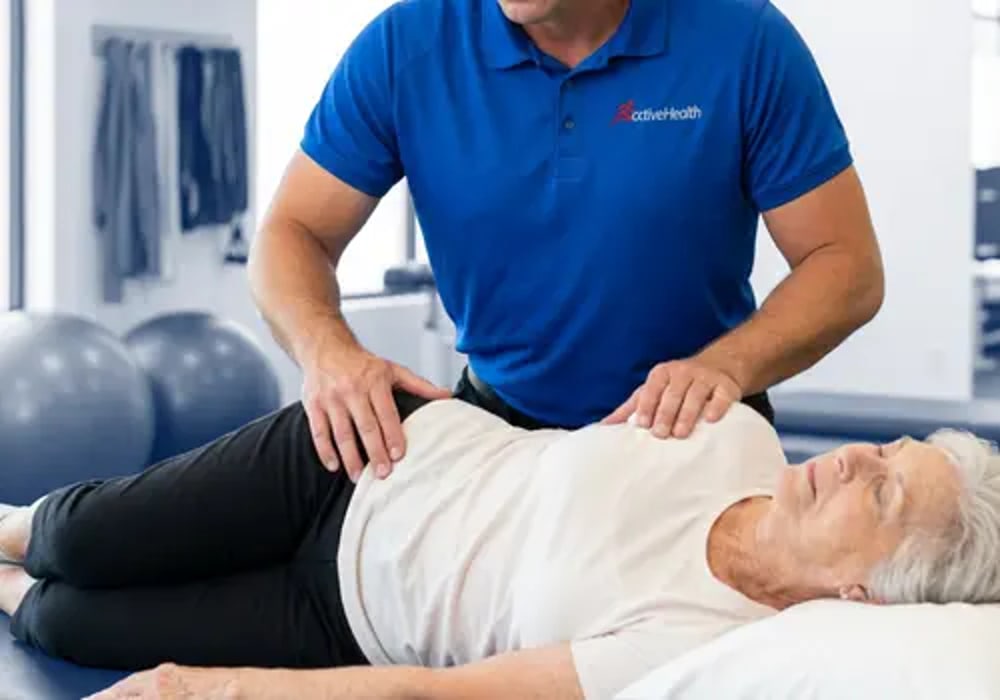
If you are recovering from surgery or an injury and feeling uncertain about what to do, when to progress and how hard to push, the missing piece is usually a properly built exercise program rather than more effort.
Many patients come to Active Health after months of self-directed exercise that has maintained their condition rather than improved it, often because the exercises were not matched to what the body actually needed at that stage of recovery.
Therapeutic exercise here is a prescription with a sequence, not a list of movements. Exercises are selected for a stated reason, progressed on how you respond to load, and changed as you improve. You leave the first visit knowing which deficit is being treated and what has to happen before the next phase opens.
What Therapeutic Exercise Involves
Therapeutic exercise is individually prescribed, clinically supervised movement aimed at restoring a specific physical capacity. StatPearls describes it as movement prescribed to correct impairments and restore muscular and skeletal function, which is a different job from general fitness training. A gym program is organized around what you want to be able to do. A therapeutic program is organized around what the assessment says you currently cannot.
What the work looks like changes with the phase. Early after surgery or an acute injury it is neuromuscular activation and motor re-education, because a muscle the nervous system has turned down cannot be strengthened until it is switched back on. Once the pattern is available, progressive resistance work closes the strength deficit that testing found. Proprioceptive and balance work follows where joint stability is the limiting factor, and functional or sport-specific loading closes the remaining gap to whatever you are going back to.
The distinguishing feature is clinical direction rather than difficulty. Every exercise is chosen because it answers a deficit identified at the assessment, whether that is a motor pattern, a strength ratio between sides, or a timing problem in how muscles fire. Progression is decided on measured response instead of on comfort, and the selection is adjusted inside the session based on how you actually move through it. Generic programs tend to stall for a mundane reason: the same exercises get applied to different deficits.
Conditions We Support With Therapeutic Exercise in Jacksonville
Therapeutic exercise is a component of nearly every rehabilitation plan at the Bowden Road clinic. These are the presentations where it carries most of the work rather than supporting it.
Post-Surgical Rehab
The program is designed around the specific procedure, the healing timeline your surgeon set, and the function you need back, advancing from activation to strength to full demand as objective milestones are met rather than as weeks pass. See how we approach strength and control rebuilt after an operation.
Sciatica and Radiculopathy
Gluteal weakness, poor lumbar stabilizer activation and hip mobility deficits are the most common reason a settled case comes back. Targeted loading reawakens the inhibited stabilizers and builds the endurance that has to hold when you are tired. Read about leg pain driven by deficits further up the chain.
Mobility Restrictions
Restored range only holds if the nervous system can use it. Loading the new range under progressively heavier demand is what turns a measurement taken on a table into movement your body keeps. Start with range that slips away again within a day.
Tech Neck and Postural Strain
Screen posture is an endurance problem before it is a strength problem. The deep neck flexors and the muscles that hold the shoulder blade give out well before the workday does, so the program trains the endurance those muscles are actually short of. See the muscles that fatigue first at a desk.
Plantar Fasciitis
Heel pain responds to load applied properly, so progressive calf, posterior chain and intrinsic foot work carries much of the treatment once the tissue tolerates it. Read about heel pain that needs loading rather than rest.
The same loading logic carries three more presentations: a pulled hamstring, a herniated disc or a bulging disc, and tennis elbow or golfer's elbow.
What a Course of Therapeutic Exercise Looks Like
Four phases, each with an entry requirement. You always know which one you are in and what opens the next.
- Assessment. Movement testing, strength measured side to side, and a look at the joints above and below the painful one. Bring your operative report or your post-operative protocol if you have one.
- Activation and control. Waking up the muscles that have switched off and re-establishing the pattern, because strength work built on a disordered pattern reinforces the pattern.
- Progressive loading. Graded resistance aimed at the specific deficits testing found, advanced on retesting rather than on a schedule.
- Functional demand. The loading, positions and speeds your job, your sport or your daily life actually asks for, added once the capacity underneath them is there.
Between visits you get a home program that carries the same reasoning, adjusted as you change rather than handed over once and left alone. Results vary with the tissue involved, how long the deficit has been there and how consistently the home work gets done, so timelines are given from your findings rather than from an average.
Why Jacksonville Patients Choose Active Health for Therapeutic Exercise
Plenty of patients arrive after months of self-directed exercise that held their condition steady without improving it, usually because the exercises were never matched to what the body needed at that stage. The other common story is the handout: generic core work for a back, generic band work for a shoulder, given out because the diagnosis category looked familiar rather than because anything was measured.
What separates the work here is that the exercise is only one component of a sequence. Manual soft tissue therapy, Active Release Techniques, mobility work and acoustic treatment sit in the same building and can be added when they are indicated, so tissue that is not ready to be loaded gets prepared first instead of being loaded anyway. That coordination is what the physical therapy program this sits inside is built around.
Exercise is also not the answer to every presentation. Where the assessment points at something structural, or at a problem that belongs to another specialty, you hear that at the evaluation rather than after a course of care. That is the standard the practice that owns both halves of a rehabilitation plan holds itself to. Therapeutic exercise is usually the covered side of what we do, and we verify your benefits and your visit limits before the first appointment.