
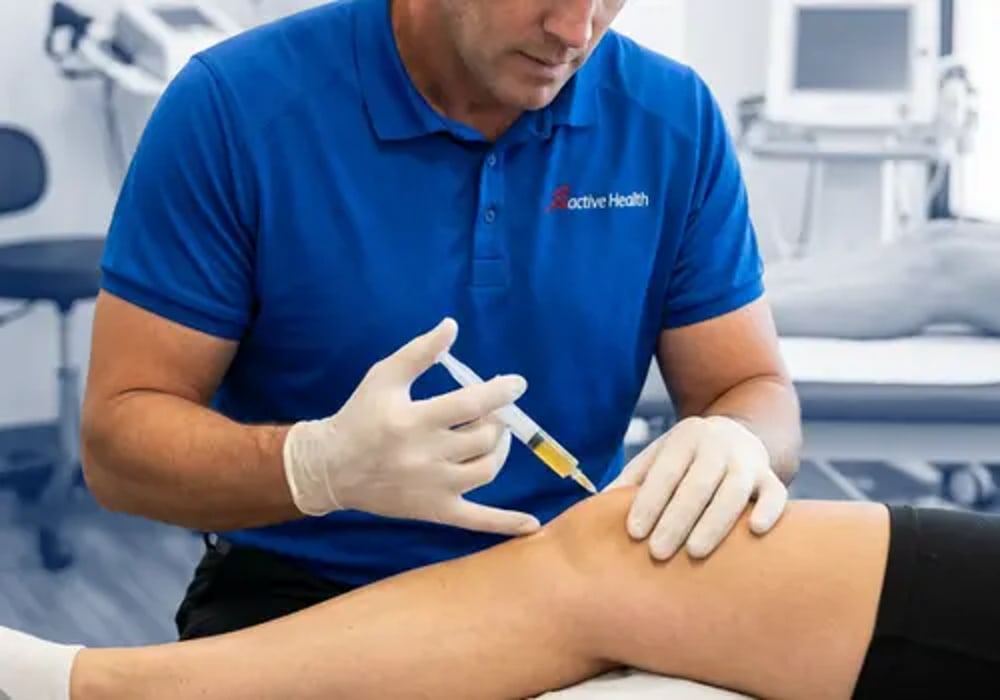
Conventional medicine often reaches its limit before patients reach theirs. When anti-inflammatory medication stops working, when surgery is not yet indicated or not wanted, and when rest and standard therapy have produced a plateau, regenerative options open a different door. Rather than blocking the body's signals, these therapies work with its own biology to restart healing that has stalled.
At Active Health, a medical clinic in Jacksonville, FL, we offer regenerative options such as PRP, A2M injections, and umbilical cord tissue injections alongside joint injections and OmniWave therapy, delivered inside a coordinated musculoskeletal care model rather than in isolation.
These are emerging therapies. The evidence is still developing, results vary from patient to patient, and none of them is a guaranteed outcome. What you will get here is a straight answer about whether one fits your diagnosis, and about what it can and cannot do.
How We Decide Whether a Regenerative Option Fits
The honest answer for a lot of people who ask about these injections is no, or not yet. This is how that call gets made.
- Diagnosis first. Every recommendation starts with a review of your history, your symptoms, your imaging where it exists, and what you actually need to be able to do again.
- The mechanism has to match. PRP, A2M, and cord tissue work differently. What is dominant in your joint decides which one is even a candidate, and sometimes the answer is none of them.
- Expectations in plain terms. You hear the realistic timeline, what the injection is meant to change, and what it will not change, before anything is scheduled.
- The plan around it. An injection is scheduled alongside the rehabilitation that has to follow it, because tissue given a better healing environment still has to be loaded to benefit from it.
Regenerative and Medical Services in Jacksonville
Five services carry the medical side of Active Health. Each of them may support tissue repair, joint health, inflammation control, and longer-term function, and each begins with the same detailed review.
PRP (Platelet-Rich Plasma) Therapy
Platelet-Rich Plasma uses growth factors from your own blood, which play direct roles in tissue repair and in the formation of new blood vessels. We review your imaging and clinical history first to confirm you are an appropriate candidate for the expected outcome. Read more about growth-factor injections drawn from your own blood.
A2M (Alpha-2-Macroglobulin) Injections
Alpha-2-Macroglobulin is a protein that occurs naturally in blood and can neutralize cartilage-degrading enzymes at the site of damage. For an arthritic joint that is a different mechanism from PRP rather than a competing one. See how A2M targets enzyme activity in arthritic joints.
Umbilical Cord Tissue Injections
Allograft material derived from ethically donated umbilical cord tissue, which may contain growth factors, cytokines, hyaluronic acid, and extracellular matrix proteins that support the body's natural repair environment. This is not stem cell therapy, and we are specific about that. Read about umbilical cord tissue allograft injections.
Joint Injections
A targeted injection into or around a painful joint, used to bring symptoms down far enough that rehabilitation can begin and progress. Explore injections placed directly into a painful joint.
OmniWave Therapy
Acoustic wave treatment used for nerve-related pain and for circulation in tissue that has become poorly supplied. It is the option we reach for most often on neuropathic presentations. See how acoustic wave treatment supports nerve-related pain.
Which of these is on the table, if any, is decided by your diagnosis rather than by what we happen to offer.
Conditions We Treat at Our Medical Clinic in Jacksonville
These are the presentations that most often bring people to the medical side of the Bowden Road clinic, usually after anti-inflammatories and standard therapy have plateaued.
Chronic Joint Pain
Pain in a knee, hip, or shoulder that has outlasted rest, medication, and time. The first job is working out whether the driver is degeneration, inflammation, or mechanics, because each points somewhere different. See how we approach joint pain that has stopped responding.
Osteoarthritis
Osteoarthritis is a degenerative joint disease in which the tissues of the joint break down over time, and researchers still do not know what starts the process. Care here targets pain, inflammation, and function rather than promising to reverse the damage. Start with arthritic joint degeneration.
Inflammation Control
Inflammation that never resolves keeps tissue in a state where healing does not finish. Bringing that down is often what makes the rest of a plan possible. Read about persistent inflammation and what drives it.
Neuropathy
Burning, tingling, and numbness in the feet or hands often carry a circulation and tissue-quality component alongside the nerve irritation itself. That is the part acoustic wave treatment is aimed at. See nerve pain in the hands and feet.
Tendonitis
A tendon that has degraded rather than simply inflamed will not respond to rest alone. Biologic options are one route when loading has stalled, and they work best with the loading rather than instead of it. Read about degenerative tendon pain.
How Regenerative Options Compare With Standard Care
These are emerging therapies. The evidence base is still developing, results vary from patient to patient, and none of them is FDA-approved as a treatment for arthritis or tendon injury. The FDA publishes patient guidance on regenerative medicine therapies, and we would rather you read it than not. Here is an honest read on what people usually weigh.
| Option | When it is worth considering | The trade-off |
|---|---|---|
| PRP | Chronic tendinopathy, mild to moderate joint degeneration, or a soft tissue injury that conservative care has not resolved. | Peak effects typically take four to eight weeks. It is self-pay, and response varies between patients. |
| A2M | Arthritic joints where enzyme activity is degrading cartilage and the aim is to slow that process down. | Self-pay, still emerging, and it does not restore cartilage that is already gone. |
| Umbilical cord tissue | Cases where the goal is a richer repair environment and your own blood is not the better source material. | Allograft material, self-pay, and not stem cell therapy despite how it is often marketed elsewhere. |
| Cortisone injection | Pain high enough to block sleep or to make starting rehabilitation impossible. | Dependable short-term relief, but repeated use in the same tissue is not a long-term plan. |
| Joint replacement surgery | End-stage joint damage where function is largely gone and conservative options are genuinely exhausted. | Major surgery with a long rehabilitation, and it is not a decision you can walk back. |
Nobody here will tell you a regenerative injection is a certainty. If your joint is past the point where biology can help, that is what you will hear instead.
Why Jacksonville Patients Choose Active Health for Regenerative Care
The regenerative medicine space has grown quickly, and not every provider approaches it with the same clinical rigor. We use patient selection criteria, imaging review, and outcome tracking so these therapies are applied where the evidence supports them, with realistic expectations set before treatment rather than after it.
Being told no is part of that. If imaging shows a joint past the point where biology helps, or if your presentation points somewhere else entirely, you will hear it at the consultation. Results vary even among good candidates, and we would rather say so plainly than sell around it.
A regenerative injection is not a standalone solution. Tissue given a better healing environment still has to be loaded properly, which is why every injection plan here is built alongside the rehabilitation and physical therapy work of the multidisciplinary pain control team behind it.
Insurance and Coverage
PRP and A2M injections are generally not covered by insurance in most cases, as they are considered elective regenerative therapies. That is true almost everywhere, not only here. Joint injections and the rehabilitation surrounding a regenerative plan are often covered, and Active Health accepts Aetna, BCBS, United Healthcare, Tricare, Humana, UMR, and Medicare for eligible services. We are clear about cost before treatment begins. Call (904) 296-0202 and we will tell you which parts of a proposed plan your policy will pay for.