
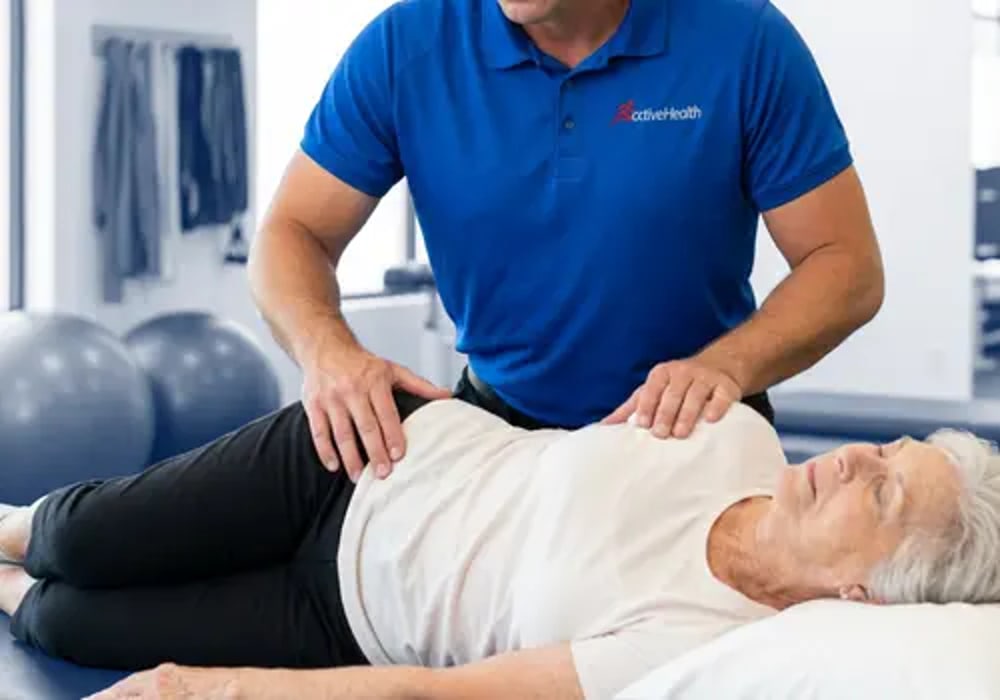
If stiffness, restricted movement or a sense that your body simply does not move freely is limiting what you can do, mobility work is often the part of the plan that has been missing.
Many patients come to Active Health after finishing basic treatment for an injury or an operation, only to find that the acute pain has settled while movement still feels tight, guarded or incomplete.
Active recovery and mobility work here is not passive stretching. It is a progression-based approach to restoring range, tissue extensibility and the control that lets you use that range under real demand, coordinated with the rest of your plan rather than run beside it.
What Active Recovery and Mobility Work Involves
Active recovery and mobility work is a structured clinical approach to restoring range of motion, tissue extensibility and the motor control that lets you use that range. It is movement-based and load-progressive rather than passive, and it is built around whichever restriction the assessment finds most limiting.
The reason it is active is that active and passive range answer different questions. StatPearls notes that active range is patient-initiated, so it reflects the nervous system as well as the joint, while passive range isolates what the joint will allow when someone else moves it. A stretch that opens passive range without changing what you can produce yourself has moved a measurement rather than a capability, which is the usual reason range keeps disappearing overnight.
The work itself includes targeted joint mobilization, controlled active range of motion, tissue preparation, dynamic flexibility and neural mobility techniques. Which of those leads depends on whether the restriction is joint-driven, tissue-driven or neurally driven, since the three do not respond to the same handling. Sorting that out at the assessment is most of the job, and it is the step a general stretching routine has no way to perform.
Conditions We Support With Active Recovery and Mobility in Jacksonville
Mobility work matters most when restricted movement is capping rehabilitation progress, limiting daily function, or holding up a return to activity after surgery or injury.
Post-Surgical Rehab
Range work starts as early as your surgeon's protocol safely allows, to keep the joint capsule from tightening and scar tissue from setting restriction in place, then progresses alongside the strengthening phases. Read about early range work inside the limits a surgeon has set.
Mobility Restrictions
Structured mobility work identifies which restrictions are joint-driven, tissue-driven or neurally driven and treats each with the technique that suits it, which is what produces range that is still there the next morning. Start with stiffness with a joint, tissue or nerve cause behind it.
Sciatica and Radiculopathy
Sciatic symptoms often involve a nerve that has lost its normal movement through the surrounding tissue and protests during hip flexion or long periods of sitting. Nerve gliding work restores that movement and, with it, the hip and lumbar range that daily function needs. See a nerve that has lost its glide through the tissue.
Chronic Fatigue
Here the mobility work is deliberately bounded. It is movement dosed to what you can repeat the next day, never a program of fixed weekly increases, and it is allowed to go backwards when the following day says so. This is capacity work and symptom management, not a treatment for the underlying illness.
What a Course of Mobility Work Looks Like
Three phases and a handover. Each one has to hold before the next is worth starting.
- Movement assessment. We measure what is restricted, compare it against the other side, and work out whether the block is the joint, the tissue or the nerve. Pain and guarding are separated from true restriction, because they need different answers.
- Open the restriction. Joint mobilization, tissue preparation or neural gliding, chosen for the restriction type rather than applied as a routine, with hands-on work first where the tissue needs it.
- Load the new range. The range is used under progressively heavier demand in the same session or the next one, because range the nervous system has not been asked to control is range it gives back.
You leave with a short home program built for your restriction and updated as it changes. Results vary with how long the restriction has been there, what caused it and how consistently the home work happens, so timelines come from your findings rather than from an average.
Why Jacksonville Patients Choose Active Health for Mobility Work
Most patients arrive having been handed a stretching routine that produced very little lasting change, and the reason is nearly always the same: it made no distinction between a joint restriction, a tissue restriction and a neural one, which are three different problems wearing the same symptom.
Mobility work here is assessment-driven and specific to the restriction type, and it is sequenced with the rest of the plan rather than sold as its own appointment. Manual soft tissue therapy or Active Release Techniques prepare tissue that is not ready to be moved, and therapeutic exercise loads the range immediately afterwards so it holds. That sequencing is what the physical therapy clinic this work is coordinated inside is set up to do.
Mobility work is also not the whole plan, and on its own it rarely finishes the job. Where the assessment points at a strength deficit, a structural problem or something that belongs with another specialty, you are told that at the evaluation. That is the standard a practice that plans the hands-on work and the loading together holds itself to. Mobility work delivered inside a rehabilitation plan is usually covered, and we verify your benefits before you start.