
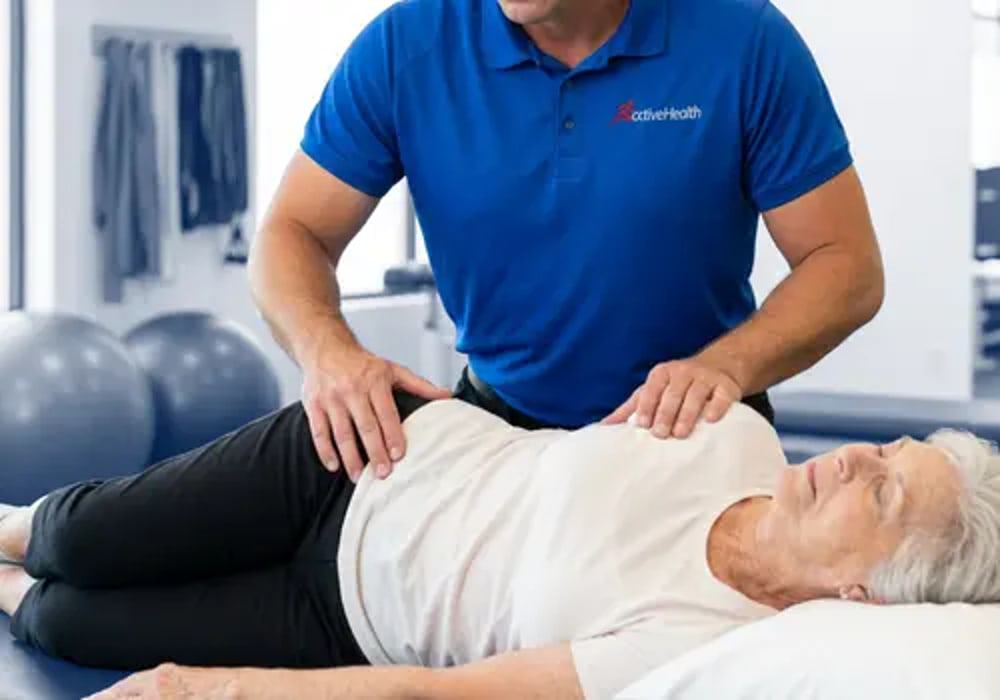
Whiplash is a neck injury caused by the head being thrown rapidly forward and back, most often in a rear-end collision. The acute pain usually settles within weeks, while the ligament and deep muscle changes underneath it frequently do not. Active Health treats it in Jacksonville, FL with structural rehabilitation, hands-on release and measured progress testing. Same-week evaluations, no referral needed.
Whiplash is among the most under-rehabilitated injuries we see. The acute neck pain improves enough within a few weeks that treatment stops, and the ligament laxity, joint irritation and neuromuscular instability underneath it carry on unaddressed.
Eight months later the same patient has a headache that starts at the base of the skull every afternoon and a neck that will not turn far enough to reverse the car. Nobody connects it to a collision that is long out of mind.
At our Jacksonville rehabilitation center, a whiplash evaluation measures what the neck actually does rather than asking how sore it feels. You leave the first visit with a written plan and a number to beat.
What Whiplash Does to the Cervical Spine
Whiplash is a neck injury caused by the head being forced rapidly forward and then backward, or the reverse. It is not a single-tissue problem: ligaments, disc, facet joints and the deep stabilizing muscles are all loaded at once, which is why one finding rarely explains the whole presentation.
Johns Hopkins Medicine is candid that the injury is not well understood, and often involves the muscles, discs, nerves and tendons in the neck together. Most cases follow a collision with sudden acceleration or deceleration, and rear-end impacts are the classic mechanism.
The reason whiplash so often turns chronic is the part that gets no attention. The deep cervical flexors are inhibited by the injury, joint position sense is altered, and the protective movement patterns adopted in the painful fortnight afterwards stay put. None of that resolves with time and rest, even while the acute tissue injury heals on schedule, so a neck can be technically healed and still not work. That gap is what a plan at our pain control clinic in Jacksonville is aimed at.
Common Symptoms of Whiplash Injury
Whiplash spreads further than the neck. These are the presentations we evaluate at Active Health.
- Neck pain and stiffness, with reduced rotation or side-bending
- Headaches that start at the base of the skull and travel forward
- Pain spreading into the shoulders, the upper back, or between the shoulder blades
- Tingling, numbness or weakness in an arm or hand
- Dizziness, unsteadiness or a sense of spatial disorientation
- Jaw pain, clicking or difficulty chewing
- Trouble concentrating, memory lapses or a general mental slowing
- Fatigue and disrupted sleep in the weeks after the impact
- Irritability or anxiety that has been heightened since the injury
Several of those overlap with concussion and with more serious injury, so the section further down on when to seek care right away is worth reading before you book anything.
How Whiplash Injuries Happen
The mechanism is the same in each case: the head travels through more range, and faster, than the neck can control.
Rear-End Automobile Collisions
The most common mechanism by far. The occupant's head is thrown backward and then forward by the collision, and a low-speed impact is capable of producing a real cervical injury, which is why the damage to the car is a poor guide to the damage to the neck.
Sports Impacts and Contact Injuries
Tackles, collisions and falls in contact sport produce the same acceleration and deceleration. Sports whiplash tends to be rehabilitated as a stiff neck rather than as a cervical injury, and the deep stabilizer deficit gets missed.
Falls Where the Head Meets the Ground
A backward fall loads the cervical spine the same way a collision does. Attention goes to the impact site, the neck injury goes unrecognized, and the patient turns up months later with headaches nobody has connected to the fall.
Repetitive Micro-Trauma
Not all whiplash is acute. Repeated small-force extensions and rotations from occupational demands or habitual positions can accumulate into a chronic whiplash-like presentation with no single event to point at.
How We Treat Whiplash in Jacksonville
Treatment starts with a measured picture of what the neck can and cannot do, then works in order: settle the guarded tissue, restore rotation and side-bending, and retrain the deep cervical muscles that stop holding the head once they have been overloaded.
Postural and Structural Rehabilitation
This is the core of the plan. Deep cervical flexor retraining and cervical alignment work rebuilds the stability and joint position sense that the injury interrupted, and the movement retraining that follows unpicks the guarding strategies established while the neck was painful.
Manual Soft Tissue Therapy
A neck that has been braced for weeks does not simply relax on request. Hands-on release of the guarded neck and upper back muscles reduces the protective tone and restores the tissue glide that has to be there before retraining will hold.
Active Release Techniques
Where adhesion or nerve tethering is limiting a specific direction, tissue release performed while the neck moves through its range creates shear between the tissue layers. It is the option that usually moves rotation when passive work has stopped producing change.
Biomechanical Performance Labs
Neck rehabilitation goes wrong when progress is judged by how the neck feels on the day. Objective measurement of cervical range and postural asymmetry gives the plan real targets, and the same measurements are repeated at each phase so the programme advances on findings rather than on your best guess.
Recovery and Realistic Timelines
Every plan moves through the same four phases, and you are told which one you are in at each reassessment.
- Settle the neckReduce the guarding enough that the neck will move and you can sleep.
- Restore rangeRotation and side-bending back, hands-on work where the block is tissue.
- Retrain the stabilizersDeep cervical flexors and scapular control, loaded progressively.
- Rebuild toleranceDriving, screen work and lifting tested against the real demand.
Johns Hopkins notes that most people with a whiplash injury recover within a few weeks to a few months, while some have persistent pain for several months or longer. In our experience a mild case commonly settles in 4 to 8 weeks, and a case involving ligament laxity and deep stabilizer inhibition usually runs 12 to 16 weeks. Results vary with the mechanism, what else was injured, and how early the retraining starts.
Progress here is measured in range and tolerance rather than in pain scores. Turning your head far enough to reverse a car, or getting through a working day without the headache arriving, are the markers that actually mean the neck is changing.
When to Seek Care Right Away
Most whiplash is not dangerous. A collision can injure more than soft tissue, though, and a few presentations belong in an emergency department rather than in a rehabilitation plan.
Go to an emergency room now
MedlinePlus lists the head-injury signs that mean calling 911 straight away. After a crash, any of these needs emergency assessment before anything else.
- Loss of consciousness at the scene, even briefly
- Confusion, unusual drowsiness, or speech that does not make sense
- A severe headache, or severe tenderness right down the midline of the neck after a high-speed impact
- New weakness, numbness or tingling in an arm or a leg, or being unable to move part of a limb
- Vomiting more than once, a seizure, or pupils of noticeably unequal size
MedlinePlus is equally clear about what to do at the roadside: if you suspect a neck or spinal cord injury, call 911 and keep the person still rather than moving them, unless they are in immediate danger. Do not wait for an appointment with us, and do not wait until morning.
See a physician before starting conservative care
Johns Hopkins advises contacting your healthcare provider if symptoms have not improved in the timeframe you were given, if they get worse, or if new ones appear. These belong with a physician first.
- Symptoms that are worsening rather than easing as the days pass
- New symptoms that have appeared since the day of the impact
- Dizziness, visual disturbance, ringing in the ears, or trouble concentrating and remembering
- Arm symptoms that follow one clear pathway, or a grip that has weakened
- Jaw pain or clicking that started with the collision
Everything outside those two lists is where a conservative plan starts.
Expert Whiplash Care in the Jacksonville Area
J. Turner Butler Boulevard, San Jose Boulevard, Roosevelt Boulevard and the I-295 corridors carry a large share of the Southside and Westside commute, and they produce a steady volume of collision injuries in Deerwood, San Jose and Ortega. Most of those patients feel better in a fortnight and stop, which is exactly when the retraining should be starting.
Our interest is in the rehabilitation rather than the paperwork. Whiplash care sits inside the pain control practice the rehabilitation team works within, so if the headaches turn out to be the main problem, the people who treat that are already down the corridor.