
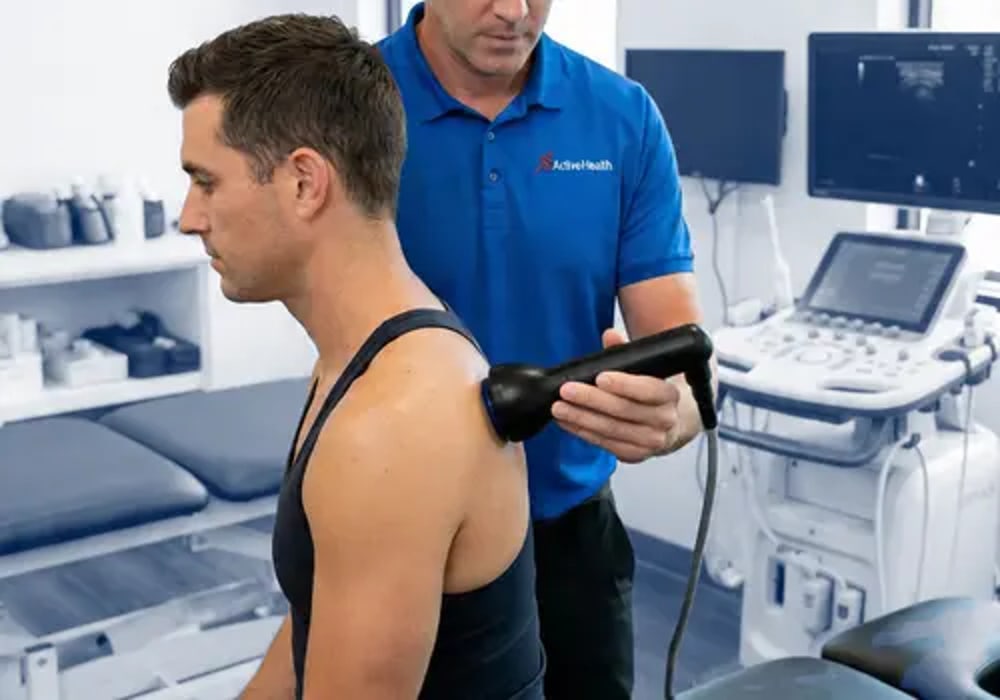
If you have pain, tightness or restricted movement in one specific area that stretching, rest and general massage never quite reach, the problem may be a soft tissue adhesion or an entrapment that needs a targeted, movement-integrated technique to release.
Plenty of patients arrive here after months of relief that lasts a few days. The tissue gets treated, the symptom settles, and the specific restriction driving it was never found.
Active Release Techniques is a patented soft tissue method that pairs precise manual contact with your own active movement to release adhesions between tissue layers, restore normal glide, and free structures that have stopped moving as they should. At Active Health it is delivered by certified practitioners and always inside a plan that loads the change afterwards.
What Active Release Techniques Is
Active Release Techniques is a patented, hands-on soft tissue system. The practitioner holds a specific tension on the affected structure while you actively take the body part through a prescribed range of motion, and that combination of contact and movement is what separates it from a technique applied to a limb lying still.
The target is adhesion. Muscle, tendon, fascia and nerve are built to slide against one another, and after an overload, a repetitive task or an operation, those layers can bind. The result is not always felt as tightness in the tissue that has bound; it shows up as lost range, as pain somewhere along the chain, or as a nerve that no longer travels freely through its tunnel.
The system covers more than 500 documented protocols, one for each muscle, tendon, ligament, fascial structure and nerve the technique is applied to. Certification requires training and a hands-on examination in anatomical precision and protocol proficiency, and ART at Active Health is delivered by certified practitioners inside a plan rather than as a standalone appointment.
Conditions We Treat With ART in Jacksonville
ART earns its place where the restriction is a binding between layers rather than a short or a weak muscle. These are the presentations it is used on most at Bowden Road.
Post-Surgical Recovery
Surgery repairs the structure and leaves scar tissue that binds the layers around it. Once healing allows, the movement-integrated protocol is introduced progressively to restore glide where passive work cannot reach. See how we handle adhesion between tissue layers after an operation.
Mobility Restrictions
Stiffness that stretching never touches is often inter-layer adhesion rather than muscle length or joint capsule. The assessment identifies which structure is holding the restriction, then the protocol is aimed at that one. Start with range that stretching alone never restores.
Whiplash and Neck Injury
A neck loaded fast enough to overstretch the supporting tissue guards afterwards, and the guarding itself becomes the restriction. Release work is paired with endurance training for the deep neck muscles. Read about guarded tissue in the neck after a collision.
Plantar Fasciitis
Heel pain rarely lives only at the heel. Protocols through the calf, the posterior chain and the plantar fascia address the tissue that has stopped lengthening under load. Start with fascial and calf tissue that will not lengthen.
Nerve entrapment is the other place the technique is aimed. Where a nerve is restricted at a tunnel, as it is in carpal tunnel syndrome at the wrist or in piriformis syndrome in the buttock, the protocols work at the interface between the nerve and the tissue around it rather than at the muscle alone.
What an ART Session Involves
The technique is short, specific and active. You are not lying still for it.
- Locate the structure. Your clinician palpates through the region under tension to find the texture, tension and movement restriction that identify the adhesion, rather than treating the area that hurts.
- Set the contact. A precise contact is placed on the structure and held at a specific tension.
- Move it. You take the body part actively through the prescribed range while the contact holds, which creates a shear along the tissue. Most people describe a firm stretch that is distinct from their usual pain.
- Retest, then load. The range is retested in the same visit, so you can see what changed. The exercise that follows is what keeps the change, because tissue that regains glide and is not then loaded tends to bind again.
How ART Compares With Other Soft Tissue Options
Four honest options for restricted, painful soft tissue, one of which we do not perform.
| Option | When it is the right call | The trade-off |
|---|---|---|
| Active Release Techniques | A defined restriction between tissue layers, or a nerve that is not travelling freely, especially where general work has plateaued. | It is specific rather than relaxing, and the change holds only if the loading work behind it is done. |
| General or sports massage | Broad tension, training soreness, and recovery between hard sessions where no single structure is at fault. | Pressure over a region is not aimed at a named structure, so a defined adhesion often survives it. |
| Stretching and foam rolling alone | Ongoing maintenance for tissue that already moves well, and a reasonable first thing to try for mild stiffness. | Both act on tissue length. Neither reaches a binding between layers, which is why the range comes back and goes again. |
| Injection or surgical release (not performed here) | A confirmed entrapment with progressive weakness or sensory loss that conservative care has not changed. | An injection treats the irritation rather than the restriction, and a release is a one-way decision that still needs rehabilitation after it. |
If your presentation points at a surgeon rather than at soft tissue, you hear it at the evaluation.
Why Jacksonville Patients Choose Active Health for ART
Most people who have had ART elsewhere had it as isolated sessions. No exercise to reinforce the tissue change, no explanation of why the adhesion formed, and no assessment of the pattern that will re-form it. The technique gets blamed for a result the plan around it never supported.
Here it is one component of a coordinated plan. Therapeutic exercise loads the restored range, mobility work builds on it, manual soft tissue therapy prepares the region before and settles it after, and acoustic treatment is added when the underlying tissue quality is part of why the adhesion keeps forming. None of that requires a second referral, which is the point of running it inside the sports medicine clinic ART is delivered inside.
For athletes the technique is used through a training block to hold tissue quality under load, not only after something has already failed. For post-surgical and chronic pain patients it reaches the adhesion no other part of the plan can. Either way it is prescribed on an assessment, which is how the wider practice on Bowden Road works.
Insurance and Access
Active Health accepts a wide range of insurance plans for eligible physical therapy and rehabilitation services in Jacksonville, including Aetna, BCBS, United Healthcare, Tricare, Humana, UMR, and Medicare. Coverage for manual techniques depends on your plan and on how the visit is coded. Call (904) 296-0202 and we will verify your benefits before the first visit.