
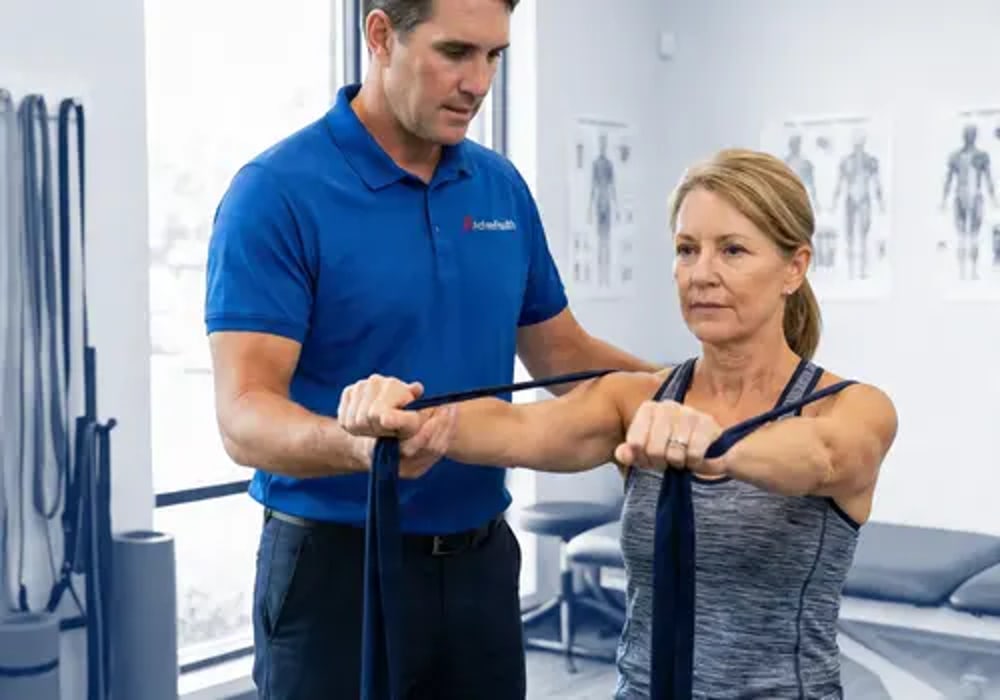
Neck pain treatment at Active Health in Jacksonville, FL starts by finding what hurts: a strained muscle, a stiff joint, a worn or bulging cervical disc, or a pinched nerve. Plans pair hands-on work with graded strengthening and add spinal decompression when a nerve root needs room. No referral needed, and we will contact you within 24 to 48 hours.
Neck pain rarely comes with an explanation. You wake up unable to turn toward the mirror, or a desk ache now runs over the shoulder blade and into the hand. Checking a blind spot on I-95 becomes a whole-body turn.
Rest, heat and a few days of ibuprofen settle plenty of stiff necks. When the pain keeps returning, or an arm starts to tingle, it is time to find out which part of the neck is producing it.
That is where our physical therapy services in Jacksonville begin: an evaluation of how the neck turns, how each nerve root responds to movement, and how long the deep neck muscles can hold. The first visit ends with a written plan.
Understanding Neck Pain and a Pinched Nerve
Neck pain is discomfort in any structure of the cervical spine: the muscles, the joints between the vertebrae, the discs or the nerves. When a nerve root is squeezed or irritated where it branches off the spinal cord, the condition is called cervical radiculopathy, or a pinched nerve, and pain can travel into the shoulder, arm and hand.
The American Physical Therapy Association's neck pain clinical practice guideline, revised in 2017, sorts neck pain into four groups, and each group is treated differently.
Neck Pain With Mobility Deficits
The stiff neck. Turning or looking up is limited and hurts at the end of the range.
Neck Pain With Radiating Pain
The pinched nerve. Pain, tingling or weakness travels into the arm along one nerve pathway.
Neck Pain With Headaches
Headaches that begin in the upper neck and are set off by neck movement or by one position held too long.
Neck Pain With Coordination Problems
The group that includes whiplash. The neck moves, but the deep muscles no longer control it well.
Scans help less than most people expect. The American Academy of Orthopaedic Surgeons notes that nearly half of people middle-aged and older have worn discs and pinched nerves that cause no pain, so an MRI finding matters only when it matches the exam.
Symptoms of a Pinched Nerve and Neck Strain
Some neck symptoms stay in the neck and some travel down the arm. Both kinds are worth having checked.
- A stiff neck that will not turn fully to one side
- Aching across the top of the shoulder and along the shoulder blade
- Sharp or burning pain that travels down one arm
- Pins and needles or numbness in the hand or fingers
- Weakness in the shoulder or arm, or a weaker grip
- Pain that sharpens when you look up or turn your head
- Headaches that start in the upper neck
- Arm pain that eases when you rest your hand on top of your head
- Muscle spasm after a night in an awkward position
What Causes Neck Pain and a Pinched Nerve
Neck pain has a few common sources, and two of them often turn up in the same neck.
Muscle Strain From Everyday Positions
MedlinePlus names muscle strain as a common cause, usually from ordinary days: an hour or more bent over a desk, a monitor set too high or too low, an awkward sleeping position, or lifting too quickly.
Cervical Disc Herniation or Bulge
The soft center of a disc pushes through its tougher outer ring and presses on a nerve root, often after lifting, pulling, bending or twisting. In younger adults a sudden disc injury is the usual cause of a pinched nerve.
Cervical Spondylosis and Bone Spurs
With age the discs lose height and water, and bone spurs form around them. The spurs stiffen the neck and can narrow the openings where nerve roots exit. Everyone gets these changes; only some people get symptoms.
Stiff or Irritated Facet Joints
The facet joints link each vertebra to the next and let the neck bend and twist. When one stiffens, the pain usually sits on one side and catches at the end of a turn or when you tip your head back.
How We Treat Neck Pain in Jacksonville
Treatment follows the group your evaluation places you in. A stiff neck gets joint, soft tissue and range work, an irritated nerve root gets room and gentle loading, and every plan builds endurance in the neck and shoulder blade muscles, in line with the APTA guideline.
Postural and Structural Rehabilitation
A stiff neck usually comes with a stiff mid-back. For a recently stiff neck the guideline pairs mid-back treatment with neck range exercises, and structural rehab for the cervical spine and upper back restores the motion and alignment each level depends on.
Manual Soft Tissue Therapy
Muscles around an irritated segment tighten to protect it, and that guarding often stops the turn. Hands-on release of the muscles guarding a sore neck eases the side and back of the neck and the shoulder blade, so range work can start.
Therapeutic Exercise
Once neck pain passes six weeks, the guideline recommends endurance exercise for the neck and shoulder girdle. A graded endurance program for the neck and shoulder blade muscles starts with short holds and builds toward a full working day.
Spinal Decompression Therapy
For arm symptoms from a disc or narrowed opening lasting past 12 weeks, the guideline recommends intermittent mechanical traction combined with exercise. Cervical decompression for a pinched nerve supplies that traction as one part of the plan. It is a set protocol of 10 to 20 visits over six weeks, 20 recommended, and never covered by insurance.
How Your Neck Pain Options Compare
Two of the four options below are not performed here. Each one has a place.
| Option | When it fits | The trade-off |
|---|---|---|
| Conservative care at Active Health | First line for most neck pain. AAOS notes that most cervical radiculopathy responds to conservative care such as physical therapy without surgery. | Weeks of visits, plus your own work between them. |
| A soft cervical collar | A short rest for a very painful neck, on a physician's advice. | AAOS limits it to short periods, since long wear may weaken the neck muscles. |
| Cervical steroid injection (not performed here) | Pain too severe to start rehabilitation. | It calms swelling around the nerve without removing the pressure, though relief may last long enough for the nerve to recover. |
| Surgery, such as discectomy and fusion (not performed here) | Spinal cord compression, progressing weakness, or a pinched nerve that nonsurgical care has not helped. | Irreversible, and rehabilitation is still needed afterward. |
When an exam points toward an injection or surgery, you hear it at the evaluation, with help finding the right physician.
How Long Neck Pain Takes to Settle
Plans run in four stages, and each reassessment tells you which one you are in.
- Find the sourceMovement, nerve and strength tests place you in one of the four groups.
- Calm the irritationHands-on work, easing positions, and traction where a nerve needs room.
- Restore the turnRotation, looking up, and the mid-back motion the neck borrows from.
- Build enduranceDeep neck and shoulder blade muscles trained to last a full day.
The APTA guideline notes that recovery from a new episode is usually fastest in the first 6 to 12 weeks, and that long-standing neck pain tends to come and go. Structural rehabilitation commonly runs an initial phase of four to eight weeks. Results vary with the cause, the duration and whether a nerve is involved.
Progress is measured in what the neck allows: checking a blind spot, sleeping through the night, a working day that ends without a tingling arm.
Neck Pain Warning Signs That Need a Physician
Most neck pain is mechanical and safe to treat conservatively. A few presentations are not.
Call 911 or go to an emergency room
MedlinePlus advises getting medical help right away for neck pain with any of these:
- Fever and headache with a neck so stiff you cannot touch your chin to your chest
- Shortness of breath, sweating, nausea or vomiting, or pain in the arm or jaw, which can signal a heart attack
- A fall, blow or collision after which you cannot move an arm or hand
Get emergency care before anything else.
See a physician before starting conservative care
Pressure on the spinal cord itself usually builds slowly, and many people have it for a long time without knowing. AAOS calls it generally a surgical condition, so these signs go to a physician first:
- Hands that have turned clumsy, with trouble writing, doing up buttons or holding a fork
- Trouble walking, or a new loss of balance
- Loss of control over urination or bowel movements
- Arm numbness, tingling or weakness that is spreading or getting worse
- Pain that is worse lying down or wakes you at night
- A lump or swollen glands in the neck, or trouble swallowing or breathing
Outside those two lists, a conservative plan can start.
One Jacksonville Clinic for the Neck, Shoulder and Arm
A stiff neck makes every lane change on I-95 and J. Turner Butler Boulevard harder, and the clinic sits off both at 6500 Bowden Rd. Patients come from across Northeast Florida, from Ponte Vedra and the Beaches to Mandarin, Riverside and Orange Park.
Dr. Jeffrey D. Lipp founded Active Health in 2005, and physical therapy, sports medicine and medical care still share that one location. Neck care runs inside our Jacksonville physical therapy and sports medicine clinic, so a shoulder or elbow that turns out to be involved is examined in the same building.