
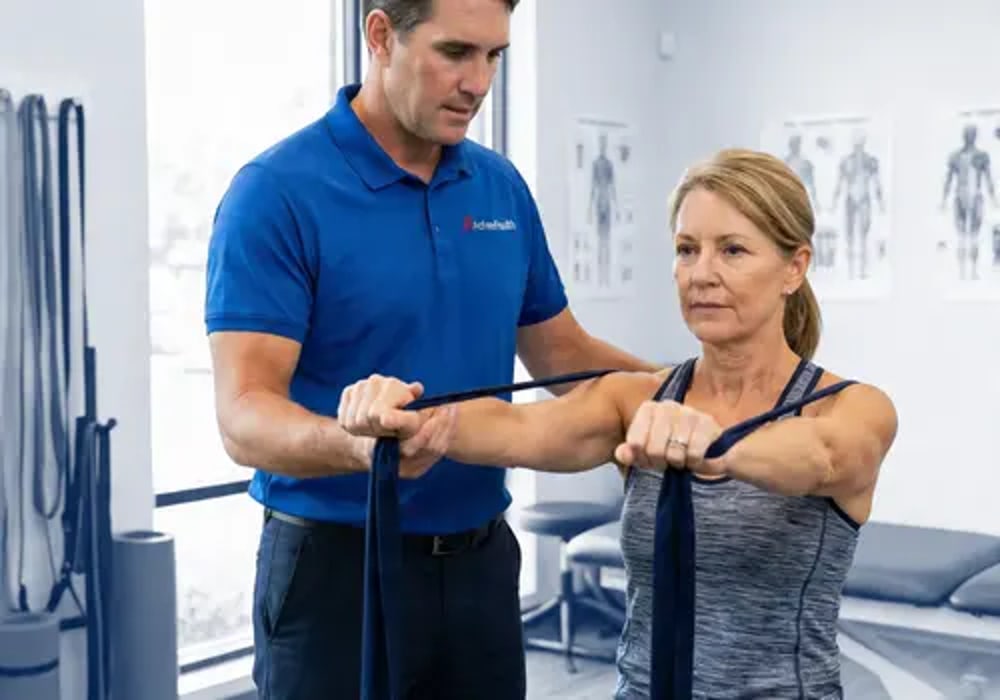
Post-surgical rehabilitation is the structured recovery work that follows an operation, once the surgeon has repaired the structure and the strength, range and control still have to be rebuilt. Active Health delivers it in Jacksonville, FL with graded mobility, hands-on scar and soft tissue work and progressive loading, coordinated with your surgical team and your post-operative protocol.
Surgery is the start of a recovery rather than the end of one. What happens in the weeks and months afterwards decides whether you get full function back or spend years quietly working around a deficit nobody measured.
Most people are handed a printed sheet and a follow-up date. That is enough for some procedures. For a replaced knee, a reconstructed ligament or a repaired cuff, the sheet is where recovery stalls, and the stall is rarely obvious until you try to load the limb properly.
At the physical therapy clinic at Active Health, a post-surgical evaluation starts with your operative report and your surgeon's protocol. You leave with a written plan built around the procedure you actually had.
What Post-Surgical Rehabilitation Is
Surgery disrupts more than the tissue it repairs. Surrounding muscle is retracted, swelling and pain interrupt the signals that drive it, and the movement habits you built while guarding the area do not switch off on their own once the incision has healed.
That is the predictable part of every operation. The surgical site heals on schedule while the neuromuscular system around it stays reorganized around the old problem, so muscles that were inhibited before surgery remain inhibited afterwards and the compensations persist on top of newly altered anatomy.
Rehabilitation is the part of the job that addresses that. The American Physical Therapy Association puts the point simply for joint replacement: it recommends consulting both your surgeon and your physical therapist when you are weighing the procedure at all. At our pain control clinic in Jacksonville we work inside the protocol your surgeon sets, not around it.
Signs Your Recovery Needs Structured Rehabilitation
Some recoveries genuinely finish on their own. These are the presentations that benefit from an evaluation at Active Health.
- Pain or stiffness at the surgical site beyond the healing timeline you were given
- Muscle weakness, or an inability to fully switch on the muscles around the operated joint
- Range of motion that has plateaued below the target your surgeon set
- Compensatory movement patterns that have not corrected themselves
- Scar tissue tightness that limits how far or how comfortably the area moves
- Swelling that keeps returning whenever you increase your activity
- A limp, or a changed walking pattern you have stopped noticing
- A sense that recovery has stalled and you are no longer progressing on your own
The Procedures We Rehabilitate Most Often
Different operations leave different deficits behind, and the plan is built around which one you had.
Joint Replacement at the Knee, Hip or Shoulder
Replacement creates immediate neuromuscular disruption. Quadriceps inhibition after a total knee, hip abductor weakness after a hip, and rotator cuff coordination deficits after a shoulder all need specific retraining, or the gait deviations and mechanical stress that follow become the new normal.
ACL Reconstruction and Ligament Repair
One of the most demanding rehabilitations there is. The proprioceptive deficit created by the original injury is not resolved by the reconstruction itself, and retraining it under progressive challenge is the part that protects the knee on the way back to sport.
Spinal Surgery: Discectomy, Fusion and Decompression
Deep stabilizer inhibition and the biomechanical faults that contributed to the original pathology both survive the operation. Left alone, the same forces keep acting on a spine whose architecture has now changed.
Rotator Cuff Repair
Strength is the easy half. Restoring the timing and coordination of the four cuff muscles relative to the larger movers is the half most commonly under-addressed, and it is what separates a shoulder that works from a shoulder that merely does not hurt at rest.
Abdominal and Thoracic Procedures
Abdominal surgery disrupts the anterior core, with downstream effects on how the lumbar spine is stabilized. The fascial adhesions that follow can produce low back pain and hip flexor tightness that neither patient nor surgeon connects back to the operation.
How We Rehabilitate After Surgery in Jacksonville
Rehabilitation here runs inside your surgeon's protocol rather than alongside it. Graded movement protects the repair while it heals, hands-on work addresses scar tissue and inhibited muscle, and loading is progressed on objective testing rather than on how many weeks have passed since the date of surgery.
Active Recovery and Mobility
Early movement is dosed, not improvised. Graded movement kept inside the range your surgeon has protected guards against joint stiffness, muscle wasting and neuromuscular inhibition while healing runs its course, then becomes more dynamic as the protocol allows.
Manual Soft Tissue Therapy
Exercise cannot resolve a fibrotic adhesion. Scar tissue mobilization and myofascial release around the repair restores tissue glide, and hands-on facilitation alongside the exercise helps a muscle that has gone quiet switch back on before it is asked to carry load.
Therapeutic Exercise
The progression is individual, supervised and driven by assessment. Supervised exercise progressed on objective milestones targets the specific deficits your evaluation found, moving from isolation to integration once motor control is demonstrated rather than once the calendar says so.
Active Release Techniques
Practitioner contact combined with your own active movement creates shear between tissue layers. Treatment applied while you actively move the joint is aimed at adhesions and at the nerve tethering behind the tingling and hypersensitivity many post-surgical patients report and few have specifically treated.
Normatec Compression Therapy
Where swelling keeps limiting range, sequential compression used to manage post-operative swelling can be added to a session. It is not appropriate for everyone after surgery, so it is used only once your surgeon has cleared it and only where the evaluation supports it.
How Your Recovery Options Compare
Not every recovery needs supervised rehabilitation. This is an honest read on the four paths, including the one that costs nothing.
| Option | When that is the right call | The trade-off |
|---|---|---|
| Supervised rehabilitation at Active Health | Complex procedures, stalled recoveries, and anyone returning to physical work or sport rather than to daily activity alone. | It costs time and visits, and the home program still has to be done between them. |
| The home exercise sheet on its own | Genuinely reasonable after minor procedures in patients who are already progressing well and hitting their milestones. | Nobody is measuring, so a deficit that is not resolving is usually found late, if at all. |
| Waiting to see whether it settles | Sensible in the first weeks, when swelling and guarding are expected and the protocol says to protect the repair. | Past that window, inhibited muscle and compensatory patterns tend to entrench rather than resolve. |
| Revision surgery (not performed here) | The right call for a failed repair, hardware failure, or a structural problem that rehabilitation cannot address. | Irreversible, and the second recovery still needs the rehabilitation the first one did. |
Surgery and revision surgery are not performed at Active Health. If your evaluation suggests the structure rather than the rehabilitation is the problem, you hear that from us and we help you get back to your surgeon.
Recovery and Realistic Timelines
Every plan moves through the same four phases, and you are told which one you are in at each reassessment.
- Protect and moveRange and gentle activation inside the surgeon's protected limits.
- Restore the tissueScar and fascial work, swelling control, and getting quiet muscle firing again.
- Rebuild strengthProgressive loading from isolation to integrated, controlled movement.
- Return to demandYour job, your sport and your stairs, tested rather than assumed.
Minor soft tissue procedures commonly need 6 to 12 weeks, while major joint replacements and ligament reconstructions usually run 3 to 6 months to full functional recovery. The American Physical Therapy Association is blunt that the timeline for getting back to work, daily life and sport varies from person to person. Results vary here too, with the procedure, your starting point and how consistently the home program gets done.
Judge progress on milestones rather than dates. Full knee extension, a stair descended without a hand on the rail, a shoulder that reaches overhead without hiking are the markers that actually move the plan forward.
Expert Post-Surgical Care in the Jacksonville Area
Jacksonville's major hospital systems and surgical centers generate steady post-operative volume across Deerwood, San Jose and Ortega. Our patients are active adults heading back into Northeast Florida's outdoor life after an orthopedic procedure, working professionals recovering from spinal surgery, and athletes who want rehabilitation that matches the standard of their surgical care.
What that needs is one plan rather than four. Post-surgical care draws on the wider practice that picks up the rest of your recovery, so the hands-on work, the loading program and the swelling management are sequenced by the same team.