
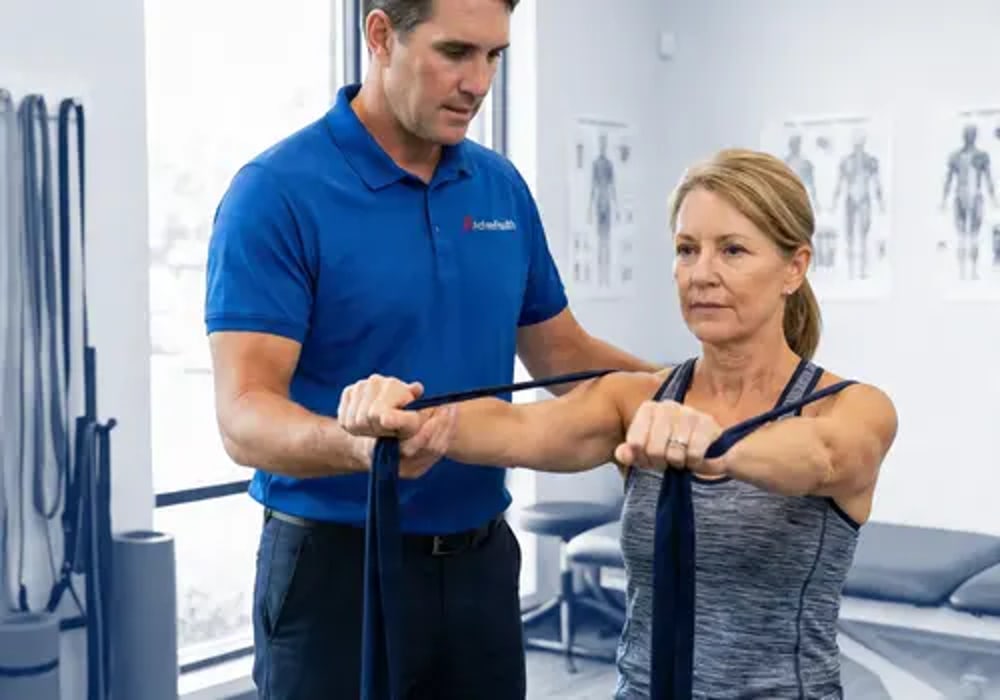
If you are dealing with neck or back pain that never fully clears, headaches that build through the afternoon, or discomfort that grows with sitting, standing and screen time, the driver may be a postural and structural pattern nobody has addressed directly.
Plenty of patients arrive after months of managing symptoms that respond briefly to massage, manipulation or rest, then come back the moment normal activity resumes. That pattern is the signal: the tissue was treated and the loading that irritates it was not.
Postural and structural rehab at Active Health starts with a detailed movement and alignment screen, then builds a correction sequence from what it finds, so the change is loaded into your day rather than left on the treatment table.
What Postural and Structural Rehab Is
Postural and structural rehabilitation is a clinical process that identifies and corrects the alignment faults, muscle imbalances, joint restrictions and movement compensations behind long-running musculoskeletal pain. The aim is not only to reduce the symptom. It is to change the mechanical environment that keeps producing it, which is the aim physical medicine and rehabilitation is organized around.
It opens with a postural and movement screen. Spinal alignment, joint mobility, muscle activation patterns and movement quality are each assessed, and the findings are ranked rather than listed, so the most foundational deficit is addressed first and the rest are loaded on top of it in order.
The last phase is the one that decides whether any of it lasts. Corrections that hold on a treatment table and nowhere else are not corrections, so the program finishes by loading the new pattern into the demands you actually meet: the commute, the workday, the sport. Results vary with how long the pattern has been there and how consistently the home work gets done.
Conditions We Treat With Postural Rehab in Jacksonville
Structural work is most useful where the pain is driven by how the body is loading itself rather than by tissue damage in isolation. That includes a herniated or bulging disc in the lower back, where the way you sit and lift keeps loading the same segment.
Whiplash Recovery
A neck loaded faster than it could brace overstretches the supporting ligaments and changes the normal cervical curve, and the deep neck flexors usually stop working properly afterwards. The program restores cervical alignment and rebuilds the endurance those muscles have lost. See our approach to a cervical curve that changed after the impact.
Tech Neck and Postural Strain
Screen time and a forward head position raise the load the cervical spine carries all day, and the muscles asked to hold against it are the first to fail. Structural work changes the alignment and trains the endurance so upright sitting stops being the uncomfortable option. Read about pain that builds hour by hour at a screen.
Mobility Restrictions
Range that keeps closing back down after it is released is usually being taken by something upstream, and the restriction moves rather than resolves. Mapping the chain finds what is taking it. Start with restriction that keeps returning after it is released.
How Your Correction Program Is Built
Four phases, each with something it has to produce before the next one opens.
- Postural and movement screen. Alignment, joint mobility, muscle activation and movement quality, assessed as one chain rather than region by region. Where a case needs more measurement than the screen provides, the performance labs on the same floor supply it. What the screen finds decides everything after it.
- Prioritize the deficits. Findings are ranked. The most foundational restriction is treated first, since correcting a compensation while its driver is still in place is how programs stall.
- Corrective work, then load. Specific corrective exercise for the ranked deficits, progressed into loaded patterns as tolerance allows. Hands-on work, decompression or acoustic treatment is added where a pain barrier is blocking the correction.
- Functional transfer. The corrected pattern is loaded into the demands of your day and your sport, which is the phase that separates a lasting structural change from relief that ends when normal activity resumes.
Corrective Exercise for Posture and Compensation Patterns
Corrective exercise is the part of the program that does the correcting: targeted drills for the structural imbalances, posture habits and muscular compensations left by repetitive strain or an old injury. Each drill is matched to a ranked finding from the screen, so two people with the same neck pain can leave with different programs. Joshua Wise, PTA, holds the NASM certification in Corrective Exercise Prescription.
How Postural Rehab Compares With Your Other Options
Everything below has a legitimate use. The differences are in what each one actually changes.
| Option | When it is the right call | The trade-off |
|---|---|---|
| Postural and structural rehabilitation | Pain that returns as soon as normal demands resume, and patterns that have been building for years rather than weeks. | It is measured in months, and the work you do between visits is most of it. |
| Massage or manipulation on its own | Bringing a painful, guarded region down far enough that corrective work becomes possible. | Passive relief does not change what is loading the tissue, so the pattern reassembles within days. |
| A workstation change on its own | Genuinely worthwhile, and the first thing to fix for anyone whose symptoms track the workday. | A better desk lowers the demand. It does not restore the endurance and control the position needs. |
| Injections into the painful segment (not performed here) | Pain high enough to block sleep or to make any corrective work intolerable. | Quieting the segment leaves the alignment and the loading exactly as they were. |
The workstation option is worth taking seriously alongside the program rather than instead of it. OSHA sets out what an ergonomic assessment of a job actually covers, and for a lot of Southside desk workers that is half the exposure.
Why Jacksonville Patients Choose Active Health for Structural Work
A lot of people arrive holding an exercise sheet that was never explained, or a history of treatments that helped for two days at a time. What is usually missing is not effort. It is a screen that looked at the whole chain and a program built from what it found.
Nothing here is a generic postural routine. What gets corrected, in what order, and how it is loaded back into function all depend on your assessment. Where a pain barrier is in the way, hands-on work, decompression or acoustic treatment can be brought in alongside it, which is the practical benefit of running the program inside the rehabilitation center this program runs inside.
You are also told why. Patients who understand how the pattern developed and what each phase is for stay consistent with the home program, and consistency is the whole game after discharge. That is the standard the practice that treats the chain rather than the sore spot works to.
Insurance and Coverage
Active Health accepts a wide range of insurance plans for eligible physical therapy and rehabilitation services in Jacksonville, including Aetna, BCBS, United Healthcare, Tricare, Humana, UMR, and Medicare. Structural rehabilitation is usually delivered as part of a covered plan of care. Call (904) 296-0202 and we will check your plan's visit limits and your likely share before your first visit.