
Inflammation is how tissue repairs itself, and it is meant to stop when the repair is done. When a joint, tendon or bursa stays irritated for months, something is still loading it. Active Health treats persistent musculoskeletal inflammation in Jacksonville, FL by identifying the structure involved and the load driving it, then treating both. We will contact you within 24 to 48 hours.
The shoulder is still warm in October from something that happened in April. The knee puffs up after a walk it used to handle. The anti-inflammatories work, and they keep working, which is exactly the problem, because you are still taking them.
Persistent inflammation in a joint or a tendon is not bad luck and it is not something you have to manage forever. It is a signal that the tissue has never had an uninterrupted run at repair.
At the medical team at the Bowden Road clinic, an inflammation evaluation identifies which structure is actually irritated and what is still loading it. You leave the first visit with a written plan.
Understanding Inflammation That Will Not Settle
Inflammation is how tissue repairs itself, and after an injury it is supposed to arrive, do its work and leave. The problem this page is about is what happens when it does not leave: a joint, tendon or bursa that stays irritated for months after the event that started it, and stays sore because of that.
Cleveland Clinic draws the line clearly. Acute inflammation is sudden and temporary, while chronic inflammation can go on for months or years. The acute version is the swollen ankle that settles in two weeks. The chronic version is the shoulder that has been warm and puffy since spring.
Everything on this page is about inflammation in musculoskeletal tissue: joints, tendons, bursae and the soft tissue around them. Whole-body inflammatory conditions are real and they are managed by physicians, not here. If your picture is systemic, you hear that at the evaluation and you get pointed to the right specialist.
A local inflammatory problem that persists is almost always mechanical. Something is still loading the tissue the way that irritated it, so it never gets an uninterrupted run at repair. Anti-inflammatory medication turns the volume down for a few hours; it does not change what is turning it up.
Signs Inflammation Has Stopped Being Useful
These are the local, musculoskeletal presentations that benefit from an evaluation at Active Health.
- Persistent joint pain with stiffness that takes a while to clear each morning
- Swelling that keeps coming back in the same joint or the same tendon
- Warmth or puffiness around a joint after ordinary activity, not hard activity
- Stiffness that eases once you get moving and returns after twenty minutes sitting
- A tendon that flares every time load goes up, settles, and flares again
- Diffuse muscle soreness around an irritable joint with no new activity to explain it
- Pain that returns within days each time anti-inflammatories are stopped
- An old injury site still reacting months after it should have quietened down
What Keeps Musculoskeletal Inflammation Switched On
Five drivers account for most of the persistently irritated tissue we see at Bowden Road.
An Injury That Never Finished Healing
Soft tissue repair runs in phases, and an injury that is repeatedly re-irritated stalls in the inflammatory one. The tissue never gets to the remodelling stage, so it stays sore, stays reactive, and behaves like a fresh injury months after the original event.
Joint Degeneration and Synovial Irritation
A worn joint surface irritates the lining of the joint, and an irritated lining produces poorer joint fluid and a joint that is easier to provoke. It becomes a loop: the irritation makes the joint more sensitive to load, and the load keeps the irritation going.
Repetitive Load With No Unloaded Window
Tissue tolerates a great deal as long as it gets a recovery window. Overhead work, a running week with no easy day, or a job repeating the same motion for eight hours removes it. The tissue is not overloaded once; it is never allowed to catch up.
Tendon, Bursa and Joint Capsule Involvement
The structures around a joint inflame in their own right, and each behaves differently. A bursa reacts fast and settles fast with the right unloading; a tendon reacts slowly and needs graded loading rather than rest; a capsule tightens as it settles and takes range with it.
Systemic and Autoimmune Conditions
Rheumatoid arthritis, psoriatic arthritis and lupus produce joint inflammation that is not mechanical, and they are managed with medication prescribed by a physician. The American College of Rheumatology describes psoriatic arthritis as a chronic inflammatory autoimmune condition characterized by inflamed joints, treated with anti-inflammatories, disease-modifying drugs or biologics. A symmetric pattern, several joints at once, or pain that moves between joints week to week all point that way, and that belongs with a rheumatologist first. Where a diagnosis is already made and managed, hands-on care can still help the local joint between flares.
How We Treat Persistent Inflammation in Jacksonville
Treatment starts by identifying which structure is inflamed and what is still loading it. From there the plan combines direct treatment of the irritated tissue with the mechanical change that stops it being re-irritated, since calming a tendon and then sending it back to the same load simply restarts the clock.
OmniWave Therapy
Where a structure stays irritable between sessions, settling it is the prerequisite for the loading work. Non-invasive acoustic sessions used on a persistently irritable area require no recovery time and open a window in which the rest of the plan is tolerable. Response varies, and it is reassessed rather than assumed.
Shockwave Therapy
Some tissue is stuck part-way through healing rather than acutely inflamed, and that distinction changes the treatment. Higher-energy acoustic treatment for tissue that has stalled mid-repair is used to reintroduce a repair stimulus where conservative care has plateaued, which makes it a considered next step rather than a first move.
Joint Injections
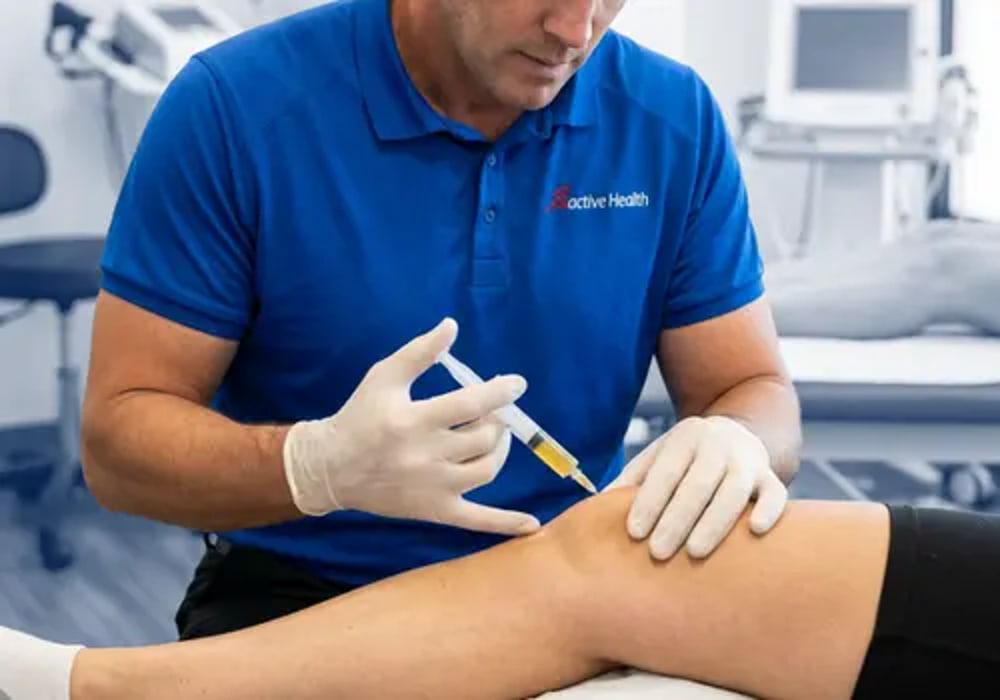
When one joint is inflamed enough to block everything else, our medical team can offer a targeted injection into the joint that keeps flaring, including corticosteroid and hyaluronic acid where appropriate. The purpose is a workable window rather than a destination: an injection not followed by the mechanical work buys months, not years.
Manual Soft Tissue Therapy
Chronically irritated tissue is usually surrounded by tissue that has thickened and stopped gliding, which keeps loading the sore structure. Hands-on work over a tendon or bursa that stays irritable restores movement between those layers and takes demand off the structure that is actually inflamed.
Recovery and Realistic Timelines
Every plan moves through the same four phases, and you are told which one you are in at each reassessment.
- Settle the tissueTake the irritability down far enough that the area tolerates being worked.
- Remove the driverChange the load, the position or the pattern that keeps re-irritating it.
- Rebuild toleranceGraded loading so the tissue can take the demand again.
- Test it against your weekBack to the work, the sport or the hobby it flared in.
A single irritated structure often improves within 2 to 4 weeks. Where several structures are involved, or the driver is an unavoidable daily load, 6 to 12 weeks of consistent work is the more realistic picture. Results vary with which tissue is involved, how long it has been reactive, and whether the loading change actually happens outside the clinic.
Watch the flare pattern rather than the daily score. Flares that arrive less often and settle faster are the real signal, and they usually move before the average pain level does.
Expert Inflammation Care in the Jacksonville Area
Patients across Deerwood, San Jose and Ortega tell us their joints track the weather, and a Florida summer supplies plenty to track. The research on why is mixed. What is not in dispute is that a joint with capacity to spare copes with a bad week, and an already irritable one does not.
That capacity is what the plan is built for. Inflammation care here runs inside a practice where the medical and rehabilitation teams treat the same irritated tissue, so an injection and the loading work that has to follow it are not two separate referrals.