Tendon pain that keeps returning. A joint that has been managed rather than fixed. Rest, therapy and anti-inflammatories each bought time, and none of them changed the tissue. Platelet-rich plasma is one attempt at changing it, using your own repair biology, concentrated and put back where the tissue needs it.
PRP is not new. It has been used in sports medicine, orthopedics and tissue repair for decades, around tendinopathy, osteoarthritis and long-running soft tissue problems where the tissue's own repair capacity ran out.
It is also not a guarantee. PRP is an emerging therapy, it is not FDA-approved as a treatment for arthritis or tendon injury, and results vary from patient to patient. At Active Health it is never used on its own: every injection follows an evaluation and is scheduled alongside the loading work that comes after. The injection opens a window. Rehabilitation is what uses it.
What Is Platelet-Rich Plasma?
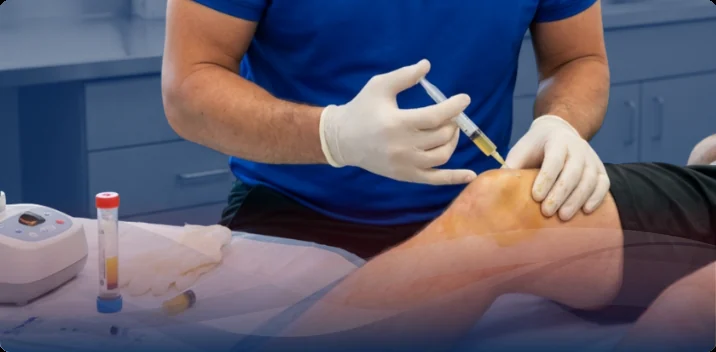
Platelet-rich plasma is a preparation made from your own blood. A sample is drawn from a vein in your arm, spun in a centrifuge to separate the platelet-rich layer from the red cells, and injected into the target tissue under sterile technique.
Platelets carry the growth factors your body already uses to start a repair. Tendons and worn cartilage have a thin blood supply, so the repair signals reaching them are limited. PRP is an attempt to deliver those signals directly rather than waiting on circulation to do it.
The material comes from your own blood, so no foreign proteins are involved and immune reaction risk is negligible. That is a safety point rather than an efficacy one, and the two get confused constantly. A treatment being low risk is not the same as a treatment that works.
Conditions We Support With PRP in Jacksonville
PRP is considered when the tissue repair environment looks like the limiting factor, which usually means conservative care reached its ceiling rather than failed.
Tendonitis and Tendinopathy
Achilles, patellar, rotator cuff, lateral elbow, gluteal. A tendon loaded repeatedly without enough recovery stops behaving like an inflamed tendon and starts behaving like a worn one, and rest alone does not fix worn. Read about a tendon that has degenerated rather than flared.
Osteoarthritis
An arthritic joint is chemically active, not only mechanically worn, and PRP is aimed at that chemistry rather than at cartilage already gone. Candidacy is best where meaningful cartilage remains. Start with arthritis in a joint that still has cartilage to protect.
Chronic Joint Pain
Pain in a knee, hip or shoulder that has outlasted rest, medication and time. Before any injection is discussed, the question is whether the driver is degeneration, inflammation or mechanics. See how we work through a joint that keeps aching long after the injury.
What a PRP Appointment Actually Involves
Nothing is drawn or injected on the day you first walk in. This is the order it happens in.
- Evaluation first. History, symptom pattern, load tolerance and your imaging. This visit is also where you may be told an injection is not the right move.
- The blood draw. A small sample from a vein in your arm, processed in the office while you wait.
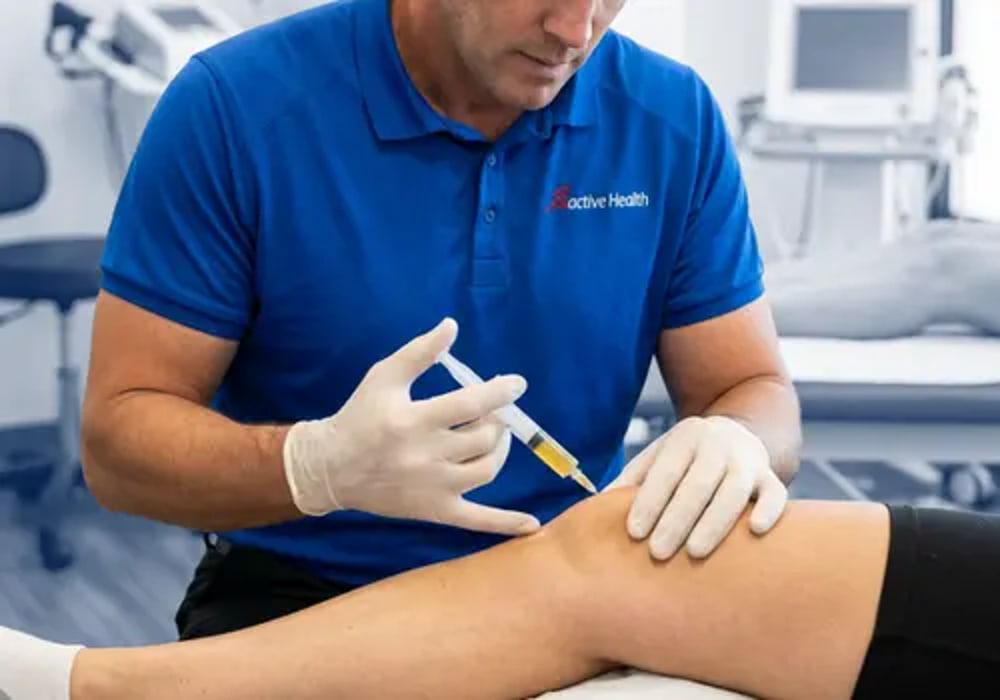
- The injection. Placed into the target tissue under sterile technique. Expect soreness for two to five days, which is part of the response the injection is meant to start.
- The rehabilitation that follows. Activity over the area is limited for one to two weeks, then loading begins. An injection with no plan behind it is the most common way this treatment gets wasted.
Who PRP Suits, and Who It Does Not
Being told no is a normal outcome of an honest evaluation, and on this treatment it is a frequent one. Here is the line, drawn before you book.
Likely a fit if
- A tendon has been painful for months and has stopped responding to a loading program you actually followed.
- Imaging shows mild to moderate joint degeneration with meaningful cartilage still present.
- Steroid injections have given short-lived relief and you want something aimed at the tissue instead.
- You will do the rehabilitation work in the weeks after, which is where the result is won or lost.
Generally not the right fit when
- The joint is bone on bone. That is a conversation about replacement, and you will hear that instead of an injection pitch.
- There is an active infection, or a blood or platelet disorder that affects clotting.
- You are on immunosuppressive medication or a treatment that would work against the healing response.
- The problem is a complete tendon tear, an unstable joint, or nerve compression that is getting worse. Those are surgical questions.
- You want a single procedure that ends the problem without a rehabilitation plan attached. That is not what this is.
How PRP Compares With the Other Injections
PRP is an emerging therapy. It is not FDA-approved as a treatment for arthritis or tendon injury, the evidence is genuinely mixed, and results vary between patients. The FDA publishes a plain-language page on regenerative medicine therapies, and we would rather you read it than not.
One example of why the honest answer is hedged. A randomized trial comparing platelet-rich plasma, A2M and a steroid injection in mild to moderate knee arthritis found no clear separation between the three at twelve weeks, and the platelet-rich plasma group did not improve significantly on its outcome scores. One trial, one joint, one time point, and other studies read more favorably. It is also why candidacy here is argued from your imaging rather than from the injection being popular.
| Option | What it puts into the tissue | When it is worth considering | The trade-off |
|---|---|---|---|
| PRP | Growth factors and signaling proteins concentrated from your own blood. | Chronic tendinopathy, or mild to moderate joint degeneration, where conservative care has plateaued. | Self-pay, peak effects typically take four to eight weeks, and response varies between patients. |
| Cortisone injection | A steroid that suppresses the local inflammatory response. | Pain high enough to block sleep or to make starting rehabilitation impossible. | Dependable short-term relief, but repeated use in the same tissue is not a long-term plan. |
| Hyaluronic acid | A gel that supplements the joint fluid rather than acting on the tissue. | Knee arthritis where the goal is symptom relief and cortisone is being avoided. | Often insurance-eligible, which PRP is not, and it makes no claim on the underlying tissue. |
| Umbilical cord tissue | A donated tissue allograft carrying growth factors and matrix proteins. | Cases where a broader repair environment is wanted and your own blood is not the better source. | Donor material rather than your own, self-pay, and it is not stem cell therapy despite how it is marketed elsewhere. |
In an arthritic joint the useful question is what the injection is meant to do. PRP delivers growth factors that push repair, cortisone suppresses the local inflammatory response, and hyaluronic acid supplements the joint fluid. In some joints PRP belongs, and in plenty of joints it does not. That call is made on the medical side of the practice that decides which injection fits, not by whichever treatment the patient read about first.
What Drives the Cost, and What Insurance Covers
PRP is generally not covered by insurance. Most plans classify it as an elective regenerative therapy, and that is true almost everywhere rather than only here.
Four things move the number: how many sites are treated, whether the protocol is one injection or a short course, which tissue is involved, and whether another regenerative option sits alongside it.
The rehabilitation that follows is separate and often insurance-eligible. Active Health accepts Aetna, BCBS, United Healthcare, Tricare, Humana, UMR and Medicare for eligible physical therapy and rehabilitation services. You get the full cost before treatment begins, not after. Call (904) 296-0202 and we will verify your benefits first.
Why Jacksonville Patients Choose Active Health for PRP
Plenty of people receive a PRP injection somewhere the injection is the entire treatment. No evaluation worth the name, no plan for the weeks afterward, no follow-up beyond a phone call. That wastes the one thing PRP offers, which is a window where the tissue can respond better to load.
Here it is one event inside a plan, reviewed rather than assumed. If the tissue is not responding, that gets said out loud instead of covered with a second injection, and if imaging shows a joint past the point where biology helps you will hear that at the consultation. What makes the plan work afterward is the wider Bowden Road practice that has to load the tissue, since an injection with nothing behind it is just an expensive afternoon.