
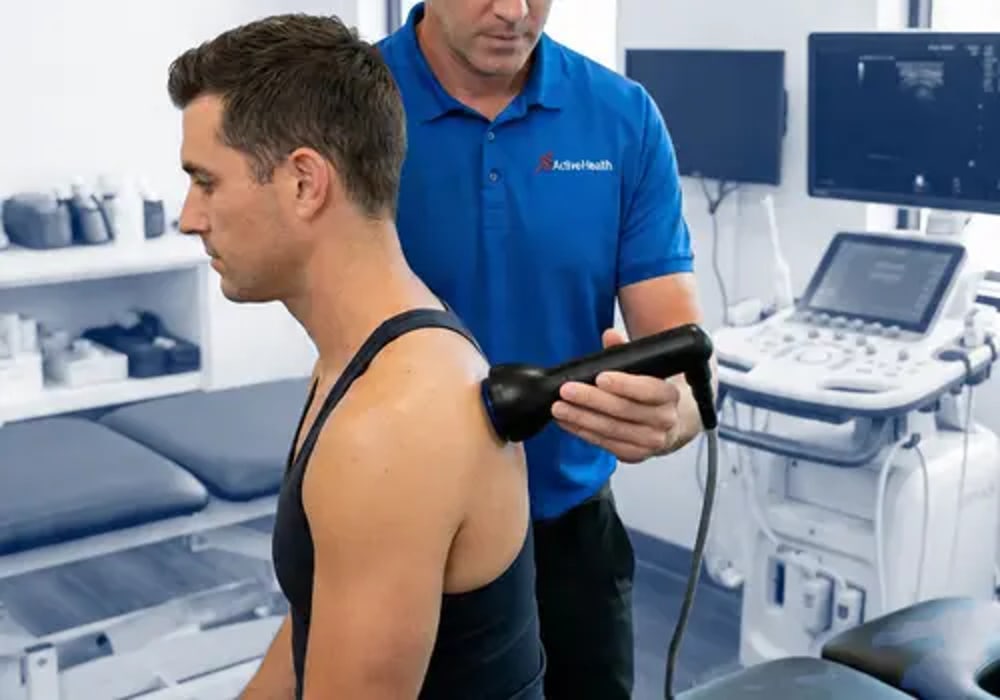
Tendonitis is pain in a tendon at the shoulder, elbow, hip, knee or heel. Most tendon pain that has lasted months is degeneration rather than active inflammation, which is why rest and anti-inflammatories stop working. Active Health treats it in Jacksonville, FL with shockwave therapy, graded loading and regenerative injection options aimed at the tissue itself. Same-week evaluations, no referral needed.
Tendon pain is the injury people try to outlast. Rest it for a fortnight, take the anti-inflammatories, stretch it, go back to what you were doing. For a genuinely fresh irritation that sometimes works.
For the shoulder, elbow or heel that has been sore for eight months, it does not, and the reason is not that you rested badly. The tissue itself has changed, and nothing in that routine asks it to change back.
At the medical clinic on Bowden Road, a tendon evaluation starts by working out which tendon it is and what it can still tolerate. You leave the first visit with a written plan and a straight answer about how long it is likely to take.
What Tendonitis Really Is
Tendonitis means tendon pain. Once that pain has lasted a few months, biopsy studies of painful tendons usually show disorganized, degenerated collagen rather than the inflammatory cells the word implies. The more accurate clinical term is tendinopathy, and the difference changes what actually helps.
The Arthritis Foundation draws the line plainly: tendinitis is inflammation and swelling in a tendon near where it attaches to bone, while tendinosis is degeneration of the collagen inside the tendon, and tendinosis does not ultimately involve inflammation even though it usually starts that way.
That distinction explains the pattern most patients arrive with. Anti-inflammatory treatment targets a process that is no longer the main event, which is why a cortisone injection buys weeks of quiet without changing the tissue underneath. The tendons we see most often at our pain control clinic in Jacksonville are the Achilles, the patellar tendon at the front of the knee, the rotator cuff, the common extensor origin at the outside of the elbow, and the gluteal and posterior tibial tendons at the hip and inner ankle.
Common Symptoms of Tendonitis
Tendon pain has a recognizable signature. These are the presentations that benefit from an evaluation at Active Health.
- Localized pain over one tendon that you can reproduce with a specific loading movement
- Morning stiffness and aching that eases as you warm up, then returns once the activity stops
- Tenderness on direct pressure along the tendon or at the bone it attaches to
- Gradual onset over weeks or months, with no single injury you can point to
- Pain that has kept worsening despite rest, stretching and anti-inflammatories
- Thickening or a nodule you can feel within the tendon itself
- A previous cortisone injection that helped for a while, then wore off
- Loss of confidence loading the limb, so you have quietly stopped doing things
What Turns a Tendon Degenerative
Tendons fail when demand outruns their capacity to repair. Five patterns account for most of what we see at Bowden Road.
Year-Round Training With No Off Season
Jacksonville never forces the seasonal rest that colder climates impose, so running and court sports run twelve months a year. The Achilles and the patellar tendon absorb that steadily, and jumper's knee and mid-portion Achilles pain are what walk through the door.
Overhead Work and a Poorly Supplied Rotator Cuff
The supraspinatus passes through a zone with limited blood supply, which is part of why shoulder tendon pain from overhead work and overhead sport is slow to settle. Repair depends on circulation the tissue does not have much of.
Grip and Forearm Load at Work
Lateral epicondylitis is not a racquet-sport problem. Tradespeople, keyboard workers, hygienists and healthcare staff load the common extensor origin all day, and the tendon degenerates without a single memorable event.
Age, Metabolic Health and Certain Medications
The Arthritis Foundation lists older age and diabetes among the contributors to tendinosis, along with statins, corticosteroids and fluoroquinolone antibiotics. Gluteal tendinopathy at the outside of the hip and posterior tibial tendinopathy at the inner ankle sit heavily in this group, and both are routinely mislabelled as bursitis or a flat foot.
Repeated Cortisone With No Load Work Behind It
Each injection quiets the pain and returns you to the same demand on the same tissue. Nothing in that cycle rebuilds the tendon, so the interval between injections tends to shorten.
How We Treat Tendonitis in Jacksonville
Treatment starts by confirming which tendon is involved and how it behaves under load. From there the plan combines acoustic wave therapy over the degenerated segment with a graded loading program, then adds a regenerative injection option at the medical clinic where the evaluation supports one.
Shockwave Therapy
A degenerated tendon has stopped running a normal repair cycle, and mechanical energy is one of the few inputs that reaches the tissue directly. Focused acoustic pulses delivered over the degenerated segment are intended to provoke a repair response and reduce local pain sensitivity. Sessions are short, need no recovery time, and are paired with loading work rather than used on their own.
PRP Therapy
Where the tendon needs a stronger biological signal, a small volume of your own blood is processed to concentrate the platelet fraction and injected into the zone of degeneration. A platelet injection prepared from your own blood delivers growth factors with the aim of restoring normal repair activity in the tendon. Evidence is strongest for the elbow and the Achilles, response varies, and we say so before you book it.
A2M Injections
Alpha-2-macroglobulin is aimed at a different half of the problem. The enzymes that break down collagen can dismantle new repair tissue faster than it is laid down, and an injection aimed at those cartilage and collagen-degrading enzymes is intended to protect the repair environment rather than stimulate it. It is offered where the evaluation supports it, with its costs stated plainly.
GAINSWave for Recovery
For patients already in a structured training or recovery block, the same acoustic technology runs as a recovery protocol rather than a single-tendon treatment. Acoustic sessions used to support tissue recovery across a training week sit alongside the loading program, and your clinician will tell you plainly if the single-site option is the better use of your money.
How Your Tendon Pain Options Compare
Tendon pain has genuine alternatives, and two of the four below are not performed here. This is an honest read on all of them.
| Option | When that is the right call | The trade-off |
|---|---|---|
| Shockwave and loading at Active Health | The default for tendon pain that has outlasted rest, and the only option here aimed at the tissue quality itself. | It takes months rather than weeks, and the loading program only works if you do it. |
| Rest, ice and anti-inflammatories | Reasonable for a genuinely acute, freshly irritated tendon in its first week or two. | The Arthritis Foundation notes that NSAIDs and steroids are not recommended for tendinosis and can damage tendons over time. |
| Cortisone injection (not performed here) | Useful when pain is severe enough to block sleep or to stop you starting a loading program at all. | Relief is usually temporary, the tendon is unchanged when it fades, and repeat injections carry their own tendon risk. |
| Tendon surgery or debridement (not performed here) | The right call for a full rupture, and for a case that has failed a genuine course of conservative and regenerative care. | Irreversible, and it still needs months of loading rehabilitation afterwards to produce a good result. |
Cortisone injections and tendon surgery are not performed at Active Health. On cost: the Arthritis Foundation notes that many insurers do not cover platelet-rich plasma, so the injection options here are quoted to you before anything is scheduled.
Recovery and Realistic Timelines
Every plan moves through the same four phases, and you are told which one you are in at each reassessment.
- Settle the tendonTake the provoking load off it and calm the pain enough to start work.
- Signal repairAcoustic sessions, and an injection option where the evaluation supports one.
- Rebuild capacityGraded loading until the tendon tolerates what you actually ask of it.
- Return to demandTest the tendon against your sport, your job and your weekend.
The Arthritis Foundation puts recovery from true tendinitis at roughly four to six weeks and recovery from tendinosis at about three to six months, and our experience tracks that. Results vary with which tendon it is, how long it has been painful, and how consistently the loading program gets done between visits.
Watch capacity rather than comfort. A tendon that hurts the same but tolerates two more sets than it did a fortnight ago is a tendon that is changing.
Expert Care for Tendonitis in the Jacksonville Area
The Southside running trails, the year-round court sport across the San Jose corridor and the shoulder demands that come with boats at Ortega all add up to cumulative tendon load with no natural break in it. Deerwood adds the desk and keyboard version of the same problem at the elbow and shoulder.
What matters for a tendon is that the acoustic work, the injection option and the loading program are decided together rather than in three separate buildings. Tendon care runs through a single practice where the rehabilitation and medical teams share a plan, so nobody has to sequence it for you.