
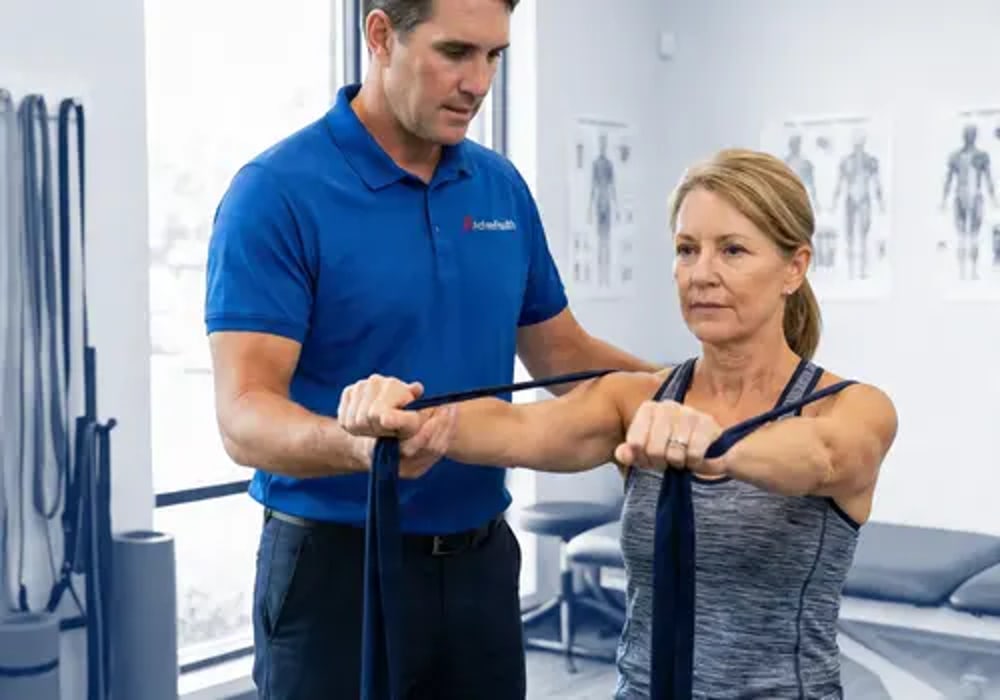
A herniated or bulging disc is a spinal disc that has pushed past its normal border. It can press on or irritate a nearby nerve, causing low back pain, leg pain, numbness or weakness. Active Health treats it in Jacksonville, FL with spinal decompression, progressive exercise and postural rehabilitation, without surgery and without a referral.
A disc problem in the lower back can be a deep ache that locks up after a long drive. It can be a leg that goes numb in the grocery store, or a sneeze that stops you where you stand.
You may already have an MRI report that says herniation or bulge, and a worry that surgery is the only way out. A scan shows the disc. It cannot tell you on its own whether that disc is causing your pain.
At our physical rehabilitation center on Bowden Road, herniated disc treatment starts with an exam of your nerves and your strength. We also test the movements that set off the pain, and the first visit ends with a written plan built from those findings.
Understanding Herniated and Bulging Discs
Each intervertebral disc is a cushion between two vertebrae, with a tough outer ring and a soft, gel-like center. In a herniated disc, part of that center pushes through a tear in the ring; in a bulging disc, the disc spreads past the edges of the bones without breaking through. Either one can press on a nerve root.
What a Bulge Means
A bulge is broad and usually shallow, more like a tire low on air than a puncture. It tends to reflect the slow, age-related drying of the disc.
What a Herniation Means
A herniation is a focused push of disc material through the outer ring. It is graded by shape as a protrusion, an extrusion or a free fragment called a sequestration. Material that reaches a nerve root can squeeze it and irritate it chemically.
A bulge on your MRI report does not prove the disc is causing your pain. A review of 33 imaging studies found disc bulges in 30% of pain-free 20-year-olds and 84% of pain-free 80-year-olds. Your strength, reflexes and sensation have to point at the same level as the scan before a plan is built around that disc.
Common Symptoms of a Herniated or Bulging Disc
Symptoms depend on the level involved and whether a nerve root is caught up in it. Any of these is reason enough to have it examined.
- Low back pain that flares when you sit, bend forward or lift
- Leg pain that is worse than the back pain
- Numbness or tingling in the leg, foot or toes
- Weakness in the leg or foot, such as trouble walking on your heels or toes
- Pain that spikes when you cough, sneeze or strain
- Muscle spasm and stiffness across the lower back
- Standing with a lean to one side to keep the pain down
- Pain that builds through a long drive or a long day at a desk
What Makes a Disc Herniate or Bulge
The American Academy of Orthopaedic Surgeons names these contributors in its guide to the causes and risk factors of a herniated disk.
Age-Related Disc Wear
Discs hold less water with age, so they stiffen, lose height and tear or bulge more easily. This disc degeneration sits behind most herniations.
Lifting With a Bend and a Twist
Lifting with the back instead of the legs, especially while twisting, leaves the disc vulnerable, and jobs that repeat it all day add up.
Long Hours Behind the Wheel
Long periods of sitting load the lumbar discs, and frequent driving adds engine vibration on top of that load.
A Fall or a Sudden Injury
A fall or similar trauma can herniate a disc in a single moment.
Body Weight, Smoking and Inactivity
Extra body weight stresses the lower discs. Smoking is thought to cut the oxygen reaching the disc and speed its wear, and inactivity is a risk factor of its own.
How We Treat Herniated and Bulging Discs in Jacksonville
Treatment starts by matching your exam to your imaging, so the plan targets the level and nerve actually involved. A plan can draw on three treatments. Spinal decompression lowers pressure on the disc, progressive exercise rebuilds tolerance to load, and postural rehabilitation changes how your lower back carries the day.
Spinal Decompression Therapy
Decompression is a motorized traction treatment that cycles between pulling and relaxing to lower the pressure inside the disc. At Active Health it is a set protocol of 10 to 20 visits over six weeks, with 20 the protocol we recommend for progression. It is never covered by insurance. Read about spinal decompression for herniated and bulging discs.
Therapeutic Exercise
Exercise is what lets a result outlast the protocol. Progressive trunk and hip strengthening for disc recovery starts at a load your back tolerates without a flare. It then builds toward the bending and lifting your week demands.
Postural and Structural Rehab
Sitting, driving and lifting habits decide how much load reaches the disc each day. Postural correction for how your lower back carries load starts with a movement screen and retrains the pattern that keeps stressing the same segment.
How Your Disc Treatment Options Compare
Two of these five paths are not offered at Active Health, and each still has a place.
| Option | Where it fits best | What to weigh |
|---|---|---|
| Rehabilitation at Active Health | First line for most herniated and bulging discs without red flags. | Progress takes weeks and depends on your work between visits. |
| Spinal decompression (self-pay) | Confirmed disc involvement with nerve symptoms that exercise alone has not settled. | Six weeks of visits, never covered by insurance, and mixed published evidence for traction. |
| Rest and medication | Easing a fresh flare for a day or two. | Relieves symptoms without restoring strength. |
| Epidural steroid injection (not performed here) | Leg pain not helped by six weeks or more of other nonsurgical care. | Relief is usually short-term. |
| Microdiscectomy (not performed here) | Muscle weakness, trouble walking, loss of bladder or bowel control, or failed nonsurgical care. | Surgical risks, possible re-herniation, and rehabilitation afterward. |
Active Health does not perform epidural injections or spine surgery. When your exam points toward either, we say so at the evaluation and help you find a spine specialist.
How Long Disc Recovery Takes
Each stage of a disc plan has a test to pass before the next one starts.
- Calm the nerveFind the positions that ease the leg and drop the ones that provoke it.
- Unload the discDecompression where it is indicated, alongside gentle loading.
- Build toleranceTrunk and hip strength progressed toward sitting, bending and lifting.
- Test it for realLifting, driving and your sport, practiced before discharge.
Nerve symptoms from a herniated disc improve with time in about 9 out of 10 people, according to the American Association of Neurological Surgeons. The body can also shrink a herniation. Across repeat scans, a systematic review of spontaneous disc regression found shrinkage in 96% of sequestered discs, 70% of extrusions, 41% of protrusions and 13% of bulges.
A bulge that never changes on a scan can still stop hurting. Progress is measured by how you sit, sleep and lift, not by a follow-up MRI. Results vary with the level involved, how long it has been symptomatic and how consistently you do the home program.
When a Disc Problem Needs Urgent Care
Most disc pain is not an emergency. A few signs are.
Go to an emergency room now
These can signal cauda equina syndrome, compression of the nerve roots at the base of the spine, which needs emergency treatment.
- Loss of bladder or bowel control, or new trouble passing urine
- Numbness in the groin, genitals, buttocks or inner thighs
- Leg weakness that is severe or getting worse
Call 911 or go straight to an emergency department.
See a physician first
The American Association of Neurological Surgeons recommends urgent evaluation for disc symptoms with these warning signs.
- Fever or a recent serious infection alongside the back or leg pain
- A history of cancer that has spread
- Pain that began with a fall or an injury
Without them, conservative care is the usual starting point.
Expert Disc Care in the Jacksonville Area
Your exam and plan come from a team that includes Dr. Christopher T. Brown, DPT, who earned his physical therapy doctorate summa cum laude and served as Slippery Rock University's graduate assistant for the Gross Anatomy Lab.
Decompression, exercise and postural work all run at one clinic, at 6500 Bowden Road. Active Health has treated Jacksonville patients since 2005, and people travel from across the state for care here. Disc treatment is one part of a physical therapy clinic that also runs sports medicine and medical care.