
Plantar fasciitis is heel pain caused by degenerative change where the plantar fascia attaches to the heel bone, and its signature is sharp pain on the first steps of the morning. Active Health treats it in Jacksonville, FL with focused acoustic wave therapy, hands-on calf and fascia work, and progressive loading for the foot and hip. Same-week evaluations, no referral needed.
Plantar fasciitis has a particular cruelty to it. The worst pain of the day arrives before your feet have properly hit the floor, eases by mid-morning, and comes back by the afternoon.
You have stretched it. You have rolled a frozen water bottle under the arch, bought the supportive shoes, tried the night splint. Each one buys a little relief and none of them finishes it, because they all work on how much load the tissue takes and none of them restarts the repair the tissue has stopped doing.
At our Jacksonville sports medicine clinic, a heel pain evaluation checks the foot, the ankle and the hip, then treats the tissue and the cause together. You leave the first visit with a written plan.
What Plantar Fasciitis Really Is
Plantar fasciitis is pain at the point where the thick band of tissue under your foot attaches to the heel. Despite the name, chronic cases involve degenerative tissue change rather than active inflammation, which is why anti-inflammatories and rest so reliably fail to finish it.
The more accurate word for the chronic version is plantar fasciosis: disorganized collagen and a repair process that has stalled, in tissue loaded past its capacity to recover between loading cycles. That distinction is not academic. It changes the treatment from calming inflammation to restarting repair.
Heel pain is also not always the fascia. The American College of Foot and Ankle Surgeons notes that it can come from a stress fracture, tendonitis, arthritis or nerve irritation, and that having it properly diagnosed matters. The first visit rules those in or out before anything gets treated.
Effective treatment has to do three things: restart repair in the degenerated tissue, get the load back inside what the fascia can handle, and correct whatever created the overload. Do one of the three and you get a few good weeks.
Common Symptoms of Plantar Fasciitis
The pattern is distinctive enough to recognize before anyone touches your foot. These are the presentations we evaluate at Active Health.
- Sharp, stabbing heel pain with the first steps of the morning
- Pain that eases after a few minutes of walking and returns with prolonged standing
- Tenderness on the inside of the heel when you press it directly
- Arch pain that is worse barefoot on hard floors
- Stiffness through the sole when the toes are pulled back
- An altered walking pattern built around not loading the heel
- Calf tightness and limited ankle bend alongside the heel symptoms
- Symptoms present more than 6 weeks despite stretching and new shoes
Common Causes of Plantar Fasciitis
Five contributors account for most cases, and three of them sit nowhere near the foot. Missing those is why heel pain recurs.
Load That Outpaces Repair
When cumulative demand exceeds what the fascia can repair between loading cycles, micro damage accumulates faster than the tissue clears it. Every other cause here is a way of arriving at this one, which is why the plan has to change the load and not only treat the tissue.
Reduced Ankle Dorsiflexion
A stiff ankle is the most overlooked contributor. If the ankle cannot bend far enough as you pass over the foot, the foot compensates by flattening, and the fascia takes the extra tension on every step. This is testable in about ten seconds and is routinely never tested.
Weak Intrinsic Foot Muscles
The small muscles inside the foot are the arch's active support. When they are weak, common in feet that have spent decades in supportive shoes, the fascia carries a share of the arch load it was never meant to carry alone.
Hip Abductor Weakness
Weak hip abductors let the pelvis drop and the knee fall inward during single-leg stance, and the foot pronates to compensate. That is a heel problem created at the hip, and it is among the most common reasons a treated heel keeps coming back.
Standing Work on Hard Surfaces
Healthcare workers, teachers, hospitality staff and tradespeople spend the day on concrete and tile with no recovery interval. Occupational heel pain has to be managed around a shift pattern that is not going to change, which is a different plan from an athlete's.
How We Treat Plantar Fasciitis in Jacksonville
Treatment starts with a full assessment of the foot, ankle and hip to find what created the overload. From there the plan combines focused acoustic wave therapy aimed at the degenerated tissue, hands-on work through the calf and fascia, and progressive loading that rebuilds the tissue's capacity rather than only stretching it.
Shockwave Therapy
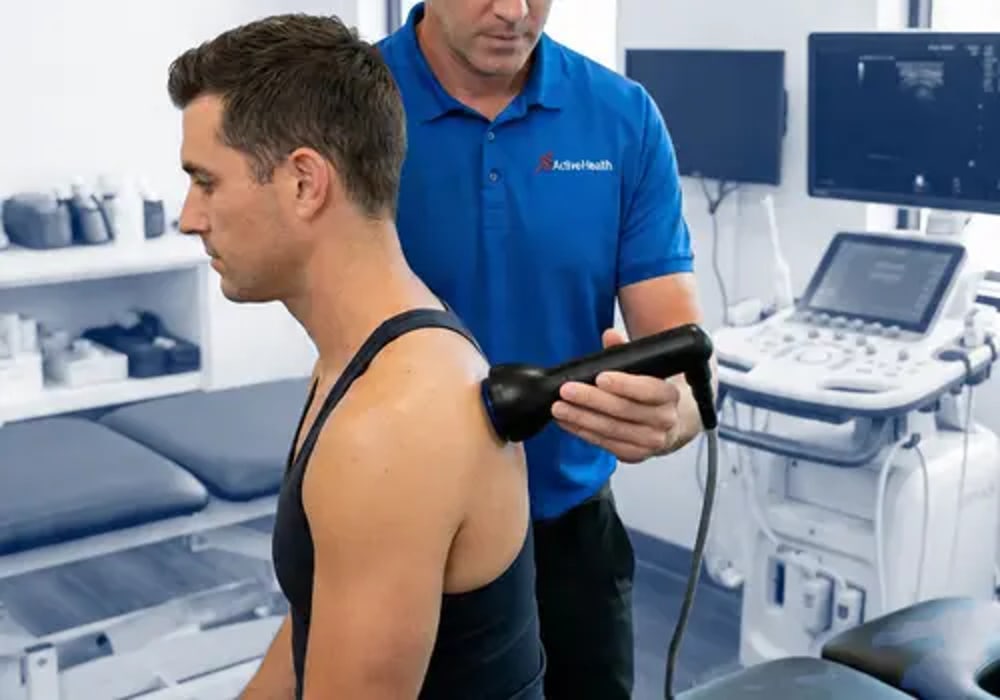
This is the treatment that answers the question the others cannot: what do you do about tissue that has stopped healing. Focused acoustic wave therapy for the degenerated fascia at the heel delivers low-intensity acoustic energy directly into the tissue at the heel attachment, with the aim of stimulating the cells that lay down new collagen, improving the blood supply at a poorly vascularized insertion, and reducing the chemical pain signalling coming from degenerated tissue.
That mechanism is why it belongs on this page specifically. Stretching, orthotics and rest all work on load. None restarts repair, which is why they fail in the cases where the tissue itself has stopped responding. Shockwave sessions are non-invasive, take minutes, and need no time off your feet, so they fit around a job that does not allow rest. Response varies between patients and is reassessed rather than assumed.
Sports Injury Treatment
The assessment is the part that stops it recurring. A full sports-injury workup of the foot, ankle and hip tests ankle range, intrinsic foot strength, hip abductor capacity and your recent work load, then targets whichever is driving the overload in your case.
Active Release Techniques
Chronic heel pain rarely stays in the heel. Active Release Techniques applied through the calf and plantar fascia address the restriction built through the calf complex and the sole, which is usually what limits the ankle bend that started the problem.
Therapeutic Exercise
Loading is what makes it hold. Progressive loading for the calf and the intrinsic foot muscles uses heavy, slow resistance work to direct remodelling in the fascia and rebuild the active support that takes tension off it. Skipping this part is why heel pain returns.
Normatec Compression Therapy
For patients whose work will not allow less time on their feet, sequential compression used between treatment sessions moves swelling out of the foot and improves the local environment for repair, so healing can proceed despite the load continuing.
How Your Heel Pain Options Compare
Heel pain has genuine alternatives, and two of the four below are not performed here. This is an honest read on all of them.
| Option | When that is the right call | The trade-off |
|---|---|---|
| Conservative care at Active Health | Heel pain that has run past 6 weeks, or that has already failed stretching, new shoes and rest. | It takes weeks, and the loading work between visits is not optional. |
| Stretching, orthotics and shoe changes on your own | Genuinely first line, and enough on its own for a good proportion of early cases. | All three manage load and none restarts repair, so they stall once the tissue itself has degenerated. |
| Corticosteroid injection into the heel (not performed here) | Sometimes used where pain is severe enough to block everything else, and it can buy a window. | Repeated injection into the heel carries recognized risks to the fascia and the heel fat pad, and it is not part of the plan here. |
| Plantar fascia release surgery (not performed here) | Reserved for the small proportion of cases still painful after months of proper nonsurgical treatment. | Irreversible, with a real recovery, and it does not address the ankle and hip mechanics that caused it. |
Corticosteroid injection into the heel and fascia release surgery are not performed at Active Health. ACFAS notes that most patients with plantar fasciitis respond to nonsurgical treatment, and if yours is one of the exceptions you will hear it here rather than after another six months.
Recovery and Realistic Timelines
Every plan moves through the same four phases, and you are told which one you are in at each reassessment.
- Settle the heelTake the first-step pain down far enough that the foot tolerates work.
- Restart repairAcoustic wave sessions and hands-on work through the calf and sole.
- Build capacityHeavy slow loading for the calf, the fascia and the small foot muscles.
- Return the loadBack to the shift, the mileage or the court, at a rate the tissue can absorb.
Patients with symptoms under 6 months often see meaningful improvement within 4 to 8 weeks. Chronic cases usually need 10 to 16 weeks for durable relief. Results vary with how long it has been there, how much of the cause sits at the ankle and hip, and whether the loading work gets done.
The first sign of progress is the morning, not the afternoon. When the first ten steps out of bed stop being the worst part of the day, the tissue is responding even if a long shift still hurts.
Expert Heel Pain Care in the Jacksonville Area
Jacksonville gives a foot no off-season. There is no cold snap that forces a few weeks of rest on a runner, so training loads run continuously, year after year, on hard roads and trails. The second cohort is bigger and gets less attention: the nurses, teachers, servers and tradespeople across the Southside standing on concrete through a full shift, whose heel pain is driven by work rather than sport.
Both groups need the same thing, a plan built around load they cannot remove. Heel pain care here sits inside a practice that treats the whole leg, not only the heel, so the ankle and hip work that stops it recurring happens in the same building as the treatment for the fascia.