
A sprain tears ligament and a strain tears muscle or tendon, and both leave more behind than torn tissue: the muscles guarding the joint switch off and the joint loses part of its sense of position. Active Health treats sprains and strains in Jacksonville, FL with graded loading, compression and acoustic wave therapy. No referral needed, and we will contact you within 24 to 48 hours.
You felt it go. Maybe on a cut, maybe on a curb, maybe on the third set when your legs had already had enough. Two weeks later the swelling is gone and the limb mostly works, so it gets filed as dealt with.
Then it happens again. Same ankle, same hamstring, same six weeks out. The second one is rarely bad luck. It usually means the first injury healed its tissue and never rebuilt the thing that protects the joint.
At the sports medicine side of the Bowden Road practice, a sprain or strain evaluation grades the injury and tests what is compensating for it. You leave the first visit with a written plan and a realistic date.
Understanding Sprains and Strains
A sprain is an injury to a ligament, the tissue that holds bone to bone. Johns Hopkins Medicine puts the other half of the pair as a twisting, pull or tear of a muscle or tendon, often caused by overuse, which is a strain. The tear is only half of it: the muscles guarding the joint switch off and the joint loses some of its sense of position, and those two deficits are what carry into next season.
Severity is described in three grades, and the definitions are worth knowing before anyone quotes you a timeline. Merck describes them as fibers stretched but not torn or only a few torn, then some to almost all torn, then all fibers torn. A grade sets the healing time for the tissue. It does not set the time it takes to get the joint working again, which is the part most people are actually waiting on.
That gap is where recurrent injuries come from. Damage to a ligament takes out some of the sensors that tell your nervous system the joint is about to be loaded the wrong way, so the protective muscle response fires late. The tissue heals, the reflex does not, and the ankle rolls again on a curb it used to handle. Treating the tear and ignoring the control is the most common reason a sprain becomes a pattern.
Signs a Sprain or Strain Needs Professional Care
Plenty of minor injuries settle on their own. These are the presentations worth an evaluation at Active Health rather than another two weeks of waiting.
- Significant swelling or bruising, or an inability to put weight through the limb
- Pain, weakness or instability still present beyond one or two weeks
- A previous injury to the same tissue, since recurrence usually means the first one was under-rehabilitated
- A sense of giving way or buckling at the injured joint
- Swelling that returns the morning after every step up in activity
- A drop in performance: slower, less powerful, or moving differently to protect something
- An ankle or a knee that has stopped trusting uneven ground
- A season or an event coming that depends on full function, not just comfort
The Sprains and Strains We See Most at Bowden Road
Five injury families account for most of what walks in, and each has its own failure mode when the rehabilitation stops early.
Ankle Sprains and Lateral Ligament Injuries
The classic rolled ankle, and the one most consistently under-rehabilitated. Ligament damage blunts the ankle's ability to sense an inversion stress and fire a protective response in time, which is the deficit behind chronic instability and the sprains that keep repeating on ground you used to manage.
Hamstring Strains
Usually at the top of the muscle where it meets the tendon, and usually during high-speed running. It heals with scar tissue that tolerates load poorly, so re-injury in the first year back is common. Progressive eccentric loading is aimed squarely at how that scar tissue organizes and at the length the muscle can produce force at.
Calf Strains and Achilles Injuries
Common in explosive push-off, and especially in the first weeks back after a rest period. An incompletely rehabilitated calf sends more load into the Achilles and the plantar fascia, which is why a badly managed calf strain so often turns into a second problem lower down the chain.
Groin and Adductor Strains
The change-of-direction injury: soccer, basketball, tennis, pickleball. This group has a real tendency to become chronic when it is managed with rest alone, progressing to a stubborn tendon problem at the pubic attachment that takes far longer to settle than the original strain would have.
Quadriceps, Hip Flexor and Upper Limb Sprains
Quadriceps strains from kicking and sprinting, hip flexor strains in acceleration athletes, and AC joint, wrist and elbow sprains in contact and overhead sport. Each has its own loading requirement on the way back, which is why immobilizing and waiting produces such inconsistent results across this group.
Ankle Sprains and Chronic Ankle Instability
The American Academy of Orthopaedic Surgeons calls ankle sprains the number one reason for missed participation in athletics. Most are inversion injuries tearing the outer ankle ligaments; a high ankle sprain, to the ligaments joining the two lower-leg bones, is examined for separately.
AAOS names incomplete rehabilitation as the most common cause of chronic ankle instability, and poor balance as a common route to repeat sprains. Pain past four to six weeks or an ankle that gives way on uneven ground is the signal. Surgery is reserved for instability that persists after months of rehabilitation.
Achilles Tendon and Calf Injuries
The Achilles, the largest tendon in the body, works with the calf to lift the heel at every push-off. Acute injuries here are usually strain-led: a calf strain on a sprint start, or a partial tear when the calf is stretched too quickly on a landing or a cut. Small partial tears respond well to nonsurgical treatment with staged calf and tendon loading.
A pop at the back of the heel and being unable to rise onto your toes need a physician first, since a repair, if chosen, goes better soon after the injury. Slow-building Achilles pain with no single injury is a tendon problem, managed differently.
How We Treat Sprains and Strains in Jacksonville
Treatment starts with an assessment that grades the injury and finds what else in the chain is compensating for it. The plan then protects the tissue for as long as it genuinely needs protecting and loads it deliberately after that, since the strength and the position sense that prevent the next one are built under load rather than during rest.
The old advice was rest, ice, compression and elevation, and the protection half of that still holds early. What changed is the rest. Merck is direct about the cost of holding still: being immobilized makes joints stiff and muscles weaken and shrink, and it names range-of-motion and strengthening work as what helps prevent injuries from recurring. Optimal loading is the word that replaced rest in the protocol, and it is a clinical judgment made week by week, not a slogan.
Sports Injury Treatment
This is the spine of the plan. Assessment-led injury care from the acute phase through to return to sport covers the protected phase, the reintroduction of load, the eccentric work the tissue needs, and the balance and reaction training that rebuilds the protective reflex. Every kinetic chain contributor found at the evaluation gets addressed, not only the tissue that tore.
Normatec Compression Therapy
Swelling is not just cosmetic. It mechanically inhibits the muscles around a joint, which is part of why a swollen knee will not fire properly. Sequential compression that moves swelling out of an injured limb works from the foot upward rather than squeezing statically, and it is used through the rehabilitation phase to keep sessions closer together than a sore limb would otherwise allow.
Shockwave Therapy
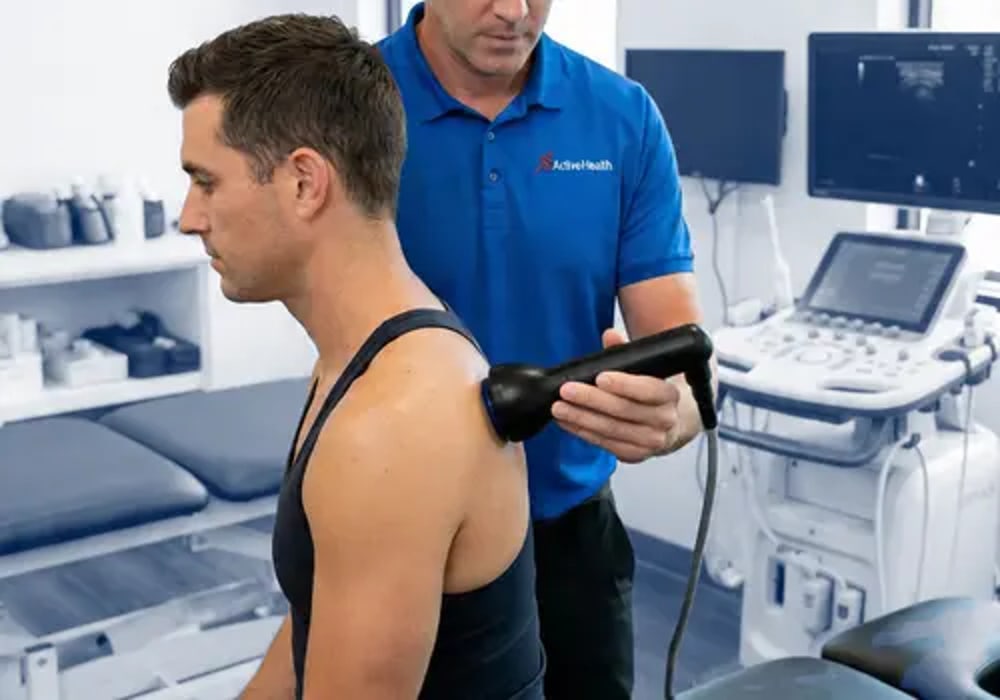
Some strains stop being an acute injury and turn into a tendon that has quietly degenerated at the same spot. Where that has happened, focused acoustic waves aimed at an old injury site that never settled reintroduce a repair stimulus to tissue that has given up on healing. It is a reasonable next step for a stubborn case, not the opening move on a fresh strain.
Recovery and Realistic Timelines
Every plan moves through the same four phases, and you are told which one you are in at each reassessment.
- Protect and settleControl swelling, protect the tissue, keep everything else moving.
- Restore the movementFull range at the joint before anything gets loaded hard.
- Rebuild the strengthProgressive loading, including the eccentric work the tissue needs.
- Retrain the reflexBalance, reaction and change of direction, so the joint protects itself again.
Grade I injuries typically need one to three weeks, Grade II four to eight weeks, and Grade III three to six months. Results vary with the tissue involved, your age, how much of the injury was ligament rather than muscle, and how consistently the loading work gets done between visits. Early expert care generally shortens the middle phases, mostly by stopping the guarding pattern from setting.
Being pain free is not the same as being ready. The last phase exists because that is where re-injury happens, and it is the phase most often skipped once the limb feels normal again.
Expert Sprain and Strain Care in the Jacksonville Area
The Southside sports complexes, the San Jose running and cycling corridor and the Ortega boating and outdoor community all produce the same conversation. People here do not want a limb that has stopped hurting. They want the ankle to hold on a trail, the hamstring to survive a sprint, and the shoulder to take a full season without a management plan.
That is why the last phase of the plan is written around your actual sport and your actual week. Injury care here sits inside a practice that rehabilitates an injury rather than waiting it out, so a strain that turns into a stubborn tendon problem does not need a new referral and a new waiting list.