
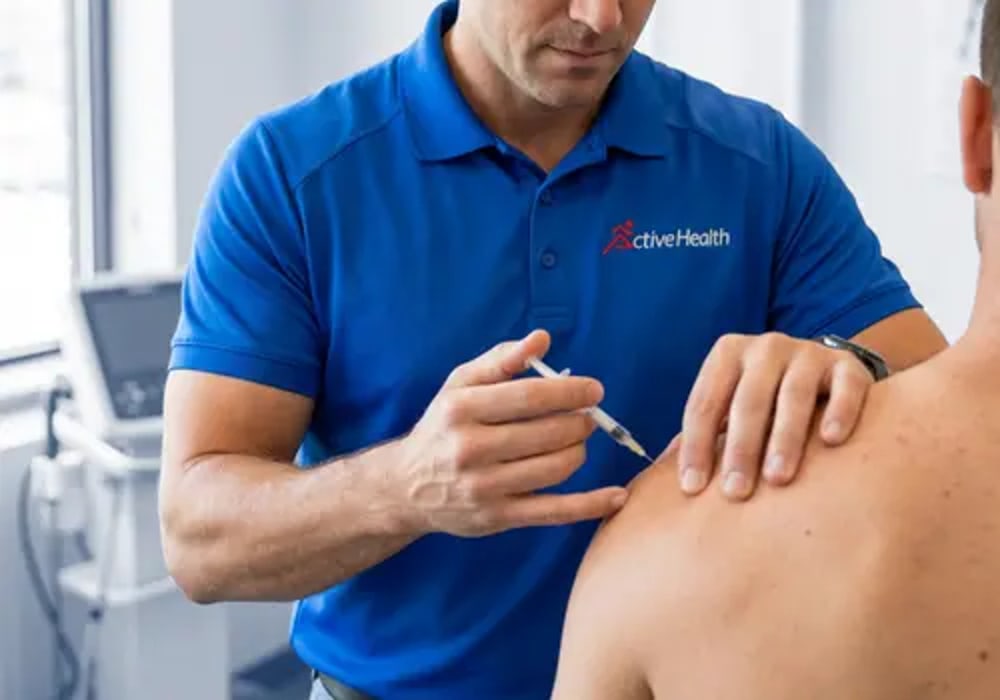
Osteoarthritis is the gradual loss of the cartilage that cushions a joint, together with inflammatory changes in the bone and joint lining that keep the breakdown going. Active Health treats it in Jacksonville, FL with regenerative and conventional joint injections alongside the loading work that protects the joint. There is no cure, and the goal is function. Same-week evaluations.
Most people receive an osteoarthritis diagnosis as a kind of sentence. Take something for the pain, keep going, come back when it is bad enough for a replacement. In between, nothing much is offered.
That gap can run for a decade, and it is the part of the condition where the joint is still worth working on. What is going on inside an arthritic joint is not only mechanical, which is why what happens to the joint environment during those years is not fixed in advance.
At the medical clinic at Active Health, an arthritis evaluation stages the joint honestly and tells you which options are genuinely open to you. If the answer is that yours is past the window, you will hear that too.
Understanding Osteoarthritis
Osteoarthritis is the loss of the cartilage that cushions the ends of the bones in a joint, along with changes in the bone, the lining and the surrounding tissue. The wear and tear description is incomplete: an arthritic joint is chemically active, and that chemistry is part of what keeps the cartilage breaking down.
The American Academy of Orthopaedic Surgeons puts it directly: there is no cure for osteoarthritis, and there are many treatment options to manage pain and keep people active. We agree with both halves of that sentence, and this page is written on the second half.
The reason it matters is the gap most patients fall into. Diagnosis arrives early, joint replacement arrives late, and the years between are handled with tablets and a shrug. That window is where load, strength and the joint's biological environment are still worth changing.
What is on offer here is not a repair. It is an attempt to slow the process, quiet the joint enough to load it properly, and buy back function inside a joint that still has something to work with.
Common Symptoms of Osteoarthritis
Symptoms change as the condition progresses, and the pattern itself is diagnostic. These are the presentations we evaluate at Active Health.
- Deep, aching joint pain that worsens with activity and eases with rest early on
- Pain that starts showing up at rest and at night as the condition advances
- Morning stiffness that clears in under half an hour
- Stiffness after long sitting that improves once you get moving again
- Crepitus, the grinding or crunching you can feel through the joint
- Swelling and warmth during a flare
- Range of motion that limits ordinary tasks rather than only sport
- Visible muscle loss around the joint from months of using it less
What Drives Osteoarthritis
Five contributors show up repeatedly at Bowden Road. Three of the five are modifiable, which is where a plan does its work.
Age-Related Decline in Repair Capacity
The cells that maintain cartilage become less metabolically active with age, matrix quality falls, and the joint's balance tips toward breakdown rather than repair. This is why prevalence climbs steeply with age, and why the same load a knee tolerated at thirty is a problem at sixty.
Prior Joint Injury
Ligament tears, fractures into the joint and significant sprains start an inflammatory process that does not fully switch off. Arthritis that follows an old injury shows up in younger patients than people expect, which matters in a city with a large military and veteran population.
Malalignment and Abnormal Loading
Bow-legged or knock-kneed alignment, hip dysplasia and a foot that pronates heavily all concentrate force on one compartment of a joint instead of spreading it. This is the modifiable one that gets ignored, and it is the reason a plan here starts with how you move rather than with an injection.
Weight and Metabolic Load
Body fat is not inert tissue. It produces signalling molecules that promote cartilage breakdown independently of the mechanical load carried through the joint, which is why arthritis in the hands tracks with weight even though hands carry none of it.
Occupational and Athletic Loading
Years of kneeling, lifting, climbing and carrying are among the most consistent risk factors for knee and hip arthritis. Construction, logistics and healthcare are all well represented in Jacksonville, and none of those jobs allows the joint an off-season.
How We Treat Osteoarthritis at Active Health
Treatment aims at the joint's biological environment and its mechanical load at the same time. Regenerative injections are used to reduce the chemistry driving cartilage breakdown and to quiet the joint, and the loading work that follows is what converts a quieter joint into a joint you can actually use.
A2M Injections
Alpha-2-macroglobulin is a protein already in your plasma that binds and neutralizes several of the enzymes that break down cartilage matrix. Concentrating it from your own blood and placing it into the joint is the reasoning behind the A2M protein that traps cartilage-degrading enzymes. It is an elective, self-pay treatment, and response varies between patients.
Umbilical Cord Tissue Allograft
For selected advanced joints, our medical team can discuss an umbilical cord tissue allograft, described as tissue and not as stem cell therapy. We name it accurately because the marketing around this category is not always accurate. It is self-pay, it is not an FDA-approved drug for arthritis, and it is a conversation with the medical team rather than a menu item.
Joint Injections
Sometimes the useful move is the conventional one. In-office joint injections including viscosupplementation restore some of the lubricating quality of joint fluid or take an inflammatory flare down far enough to let rehabilitation start. Many of these are covered by insurance, unlike the regenerative options above.
PRP Therapy
Platelet-rich plasma concentrates growth factors drawn from a sample of your own blood and delivers them into the joint, with the aim of shifting the local environment away from breakdown. It is elective and self-pay. If your joint is bone on bone, your clinician will tell you that a regenerative injection is unlikely to be a sensible spend.
One thing worth saying plainly, because a lot of clinics do not. Regenerative treatments for arthritis are not FDA-approved drugs, and the FDA maintains a consumer alert about regenerative products marketed for orthopedic conditions. PRP and A2M are prepared from your own blood at the point of care. We think they are worth considering inside the right window, and we would rather you weighed that with the regulatory picture in front of you.
How Your Osteoarthritis Options Compare
Arthritis has real alternatives at every stage, and one of the five below is not performed here. This is an honest read on all of them.
| Option | When that is the right call | The trade-off |
|---|---|---|
| Regenerative injections at Active Health | Mild to moderate arthritis where meaningful cartilage remains and you want to work on the joint environment inside that window. | Elective and self-pay, not FDA-approved for arthritis, response varies, and it will not rebuild a bone-on-bone joint. |
| Loading, strength and weight management | Every stage, and it is the option with the best evidence behind it. It also costs the least and asks the most. | Slow, unglamorous, and entirely dependent on the work you do between visits. |
| Anti-inflammatories and corticosteroid injection | Useful for taking a flare down so that rehabilitation can start, and widely covered by insurance. | Relief is temporary, and repeated corticosteroid into the same joint is not a long-term plan. |
| Joint replacement surgery (not performed here) | The right call for an end-stage joint where pain and lost function no longer respond to anything else. | Irreversible, with a real recovery, and it still needs rehabilitation afterwards to produce a good result. |
| Watchful waiting | Defensible for a mild joint that is not limiting you, provided the loading and weight side is being handled. | The modifiable contributors keep working while you wait, and the window for the options above narrows. |
Joint replacement is not performed at Active Health. If your joint is past the point where anything here helps, you hear that at the evaluation and we help you find the right surgeon.
Recovery and Realistic Timelines
An arthritis plan moves through the same four phases, and you are told which one you are in at each reassessment.
- Stage the jointImaging, exam and an honest read on what is still there to work with.
- Quiet the chemistryBring the flare down so the joint tolerates being loaded at all.
- Load it properlyStrength and alignment work that stops concentrating force on one compartment.
- Hold the groundMaintenance loading, weight, footwear and a plan for the next flare.
Patients who respond to a regenerative injection usually notice change between 4 and 8 weeks, with any further benefit developing over the following 3 to 6 months. Some patients do not respond, and that is a real outcome rather than a reason to buy another round. Results vary with the stage of the joint, your weight and loading pattern, and how consistently the strength work gets done.
The measure that matters is what the joint lets you do. Twenty minutes of walking without payback the next morning is a better read on progress than a change in the pain score on any given afternoon.
Expert Osteoarthritis Care for Northeast Florida Patients
Arthritis is common across Jacksonville for reasons that stack: an older population across San Jose and Ortega, physically demanding work across the Southside and the port, and a climate that keeps people active year-round with no seasonal break for a sore knee. What we see most often is a patient told to come back when it is bad enough for surgery.
Active Health is built for the years before that. The injection and the rehabilitation sit inside an integrated practice that also owns the loading half of the plan, which matters more here than on any other condition we treat, because an injection without the strength work is money spent on a shorter result.