
Chronic joint pain, inflammation that never resolves, or nerve-related symptoms that have not moved on standard care. Umbilical cord tissue injections come up in that conversation, usually after somebody has read about them and asked.
The injection uses an allograft, donated human tissue taken from the umbilical cord after a healthy full-term delivery. It carries growth factors, cytokines, hyaluronic acid and matrix proteins, and the intent is to give damaged tissue a better environment to repair in.
Two things need saying first. This is not stem cell therapy, whatever the category is called elsewhere, and the material contains no live cells. It is also an emerging therapy: it is not FDA-approved as a treatment for arthritis or tendon injury, and results vary from patient to patient. At Active Health it is offered inside a rehabilitation plan, never on its own.
What Are Umbilical Cord Tissue Injections?
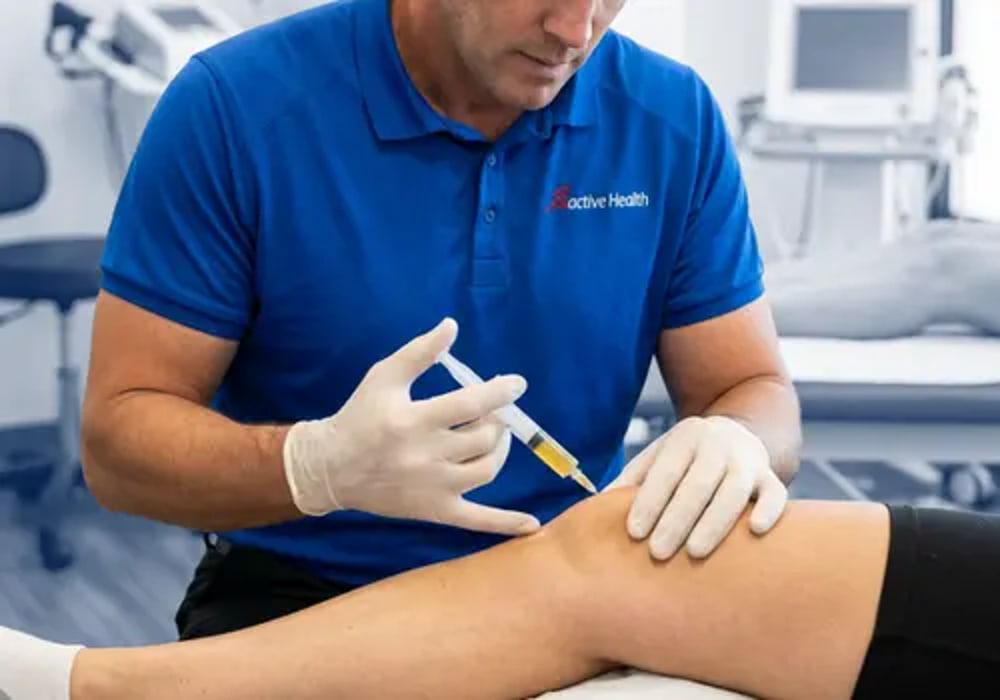
Umbilical cord tissue injections deliver an allograft, which is donated human tissue, into a joint or an area of damaged soft tissue. The material comes from Wharton's jelly, the gel-like tissue inside the umbilical cord, collected from ethically donated tissue following full-term, healthy deliveries.
What it carries is growth factors, cytokines, hyaluronic acid and extracellular matrix proteins: signaling molecules and structural components meant to give an area of chronic inflammation or degeneration a better environment to repair in.
They do not contain live cells, and they are not classified as stem cell therapy. That is the most important sentence on this page. The category is widely marketed as a stem cell treatment, which it is not. The FDA has published a consumer alert about regenerative products marketed as stem cell and exosome treatments, worth reading before you agree to anything in this category.
Where the Tissue Comes From, and How It Is Regulated
This is the section most pages in this category skip, which is exactly why it is here.
Human tissue products sit under a specific FDA framework that sets donor screening, testing and processing requirements for the establishments supplying them. The FDA explains how it regulates human tissue and tissue products in plain terms. Where a product is processed beyond minimal manipulation, the agency treats it as a drug or biologic requiring approval.
These injections are not FDA-approved as a treatment for arthritis or tendon injury, and this page will not tell you otherwise. Ask who supplies the material, which category it falls under, and what the donor screening covers. Those are fair questions, and if a clinic gets vague you have learned something useful.
Conditions We Support With Cord Tissue Injections in Jacksonville
Cord tissue is considered for chronic presentations where tissue quality looks like the barrier, and usually after the more established options have been weighed.
Chronic Joint Pain
Joint pain that has outlasted rest, medication and standard therapy, where degenerated cartilage and long-running inflammation are both in the picture. Cord tissue may be used to support tissue quality in an irritated joint. Read about a joint that no longer responds to anything conservative.
Osteoarthritis
An arthritic joint where the aim is a better repair environment and your own blood may not be the more useful source. It does not rebuild cartilage that has gone, and nothing available does. Start with joint degeneration that has progressed past the early stage.
Inflammation Control
Inflammation in a joint or soft tissue that never resolves keeps the area where repair does not finish. Bringing that down is often what makes the rest of a plan possible. Read about soft tissue that stays inflamed month after month.
Tendon and ligament degeneration is the other presentation it is considered for, alongside a structured loading program rather than instead of one.
What a Cord Tissue Appointment Involves
Nothing is injected at your first visit. The evaluation comes first, and it is where a lot of these conversations end.
- Evaluation and review. History, symptom pattern and imaging, plus an honest look at what has been tried.
- The options conversation. Cord tissue is weighed against your own blood products and against doing neither. You hear what each supports, what it does not, and what it costs.
- The injection. Placed into the target area under sterile technique. Soreness for a few days is normal.
- Rehabilitation. Tissue remodeling develops over weeks to months and the loading work runs alongside it.
Who This Suits, and Who It Does Not
This is the option we are slowest to recommend: it is donor material, it is expensive, and it is the least established of the three.
Possibly a fit if
- A chronic joint or soft tissue problem has not moved on rehabilitation, medication or a well-run loading program.
- Your own blood products are a poor source, for example where a medication or condition affects platelet function.
- You understand this is an emerging therapy, you have read what the FDA publishes, and you still want to discuss it.
- You are committed to the rehabilitation that follows, since the injection alone changes very little.
Generally not the right fit when
- The joint is bone on bone. That is a replacement conversation and you will hear it plainly.
- A standard joint injection or a structured rehabilitation program has not been tried properly yet.
- There is an active infection, or you are on treatment that makes an injection unwise.
- You are expecting stem cells. That is not what this is, and this category does not provide it.
- Cost is a strain and the expected benefit is uncertain. That is a legitimate reason to decline.
How Cord Tissue Compares With the Other Options
These are emerging therapies. Not one is approved by the FDA as a treatment for arthritis or tendon injury, the evidence base is still developing, and results vary from patient to patient. Here is a straight read, including the options we would rather you try first.
| Option | What it puts into the tissue | When it is worth considering | The trade-off |
|---|---|---|---|
| Umbilical cord tissue | A donated tissue allograft carrying growth factors, hyaluronic acid and matrix proteins. No live cells, and not stem cell therapy. | Chronic presentations where a broader repair environment is the goal and your own blood is not the better source. | Donor material, self-pay, and the less established of the two biologics. |
| PRP | Growth factors concentrated from your own blood. | Chronic tendinopathy, or mild to moderate joint degeneration where the repair signal is what is missing. | Self-pay, four to eight weeks before peak effect, and response varies between patients. |
| Cortisone injection | A steroid that suppresses the local inflammatory response. | Pain high enough to block sleep or stop rehabilitation starting. | Usually covered and reliable short term, though repeated use in one tissue is not a long-term plan. |
| Rehabilitation alone | Nothing. Progressive loading, manual work and a graded program. | Almost every case, as the first move and as the thing every injection is meant to enable. | It asks for months of consistent effort, and some tissue genuinely stalls without more. |
The bottom row is not filler. Rehabilitation is the option that works most often, and the injections above it exist to make it possible where it has stalled. Which belongs in your plan, if any, is decided alongside the other regenerative options we weigh this one against.
What Drives the Cost, and What Insurance Covers
Regenerative medicine therapies including cord tissue injections are generally not covered by standard health insurance and are an out-of-pocket expense.
Three things move the number: the allograft material itself, which is the largest component and why this costs more than your own blood products, how many sites are treated, and whether the injection sits inside a longer plan.
The rehabilitation around it is separate and often insurance-eligible. Active Health accepts Aetna, BCBS, United Healthcare, Tricare, Humana, UMR and Medicare for eligible physical therapy and rehabilitation services. You get the cost in full at the consultation. Call (904) 296-0202 and we will verify your benefits first.
Why Jacksonville Patients Choose Active Health for Regenerative Injections
This category attracts overselling: dinner seminars, marketing that is not accurate about what the product contains, and outcome promises nobody can support. This page spends its first two sections on what the material is and how it is regulated because most people arrive having been told something wrong somewhere else.
Being told no is the common outcome here. If a more established option has not been tried, or the joint is past the point where biology helps, you will hear it at the consultation rather than after the invoice. Where the injection does fit, the plan is built with the coordinated practice on Bowden Road that plans the rehabilitation, since tissue given a better environment still has to be loaded to benefit from it.