
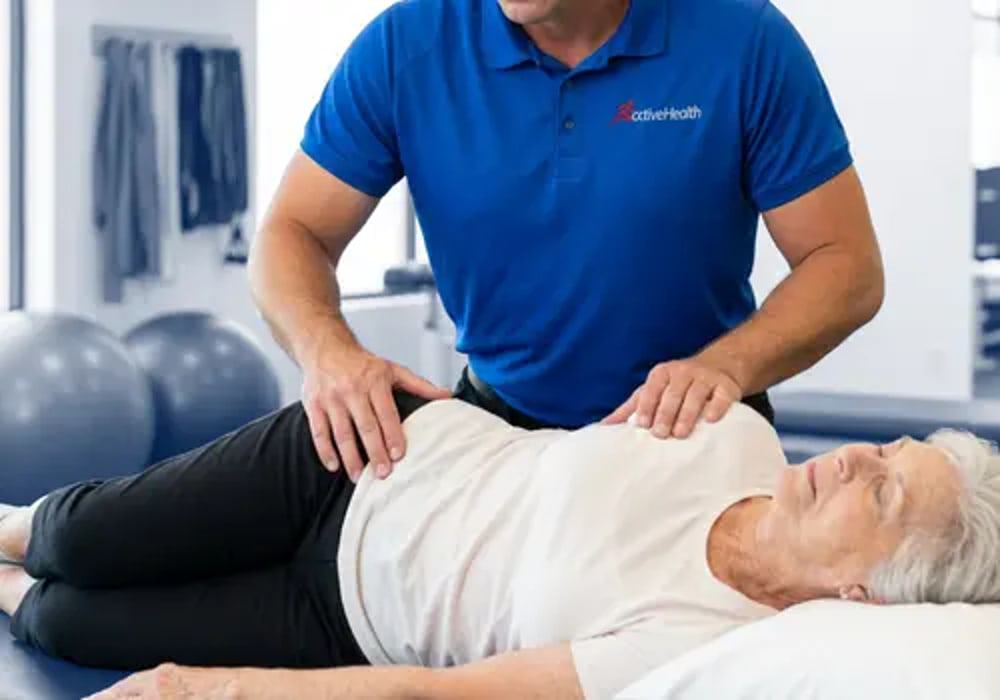
Sciatica is nerve pain that travels from the lower back through the buttock and down the leg, caused by a disc, joint, muscle or narrowed nerve opening pressing on the sciatic nerve or its roots. Active Health treats it in Jacksonville, FL with spinal decompression, hands-on soft tissue release and progressive strength work, aimed at the structure doing the compressing. Same-week evaluations, no referral needed.
Sciatica is one of the most recognizable pain patterns. Sharp, electric pain running from the lower back through the buttock and down the leg. It is also one of the most consistently undertreated, since the standard answer is imaging, anti-inflammatories and rest, none of which touch what is compressing the nerve.
You have probably already been told to wait it out. Six weeks on, the leg still lights up when you stand out of a desk chair. That is not you being dramatic. It means nobody has identified what is pressing on the nerve.
At our Jacksonville physical therapy clinic, sciatica treatment starts by finding the mechanism in your case. You leave the first visit with a written plan.
Understanding Sciatica and Radiculopathy
Sciatica is a symptom, not a diagnosis. It is the pain, numbness or weakness produced when something irritates or compresses the sciatic nerve or the lumbar nerve roots that form it. The cause can be a disc, a joint, a muscle or a narrowed nerve opening, and the right treatment depends on which one it is.
Radiculopathy is the more precise word for nerve root involvement at the spine. The same line of leg pain has at least five drivers, so a plan built without identifying yours tends to work for a few weeks and then stop.
Sciatica recurs because those causes sit there until something addresses them. Medication calms the inflammation and buys real relief. It does not unload the disc or rebuild the stability that keeps the forces away, which is why the first appointment at our pain control clinic in Jacksonville is a movement assessment.
Common Symptoms of Sciatica
Symptoms vary with what is loading the nerve. These are the presentations that benefit from an evaluation at Active Health.
- Sharp, shooting, electric or burning pain from the lower back into the buttock and leg
- Pain that follows a set path down the thigh, the outer calf, or into the foot
- Numbness or tingling that tracks along one nerve pathway
- Muscle weakness such as foot drop, trouble on stairs, or a quad that gives way
- Symptoms that worsen with long stretches of sitting or driving
- Deep buttock pain or a gluteal ache that never clears
- Pain that started after lifting, coughing, or one sudden movement
- Standing and walking that provoke the leg, with relief when you sit
Common Causes of Sciatica
Five mechanisms account for most of what we see at Bowden Road. Telling them apart is the point of the first visit.
Lumbar Disc Herniation and Disc Bulge
Disc material displaces into contact with the nerve root, producing pain, pins and needles, and sometimes weakness along that nerve. L4-L5 and L5-S1 are the usual levels, so symptoms run down the thigh and calf.
Piriformis Syndrome
The piriformis compresses or irritates the sciatic nerve directly, producing buttock-origin sciatica with nothing to show at the spinal level on imaging. It gets missed in standard workups and responds to soft tissue release and hip stabilizer work.
Foraminal Stenosis and Degenerative Changes
The opening the nerve root exits through narrows with age and wear. Symptoms are activity-related, worse with standing and walking, and ease when you sit or lean forward.
Sacroiliac Joint Dysfunction
Dysfunction at the SI joint produces buttock and thigh pain that mimics disc-related sciatica closely. It follows pregnancy, single-leg dominant sport and car accidents, and takes specific testing to separate from a disc.
Weak Core and Hip Stability
Even after the original cause settles, weak deep stabilizers and hip abductors keep overloading the piriformis and the lumbar spine. The Deerwood and Southpoint desk corridors produce plenty of this: nine hours in a chair trains the wrong things.
How We Treat Sciatica in Jacksonville
Treatment starts with a movement assessment that identifies which structure is loading the nerve. The plan then combines decompression of the involved segment, hands-on release of the tissue around the nerve, and progressive strength work, so the mechanism changes instead of the symptom being quieted.
Spinal Decompression Therapy
Where a disc or a narrowed nerve opening is driving it, the segment has to be unloaded first. A course of table-based decompression that unloads the compressed segment applies controlled traction to the lumbar spine to create room at the nerve root, alongside the strength work.
Manual Soft Tissue Therapy
Plenty of leg pain never involves the spine. Adhesions in the piriformis, deep rotators and paraspinals load the nerve directly, and neurodynamic work restores its ability to glide inside its tissue envelope. Our release work on the piriformis and paraspinal muscles targets that, which is why sitting and bending usually ease first.
Therapeutic Exercise
Strength is what makes the result last, and the order matters: reawaken the deep core, build hip abductor and gluteal endurance, then load those patterns under real demand. A graded strengthening program for the deep core and glutes delivers that sequence.
Active Recovery and Mobility
Most backs have one direction that calms the leg and one that lights it up, and finding it is a formal test. Directional movement and mobility programming builds around that preference, pulling symptoms back toward the spine and returning the range guarding has taken away.
Omniwave Therapy
Where nerve irritation stays the dominant driver after hands-on work and loading have had a fair run, your clinician may add acoustic wave sessions aimed at irritated nerve tissue as one part of the plan.
How Your Sciatica Options Compare
Sciatica has genuine alternatives, and two of the four below are not performed here. This is an honest read on all of them.
| Option | When that is the right call | The trade-off |
|---|---|---|
| Conservative care at Active Health | First line for most sciatica, and the only option here that changes the mechanics producing it. | It takes weeks, and it takes your effort between visits. |
| Rest and anti-inflammatories | Reasonable for the first week or two of a fresh, mild episode already improving on its own. | Quieting inflammation decompresses nothing, so the pattern tends to return under load. |
| Epidural steroid injection (not performed here) | Useful when pain is too severe to move or to start rehabilitation. It opens a window rather than fixing a cause. | Relief is often temporary, and the structure doing the compressing is unchanged when it fades. |
| Surgery, such as microdiscectomy (not performed here) | The right call for progressive neurological deficit, for cauda equina symptoms, and for a case that has failed conservative care. | Irreversible, and it still needs rehabilitation afterwards to produce a good result. |
Epidural steroid injections and spine surgery are not performed at Active Health. If your presentation points that way, you hear it at the evaluation and we help you find the right physician.
Recovery and Realistic Timelines
Every plan moves through the same four phases, and you are told which one you are in at each reassessment.
- Settle the nerveCalm the irritation enough that you can sit, sleep and move.
- Restore movementReopen the directions that calm the leg and unload the segment.
- Rebuild capacityDeep core, glutes and hip abductors loaded under real demand.
- Keep it awayTest the pattern against your real work and weekend demands.
Acute, disc-related sciatica caught early often improves within 3 to 6 weeks. Chronic or recurrent presentations usually take 8 to 16 weeks when the underlying causes are treated. Results vary with how long you have had it, which structure is loading the nerve, and how consistently you do the work between visits.
Visit frequency is set at your evaluation and reassessed on objective findings. Early on, watch where the pain is rather than how loud it is: symptoms pulling back from the calf toward the buttock count as progress.
When to Seek Care Right Away
Most sciatica is not dangerous. A small number of presentations are, and they are worth knowing by name.
Go to an emergency room now
These are the signs of cauda equina syndrome, compression of the nerve bundle at the base of the spinal cord. It is treated as a surgical emergency, and the outcome depends on how quickly the pressure comes off.
- New loss of bladder or bowel control, or new trouble starting or stopping urination
- Numbness in the groin, buttocks or inner thighs, the area a saddle would touch
- Weakness in both legs, or leg weakness that is getting worse by the day
- Sciatica down both legs at once alongside any of the above
Do not wait for an appointment with us, and do not wait until morning.
See a physician before starting conservative care
MedlinePlus lists the back and leg pain warning signs that call for prompt medical review. Any of these belongs with a physician first.
- Unexplained fever alongside the back pain
- Back pain after a severe fall or a hard blow
- Redness or swelling over the back or spine
- Burning with urination, or blood in the urine
- Pain that is worse lying down, or that wakes you at night
- Pain so severe that no position is comfortable
Everything outside those two lists is where a conservative plan starts.
Expert Care for Sciatica in the Jacksonville Area
The Deerwood and Southpoint corridors put a large part of Jacksonville in a chair all day, and sitting loads a lumbar disc harder than standing does. San Jose and Ortega patients whose weekends involve a boat, a bike or a yard need a back that holds under load, not a leg that has been quiet for a month.
Plans here are built around the demands you have to meet on Monday. Sciatica care is one part of our whole-practice approach to persistent pain, so your clinician can bring in the rest of the team without sending you across town.