
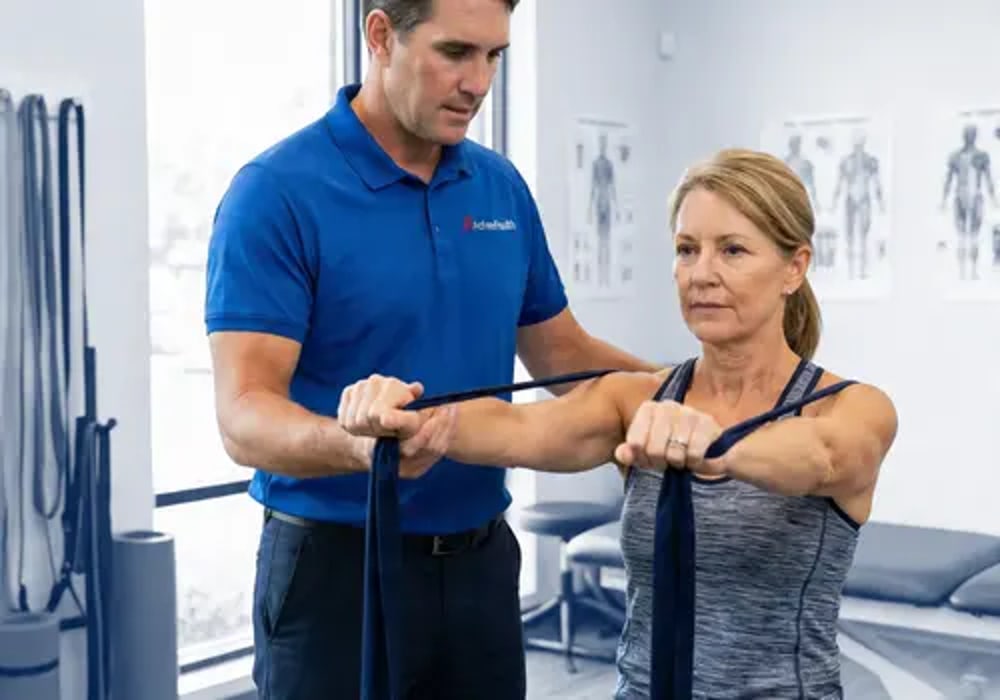
The body is designed to move well. When injury, surgery, poor posture, or years of compensatory movement patterns disrupt that design, pain and dysfunction follow. At Active Health, a physical rehabilitation center in Jacksonville, FL, we do more than help you recover. We work out why the problem developed and how to keep it from returning.
A shoulder that repeatedly tightens. A low back that constantly locks up. A hip that never fully stabilizes. These are not random events. They reflect predictable patterns in how your body organizes movement, and our Jacksonville rehabilitation team is trained to read those patterns and correct them at the source.
Whether you are recovering from surgery, returning to sport, or simply trying to get through a day without discomfort, the plan is built around your body, your goals, and the time you actually have.
How a Rehabilitation Program Is Built Here
Rehabilitation only works when the sequence is right. Nobody starts at the exercise sheet.
- Postural and structural analysis. We map where you are actually carrying load and how your alignment compares against the mechanics the joint was built for.
- Movement testing. Screening protocols, functional testing, and force analysis identify which mechanical inefficiency is producing the symptom, rather than which area happens to hurt.
- A corrective program with a real sequence. Corrective work first, then loading, then the demands of your job or your sport. Each phase has an entry requirement you have to meet.
- Reassessment, then progression. We retest instead of assuming. If a phase is not producing what it should, the program changes early rather than at the end.
Rehabilitation Services in Jacksonville
Three service lines carry the rehabilitation work at Active Health. They run together or stand alone, and the assessment decides which.
Postural and Structural Rehabilitation
Most pain conditions have a postural story. The program opens with a thorough postural analysis that maps your current alignment against optimal biomechanical benchmarks, then corrects the pattern that keeps loading the tissue that hurts. See how we approach alignment and spinal stabilization work.
Biomechanical Performance Labs
A clinical sports science approach to movement assessment. Movement screening protocols, force analysis, and functional testing identify the specific mechanical inefficiencies driving your symptoms or capping your performance. Explore movement analysis and functional testing.
Spinal Decompression Therapy
A motorized, traction-based therapy using computer-controlled tension patterns that cycle between distraction and relaxation, intended to lower pressure inside the disc and ease nerve compression across a course of sessions. Read about non-surgical decompression for disc-related pain.
Which of the three you start with is decided by what the assessment finds. Nobody here is put on a decompression table because it is in the building, or on a corrective program because it is the standard opener.
Conditions We Rehabilitate in Jacksonville
These are the presentations that most often reach the rehabilitation side of the Bowden Road clinic, usually after something quicker has already been tried.
Post-Surgical Recovery
The procedure repaired the structure. Rebuilding strength, control, and the confidence to load it is a separate job, and it is where compensation patterns quietly set in. We coordinate with your surgical team so the program matches your post-operative protocol. See how we handle recovery in the months after an operation.
Mobility Restrictions
Stiffness that stretching never seems to reach usually has a joint, tissue, or motor-control cause. The assessment identifies which one, then the program converts restored range into range you can hold under load. Start with why stiffness keeps coming back.
Muscle Sprains and Strains
A strain that was rested but never rehabilitated leaves a weak link behind. Progressive loading rebuilds tissue tolerance to the point where the movement that caused it stops being a risk. Read about strains that never fully recovered.
Tech Neck and Postural Strain
Neck, shoulder, and upper back pain that builds across a workday at a screen. Postural rehabilitation changes the alignment that keeps loading those tissues and trains endurance in the muscles that give out first. See screen posture and upper back strain.
Sciatica and Radiating Leg Pain
Disc-related leg pain often responds to reducing pressure on the nerve while the muscles around it are retrained to carry load properly. Decompression and corrective rehabilitation are used together rather than in sequence. Learn about nerve pain that travels down the leg.
How Structured Rehabilitation Compares With Your Other Options
Rehabilitation is slower than a prescription and less dramatic than an operation. It is also the option that changes the pattern. MedlinePlus notes that staying in bed for more than a day or two can make back pain worse, which is the principle underneath every program here: measured movement beats rest.
| Option | When it is the right call | The trade-off |
|---|---|---|
| Structured rehabilitation | Pain or weakness that keeps returning, recovery after surgery, and postural patterns that have been building for years. | It is measured in months rather than weeks, and the work you do between visits is most of it. |
| A generic exercise plan | Mild, recent stiffness in someone with no history of the problem, where general movement is genuinely enough. | It is not aimed at your restriction, so it tends to build strength around the problem instead of through it. |
| Medication alone | Short-term control while you get through a flare or reach the point where rehabilitation is tolerable. | It turns down the volume on the signal. Nothing about the loading that produced the signal has changed. |
| Surgery | Damage that imaging confirms and loading cannot change, such as a fracture that will not unite or a disc fragment sitting on a nerve. | It resets the structure and restarts the rehabilitation clock. The recovery work is not optional afterwards. |
Rehabilitation is not always the first move, and it is never the only one. If your presentation needs an imaging referral or a surgical opinion, you will hear that at the assessment.
Why Jacksonville Patients Choose Active Health for Rehabilitation
Jacksonville has plenty of rehabilitation options. What separates the work here is the depth of the movement analysis and the commitment to correcting a cause rather than calming a symptom. Our clinicians are trained to read the body as one connected system, so the assessment looks at the joints above and below the painful one as a matter of course.
We prioritize patient education in everything we do. You will learn how the pattern developed, how it is contributing to what you feel now, and which specific changes will produce lasting improvement. Patients who understand the reasoning behind a program are far more consistent with the home exercises, and consistency is what keeps the gains after discharge.
A rehabilitation program rarely runs alone. Hands-on tissue work, acoustic therapy, and medical input all sit in the same building, and your clinician can add any of them without sending you out for a new referral. That coordination is the point of our integrated pain control model in Jacksonville.
Insurance and Coverage
Active Health accepts a wide range of insurance plans for eligible physical therapy and rehabilitation services in Jacksonville, including Aetna, BCBS, United Healthcare, Tricare, Humana, UMR, and Medicare. Rehabilitation is usually the covered side of what we do. Call (904) 296-0202 before your first visit and we will check your plan's visit limits and what your share is likely to be.