
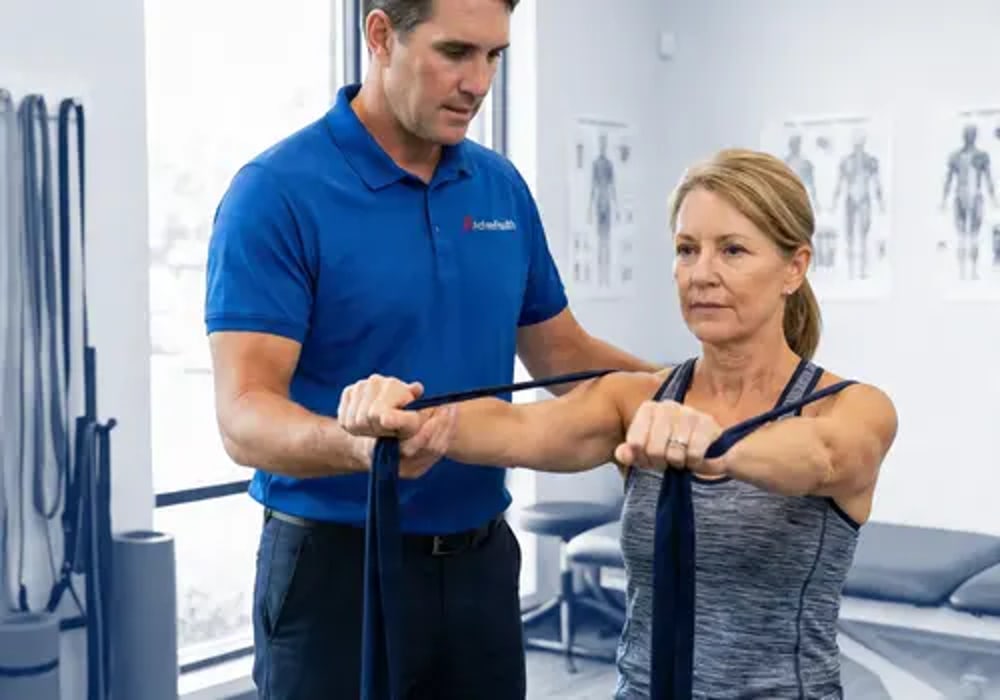
You want to keep running, playing golf or tennis, lifting at the gym, or walking the neighborhood. You want to do it without a sore knee or back deciding how far you get. Longevity medicine is care built around that goal: staying strong, mobile and active for the long run.
At Active Health the work starts with strength, balance and mobility. Recovery care keeps you training between blocks. When a joint, tendon or disc keeps interrupting the plan, a non-surgical option can be added where your evaluation shows it is indicated. Results vary from patient to patient.
It is the longevity side of the integrative medicine services at our Jacksonville clinic. Physical therapy, sports medicine and medical care share one roof there, on Bowden Road.
What Is Longevity Medicine?
Longevity medicine is care aimed at keeping you strong, mobile and active for the long run. At Active Health it pairs strength, balance and mobility training with recovery care. A non-surgical option for chronic joint, tendon or disc pain is added only where your evaluation points to one. Results vary.
How it works
- Evaluate. How you move, what hurts, and what you want to keep doing.
- Build the base. Strength, balance and mobility work, set to your level.
- Add support where it is indicated. Recovery care, and a tissue option if a joint, tendon or disc keeps getting in the way.
Who it helps
- Adults who want to keep running, lifting, golfing or walking for years.
- People whose knee, hip, shoulder or back keeps cutting workouts short.
Who it does not help
- Someone looking for a hormone program. This plan does not include one.
- A fall, a new injury or a sudden change in symptoms. See a physician first.
No biologic injection used at Active Health is FDA-approved for an orthopedic condition, and results vary from patient to patient.
Re-checked as you go. Progress is measured as the plan runs. When a measure stops moving, the plan changes.
What a Longevity Plan Can Include
Every plan starts with strength work and recovery care. The regenerative medicine options are added only where your evaluation calls for them.
Strength, Balance and Mobility Work
The National Institute on Aging advises older adults to combine aerobic, muscle-strengthening and balance exercise. It also advises stretching so joints keep their full range. Your sessions build on those, set to your level.
Recovery Between Training Blocks
Soft-tissue work, compression and guided loading help you recover between blocks. Compression uses Normatec boots or sleeves, about twenty to thirty minutes a session.
Spinal Decompression
For disc-related back or neck pain: a set protocol of 10 to 20 visits over six weeks, with 20 recommended. Never covered by insurance.
OmniWave Focused Shockwave
A focused shockwave device for tendon, fascia and joint pain that has stalled. Usually 6 to 12 sessions, and results vary.
PRP Injections
Growth factors concentrated from your own blood. Self-pay, and not FDA-approved for arthritis or tendon injury.
Umbilical Cord Tissue Injections
Donated umbilical cord tissue carrying growth factors and structural proteins, offered inside a rehabilitation plan for chronic joint and soft-tissue problems. Not stem cell therapy, not FDA-approved for these uses, and results vary. Read the FDA alert noting that no product of this kind is approved for an orthopedic condition.
Why Movement Comes First
Strength Keeps You Independent
NIA links strength training to keeping the strength you have and slowing the loss of muscle mass. It suggests at least two days a week.
Balance Work Helps Prevent Falls
Balance exercise helps prevent falls and fall-related injuries. NIA suggests about three sessions a week.
Every Other Option Needs the Base
A joint treated with an injection or shockwave still has to carry load afterward. Training puts that change to use.
How a Longevity Plan Compares With Other Options
Each route has a place. Which one fits depends on what your evaluation finds.
| Option | What it involves | When it fits | The trade-off |
|---|---|---|---|
| A staying-active plan | Strength, balance and mobility work plus recovery care. | Almost everyone, as the first step and the base for the rest. | Steady effort over months. Therapy is often insurance-eligible. |
| Non-surgical tissue options | Decompression, OmniWave, PRP or cord tissue, added to that plan. | A joint, tendon or disc that keeps flaring once the base work is in place. | Mostly self-pay, results vary, and each depends on the training after it. |
| Surgery or joint replacement | An operation to repair or replace a damaged structure. | A bone-on-bone joint, a complete tear, or nerve compression that is getting worse. | The right call in those cases, with a longer recovery and rehab after. |
| Medication management | Medicine for pain or inflammation, prescribed by a physician. | Pain that blocks sleep or keeps exercise from starting. | Eases symptoms for a while. It does not build strength or balance. |
Cases that need a surgeon are referred out.
Who a Longevity Plan Suits
This plan asks for regular effort, so fit matters.
Likely a good fit if
- You want to stay active for years and will do your part between visits.
- You would like to try a non-surgical route first.
- You want each added option and its cost explained before it starts.
Generally not the right fit when
- You want a guaranteed result, or a promise to change how you age.
- The joint is bone on bone. That is a replacement conversation.
- An active infection or a clotting disorder makes an injection unwise.
What to Expect When You Start
- Reach out. Call or book online. We will contact you within 24 to 48 hours to schedule and confirm your coverage.
- The evaluation. Your history and goals, a movement assessment, and any imaging you have.
- Your written plan. What each part is for, how often you come in, and the full cost before anything begins.
- Training and home work. Sessions build on each other, with exercises for the days in between.
Cost and Insurance for a Longevity Plan
A longevity plan mixes covered and self-pay care, so the cost depends on what goes into yours.
Active Health accepts Aetna, BCBS, United Healthcare, Tricare, Humana, UMR and Medicare for eligible physical therapy and rehabilitation services. Spinal decompression is never covered by insurance. PRP, umbilical cord tissue injections and OmniWave are self-pay.
Three things move the total: which parts you need, how many sessions each takes, and how many areas are treated. Call (904) 296-0202 and we will verify your benefits first.
Why Choose Active Health for Longevity Care
Dr. Jeffrey D. Lipp, DC, DACBSP, FIAMA, founded Active Health in 2005 and is its Founder & Owner. Physical therapy, sports medicine, rehabilitation and medical care share one address at 6500 Bowden Rd STE 200. A plan can move from strength work to recovery care to a tissue option without a new referral.
Each plan is built and re-checked with the medical clinic behind every longevity plan we write. The therapy team runs your training alongside it.