
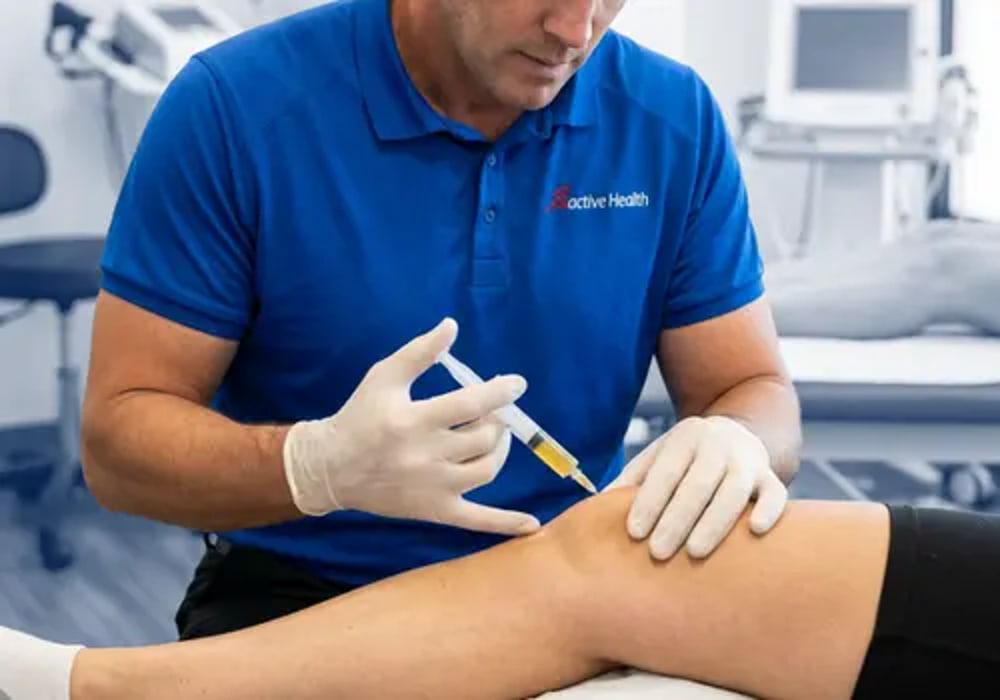
If you are managing chronic joint pain, inflammation that will not settle, or joint degeneration that is limiting your work or your training, a joint injection is one of the tools worth understanding properly rather than agreeing to on the spot.
A joint injection delivers a therapeutic agent straight into the affected joint space or the tissue around it, to lower inflammation, restore lubrication, or support a biological repair response. Which of those it does depends entirely on the type of injection and the condition being treated.
At Active Health an injection is neither a first default nor a standalone treatment. It is chosen when it fits the clinical picture, or when a specific tissue needs something delivered locally that a tablet cannot reach, and it is always scheduled alongside the rehabilitation that follows it.
What a Joint Injection Is
A joint injection places a therapeutic agent directly into a joint space or the soft tissue around it. The reason to do that rather than take something by mouth is reach: an oral anti-inflammatory circulates through the whole body and may never arrive at the joint in a concentration high enough to change what is happening inside it.
The word covers several different procedures with different jobs. A corticosteroid injection is aimed at acute or flare-phase inflammation. Hyaluronic acid, sometimes called viscosupplementation, is aimed at lubrication in an arthritic joint. PRP sits in a different category again, aimed at the biological environment rather than at the symptom, and it has its own page here because it needs a longer conversation than a comparison row.
The American Academy of Orthopaedic Surgeons sets out what a course of viscosupplementation for an arthritic knee involves, which is a useful picture of how any of these procedures actually goes. At Active Health every injection is performed or supervised by qualified medical staff, chosen from your diagnosis and imaging where it exists, and scheduled as part of a plan rather than as a standalone appointment.
Conditions We Treat With Joint Injections in Jacksonville
An injection earns its place when inflammation is blocking rehabilitation, or when a joint needs something delivered locally that a tablet cannot reach.
Chronic Joint Pain
Persistent pain in one joint usually combines cartilage loss, inflammation in the joint lining and degenerative change, in a proportion that differs from person to person. Working out which is dominant is the first job, since only some of the answers are an injection. See how we approach a joint that flares faster than it settles.
Osteoarthritis
An arthritic joint with poor lubrication and a painful, restricted range is the classic case for viscosupplementation, most often in the knee. It is a symptom-directed treatment and makes no claim on the disease process. Start with an arthritic knee where lubrication is the problem.
Inflammation Control
Inflammation inside a joint that never resolves keeps the tissue in a state where repair does not finish. Bringing it down is often what makes the rest of the plan possible at all. Read about inflammation that keeps a joint too sore to load.
Neuropathy With a Local Inflammatory Driver
Some nerve symptoms are worsened by inflammation or compression in a nearby joint rather than by the nerve alone. Where the assessment finds that, a targeted injection can lower the local irritation while the nerve-directed work continues. See nerve symptoms driven by local joint inflammation.
One narrower use is worth stating plainly: where chronic fatigue has shrunk the day and a single joint is doing most of that damage, an injection aimed at that one joint removes an identifiable drain, which is a different thing from treating the fatigue itself.
What a Joint Injection Appointment Involves
Nothing is injected at a first visit. The sequence exists so the choice is made on findings.
- Evaluation. Which joint, what stage, what has already been tried, and what you need to be able to do again. Imaging is reviewed where it exists.
- Choosing the type. Corticosteroid, hyaluronic acid or a regenerative option are different tools for different problems, and the answer is sometimes none of them.
- The injection. Placed under sterile technique by qualified medical staff. Most people describe discomfort similar to a blood draw, and an inflamed joint can be briefly more sore for a day or two afterwards.
- The window, then the work. The rehabilitation is booked before the injection is given, because the point of lowering the pain is to make loading possible while it is down.
How the Injection Types Compare
Five honest options for a painful joint, including doing nothing invasive at all and the one thing we do not perform. Results vary in every row.
| Option | When it is the right call | The trade-off |
|---|---|---|
| Corticosteroid injection | Pain high enough to block sleep, or high enough that rehabilitation cannot start at all. | Dependable short-term relief that does not change the mechanics producing the pain, and repeated use in the same joint is not a long-term plan. |
| Hyaluronic acid, or viscosupplementation | Arthritic knee pain where relief is the goal and repeated steroid injections are being avoided. | It supplements joint fluid rather than acting on the tissue, so it makes no claim on the disease process. |
| A regenerative injection, such as PRP | Cases where the goal is the biological environment of the joint rather than the pain signal, and time is available to wait for it. | An emerging therapy with a developing evidence base, and not a quick answer to a flare. |
| Rehabilitation with no injection | Most joint pain, and the default here whenever the joint can tolerate loading without help. | It takes weeks and it takes your effort. A joint too painful to load will stall on it. |
| Joint replacement surgery (not performed here) | End-stage damage where function is largely gone and conservative options are genuinely exhausted. | Major surgery with a long rehabilitation, and a decision you cannot walk back. |
The first row is the one most people arrive holding. A steroid injection that helped less each time is not a sign that injections have failed; it usually means the joint was quietened and never reloaded.
Why Jacksonville Patients Choose Active Health for Joint Injections
Most people who ask about an injection here have already had a series of them somewhere else. No rehabilitation in between, no explanation of what was driving the pain, and no plan for what happens when the relief runs out. That pattern is what we try not to repeat.
The injection type is selected from your diagnosis, your staging and your goals, whether that is a corticosteroid to open a rehabilitation window, viscosupplementation for lubrication, or a regenerative medicine option aimed at the tissue environment. Which of those, if any, is a clinical call made at the medical clinic that supervises the injection rather than a menu you pick from.
Progress is then reviewed. If the joint is responding as expected the plan advances, and if it is not, the approach changes early rather than after a third injection. That review only works because the injection is scheduled inside the rehabilitation plan the injection is timed around.
Insurance and Coverage
Coverage depends on which injection you are having. Corticosteroid and hyaluronic acid injections are often eligible under medical benefits, subject to your plan's criteria for the joint being treated. PRP is generally not covered, since most plans classify it as an elective regenerative therapy, and that is true almost everywhere rather than only here. Active Health accepts Aetna, BCBS, United Healthcare, Tricare, Humana, UMR, and Medicare for eligible services, and the rehabilitation around an injection is usually the covered part of the plan. Call (904) 296-0202 and we will verify your benefits and tell you which parts of a proposed plan your policy will pay for before anything is scheduled.