
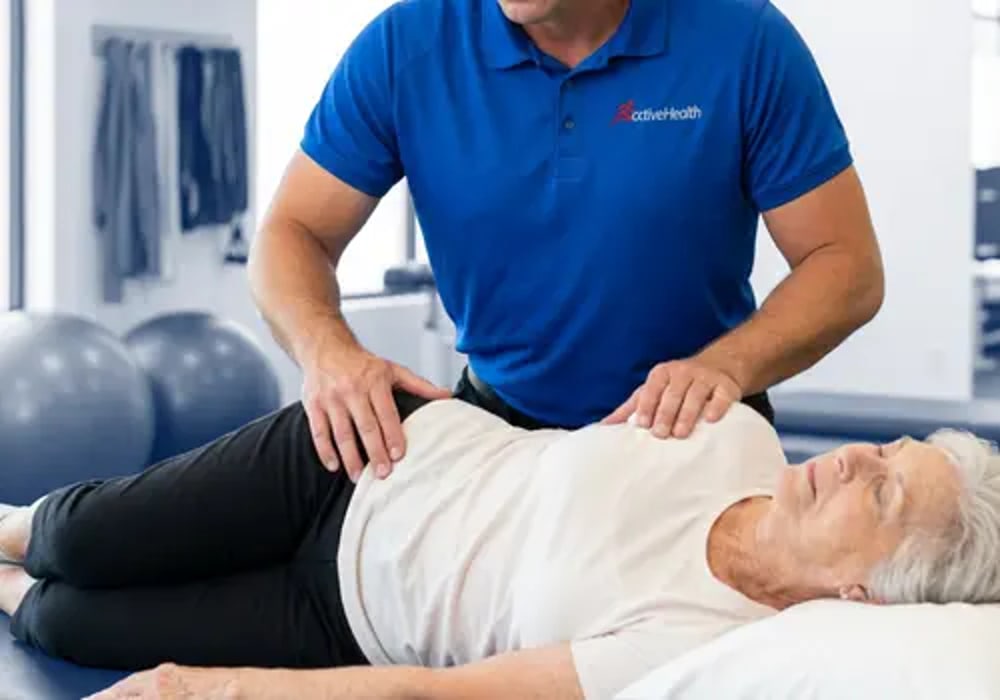
Hip bursitis is pain on the outside of the hip, where the gluteal tendons and bursa sit over the thighbone's bony point. A hip labral tear damages the cartilage rim of the hip socket and is felt deep in the groin. Active Health in Jacksonville, FL treats both with loading-based physical therapy, mobility work and PRP for a stubborn tendon.
It hurts to lie on that side at night. Stairs, getting out of the car and the first steps after sitting all set it off. Or the pain sits deep in the groin, and the hip clicks or catches when you pivot.
Those are two different problems that share one word, and a hip can have both. Each one needs its own plan.
At the physical therapy side of our Bowden Road clinic, a hip evaluation sorts out which structure hurts and what keeps loading it. Your plan is written down at the first visit, with the positions to avoid and the exercises to start.
Understanding Hip Bursitis and Labral Tears
Hip bursitis is pain and tenderness over the greater trochanter, the bony point on the outside of the hip. The gluteal tendons that attach there are usually part of it, which is why it is also called gluteal tendinopathy or greater trochanteric pain syndrome. A labral tear is different: damage to the cartilage rim of the hip socket.
Side-of-hip pain is common. A randomized trial in The BMJ reports that gluteal tendinopathy, often called trochanteric bursitis, affects one in four women over 50, and that its effect on daily life matches severe hip osteoarthritis.
- The tendons get squeezed. Positions that pull the thigh across the body press the gluteal tendons against the bone.
- Load outruns strength. A jump in walking, running or stairs asks more of the tendons than weak hip muscles can back up.
- The area turns sensitive. Pressure, lying on that side and standing on one leg all start to hurt.
Pain on the Outside of the Hip
Points to the gluteal tendons and the bursa beside them. It often spreads down the outer thigh and is worst at night and on stairs.
Pain Deep in the Groin
Points to the joint itself, often the labrum. Clicking, catching and pain when the hip turns are the usual clues.
Hip pain does not always start in the hip. Hospital for Special Surgery notes that hip pain can come from the spine, the pelvis or the leg, and that labral tears are often misdiagnosed as a common groin strain. Your evaluation checks the lower back before it treats the hip.
Signs Your Hip Pain Is Bursitis or a Labral Tear
Symptoms differ with the structure involved, and some hips have both, so note every one that fits.
- Pain on the outside of the hip, over the bony point
- Pain when you lie on that side at night
- Tenderness when you press on the outside of the hip
- Pain climbing stairs or standing on one leg
- Soreness after sitting with your legs crossed
- Deep groin pain, or buttock pain on the same side
- Clicking, locking or catching as the hip moves
- Pain when the hip rotates, as in pivoting or getting out of a car
- Stiffness when you move the hip
What Causes Hip Bursitis and Labral Tears
The side-of-hip problems and the groin problems have different drivers. Five account for most of them.
Compression Against the Bony Point
Positions that pull the thigh across the body, such as crossed legs, press the gluteal tendons against the bone. Lying on the sore side presses on them directly. The education in the BMJ trial focused on avoiding positions like these.
Weak Hip Abductors Meeting a Sudden Load
The gluteus medius and minimus steady the pelvis every time you stand on one leg. When they are weak and your walking, running or stair count jumps, the tendons take load they are not ready for.
Repeated Hip Flexion and Impact in Sport
Runners and athletes in hockey, soccer and football bend and load the hip thousands of times a season. Hospital for Special Surgery lists that repetition, and sudden impact, among the common causes of labral tears.
Hip Shape and Impingement
In femoroacetabular impingement, the ball or the socket is shaped so the two make contact at the end of range. Deep squats and pivots then pinch the labrum against bone, which makes a tear more likely.
Wear That Comes With Hip Arthritis
Osteoarthritis thins the cartilage inside the hip, and HSS names it as a condition that leaves the labrum more likely to tear.
How We Treat Hip Bursitis and Labral Tears in Jacksonville
Treatment starts by taking the compression off the tendons and calming the joint. Hip abductor and trunk strength is then built in a set order, and mobility work restores range that does not pinch the labrum. For a gluteal tendon that has not settled after a loading program, PRP is an elective option on the medical side of the practice.
Therapeutic Exercise
Strength is what lets the tendon take load again. Progressive hip abductor strengthening, dosed to what the tendon tolerates, starts with holds that do not squeeze the tendon and builds to single-leg work and stairs. For a labral tear, the same approach trains the deep hip and trunk muscles that steady the joint.
Active Recovery and Mobility
Some common hip stretches pull the leg across the body and press the tendons harder against the bone. Hip mobility work chosen to avoid the positions that pinch or compress restores rotation and extension without provoking the tendon or the labrum. Work starts in the directions that do not hurt.
PRP Therapy
When a gluteal tendon is still painful after a loading program you actually followed, a platelet-rich plasma injection for a tendon that has stalled is the next step to discuss. It is self-pay, it is not FDA-approved as a treatment for tendon injury, and results vary. Loading work resumes after the injection, and the result depends on it.
Hip Bursitis and Labral Tear Options Compared
Five options are worth weighing for side-of-hip and groin pain.
| Option | When it is the right call | The trade-off |
|---|---|---|
| Loading-based physical therapy at Active Health | First line for side-of-hip pain, and for a labral tear that hurts but is stable. | It takes weeks of visits and home work, and the positions you avoid matter as much as the exercises. |
| Rest, ice and anti-inflammatories | A short flare, or getting through the first painful week. | Rest does nothing for weak hip muscles, so the next jump in activity can bring the pain back. |
| Cortisone injection | Pain bad enough to stop sleep or block the start of rehab. In the BMJ trial, 38 of 65 people reported success eight weeks after one injection, against 51 of 66 after education and exercise. | At one year the injection group still trailed on overall improvement, though pain scores had evened out. |
| PRP at Active Health | A gluteal tendon that has stalled after a loading program you followed. | Self-pay and elective, response varies, and it still needs the loading work after it. |
| Hip arthroscopy (not performed here) | A severe labral tear, or one that still hurts after a full course of nonsurgical care. | An operation, then crutches for two to six weeks according to HSS, then rehabilitation. |
Hip arthroscopy and other orthopedic surgery are not provided at Active Health. If your exam points that way, you hear it at the evaluation and we help you find the right surgeon.
How Long Hip Bursitis and Labral Tear Recovery Takes
Hip plans run in four phases. Each one has a test you pass before the next one starts.
- OffloadDrop the positions that squeeze the tendon or pinch the joint, and settle the night pain.
- ActivateGluteal holds that build strength without pressing the tendon against the bone.
- StrengthenAbductor and trunk loading, raised each time a retest says it is ready.
- ReturnStairs, single-leg work and the activity you came in to get back.
For scale, the program tested in the BMJ trial ran 14 physical therapy sessions over eight weeks. HSS puts recovery from a torn labrum, with or without surgery, at up to six weeks, with competitive athletes back in sport between two and six months.
Results vary with the structure involved, how long it has hurt and how consistently the home work gets done.
Who Treats Your Hip at Active Health
Dr. Christopher Brown, a Doctor of Physical Therapy, has been with Active Health since 2013, and the clinic has treated Jacksonville patients since 2005. Hip plans here start with what loads the hip in your week: the stairs at home, the drive, the run or the round of golf.
The hip plan is one part of a clinic that keeps physical therapy and medical care under one roof. If a stalled tendon needs a PRP conversation, it happens in the same building as the loading work that follows it.