
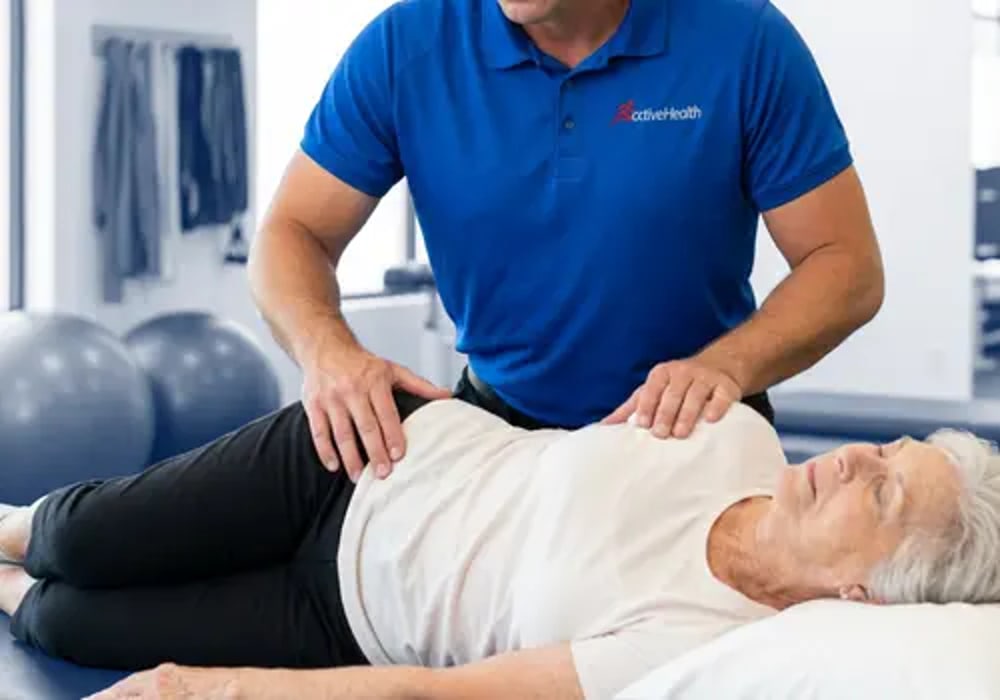
A mobility restriction is lost range with a specific cause: a tight joint capsule, fascia that has stopped gliding, a nerve that cannot move freely, or a nervous system limiting the range it allows. Stretching only addresses muscle length, which is why so much of it fails. Active Health identifies the mechanism first, then treats it, in Jacksonville, FL.
It starts small. The shoulder that no longer reaches the back seat. The hip that will not let you squat down to the bottom shelf without leaning. The neck that turns further one way than the other.
Then it accelerates, because a restriction in one place is paid for somewhere else. You have probably been told to stretch more. If four to six weeks of honest stretching has not moved it, the limit is not muscle length, and more of the same will not find it.
At the physical therapy team on Bowden Road, a mobility evaluation measures the range and tests which of the four mechanisms is holding it. You leave the first visit with a written plan and a number to beat.
What Is Actually Limiting Your Range of Motion
A mobility restriction is a loss of range that has a specific cause, and there are four candidates: a tight joint capsule, fascia and soft tissue that has stopped gliding, a nerve that cannot move freely in its sleeve, or a nervous system limiting the range it will let you into. Each responds to something different.
Harvard Health puts the case for stretching plainly: flexibility is what maintains a range of motion in the joints, and without it muscles shorten and tighten. That is true, and it is why stretching belongs in almost every plan. It is also the ceiling on stretching, because it only describes the muscle-length half of the problem.
The other half is why so many people stretch for months and finish where they started. A shortened muscle answers to stretching. A fibrosed joint capsule does not, however long you hold it. Neural tension worsens when it is stretched hard, since the nervous system tightens its guard. Motor control is not about length at all: the range is there and the system will not let you use it under load.
Telling those four apart is the point of the first visit, and it decides whether your plan is hands-on work, capsule mobilization, nerve gliding, strength in the new range, or a combination.
Signs a Mobility Restriction Is Affecting Your Function
Restrictions rarely announce themselves. They show up as things you have quietly stopped doing, and these are the ones worth an evaluation at Active Health.
- Difficulty reaching overhead, across your body, or behind your back
- Hip, knee or ankle restriction that limits squat depth or makes stairs awkward
- Neck stiffness that reduces how far you can turn to check a blind spot
- Persistent tightness that returns within hours despite regular stretching
- A clear difference between left and right side range of motion
- Pain that arrives only at the very end of a movement
- Compensating to get a task done: leaning, twisting or hitching to reach
- Range that is still shrinking despite everything you have tried on your own
Common Causes of Mobility Restrictions
Five drivers account for most restricted range at Bowden Road, and they usually arrive stacked rather than alone.
Fascial Adhesions and Soft Tissue Fibrosis
Adhesions form after injury, after surgery, under postural load and during long spells of not moving. Layers of tissue meant to slide across each other stop doing it, which is why the restriction is so often felt somewhere other than where it started.
Joint Capsule Tightness
The capsule surrounding a joint can thicken in response to inflammation, immobility or surgical scarring, and it then limits passive range independently of muscle length. Johns Hopkins Medicine describes the shoulder version directly: as the capsule folds become scarred and tightened, shoulder movement becomes restricted, which is adhesive capsulitis. This is the mechanism behind a shoulder that will not go overhead however diligently you stretch it.
Neural Tension and Restricted Nerve Glide
A nerve has to slide through its tissue envelope as you move. When adhesions or irritation stop that, the nervous system limits the range to protect it. Missed neural tension is one of the most common reasons persistent hamstring tightness, calf restriction and neck stiffness resist ordinary stretching.
Occupational and Postural Loading
Long hours seated, overhead work and repetitive one-sided loading each produce their own restriction pattern, and time off does not reverse them. The Deerwood and Southside desk corridors deliver hip flexors and thoracic spines that have been in one shape for nine hours a day.
Old Injuries That Were Never Finished
The most common driver in active adults is a stack of partly rehabilitated injuries, each leaving residual adhesion and an altered movement pattern. They compound. The ankle you walked off ten years ago is often part of why the knee above it is stiff now.
How We Treat Mobility Restrictions in Jacksonville
Treatment works in a strict order. Hands-on work opens the range that tissue and joint restriction have taken, then strength and control work inside that new range convinces the nervous system it is safe to keep. Range restored without control is borrowed, and it goes back within weeks.
Active Recovery and Mobility
The assessment looks at more than where range stops. It looks at how you move through the range you do have and where the compensation appears. Mobility programming that is progressed alongside motor control work then runs the sequence: restore the passive range, build control inside it, then put it into the movements the range was lost in.
Manual Soft Tissue Therapy
Where the restriction is tissue-level, it responds to hands. Instrument-assisted work, joint mobilization and myofascial release target the specific structures identified in the assessment. Manual work is aimed at an immediate, measurable change in range; that gain is temporary on its own, which is why the exercise half is not optional.
Active Release Techniques
Some adhesions only give way when the tissue is moving. Hands-on contact held while you actively take the limb through range creates shear between tissue layers and restores nerve glide with a precision passive techniques cannot match. It is the tool of choice where a nerve or a specific layer of fascia is the problem.
Therapeutic Exercise
New range has to be defended. Strength work built at the end of your newly available range is what stops the nervous system quietly reasserting the old limit. This is the difference between a shoulder that reaches overhead on the treatment table and one that still reaches overhead in March.
Biomechanical Performance Labs
Range is easy to guess at and easy to imagine improving. Measured joint angles and side-to-side comparison put numbers on the starting point and repeat them at each phase, which is how you separate a genuine structural change from a good day and a warm room.
Recovery and Realistic Timelines
Every plan moves through the same four phases, and you are told which one you are in at each reassessment.
- Find the mechanismCapsule, tissue, nerve or control, measured rather than assumed.
- Open the rangeHands-on work aimed at the structure actually holding it.
- Own the rangeStrength and control built at the new end range.
- Put it back to workInto the movements and the job the range was lost in.
Many patients notice a measurable change within the first few sessions, since tissue-level restrictions often move quickly. Longer-standing and multi-tissue restrictions commonly need 6 to 12 weeks for a result that holds. Results vary with which mechanism is involved, how long the range has been missing, and whether the between-visit work gets done.
The measure that matters is not the range at the end of a session. It is the range at the start of the next one, which is why the number gets taken every time.
Expert Mobility Care in the Jacksonville Area
Jacksonville makes mobility a daily requirement rather than a gym metric. Ortega boats need shoulders that reach and rotate, San Jose has multi-generational households where a hip that will not flex is a stairs problem, and the Southside corridor spends nine hours a day teaching bodies to be one shape.
Plans here are built around the movements you actually have to make. Mobility work sits inside a practice that owns the strength half of the plan as well as the hands-on half, so the range that gets opened has somewhere to go.