
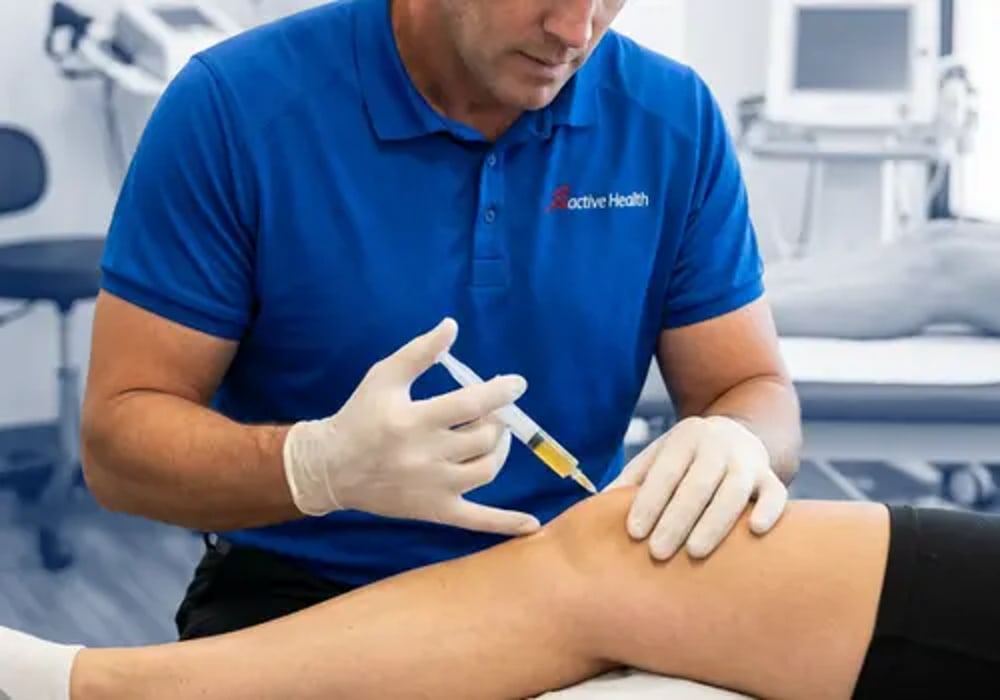
Peripheral neuropathy is damage to the nerves outside the brain and spinal cord, and it shows up as burning, numbness, tingling or weakness that usually starts in the feet. Active Health treats it in Jacksonville, FL with acoustic wave therapy, hands-on nerve release and medically supervised injections, aimed at the circulation and compression behind the symptom. Same-week evaluations, no referral needed.
Neuropathy starts quietly. A tingle at night, a burning that arrives when you sit down, then a numbness that changes how you walk before you have noticed it. Most Jacksonville patients are handed a prescription for the pain signal and nothing for the reason it is firing.
By the time people call us, the sentence is usually some version of: they told me this is just what happens now. That is worth pushing back on, because nobody has told you which of the five drivers is yours.
At our Jacksonville medical clinic, a neuropathy evaluation starts with that question. You leave with a written plan and a straight answer about what is likely to improve and what is likely to be managed.
Understanding Peripheral Neuropathy
Peripheral neuropathy is damage to the nerves that carry signals between the spinal cord and the rest of the body. It is a symptom of something else, not a diagnosis on its own, which is why the useful first question is what is damaging the nerve rather than which drug quiets it.
The National Institute of Neurological Disorders and Stroke describes peripheral neuropathy as a group of conditions affecting millions of people in the United States, with more than 100 recognized types. Most are length-dependent, so the longest nerves fail first and symptoms start in the feet.
Gabapentin and duloxetine reduce the pain signal. They do not change circulation, free a compressed nerve, or correct a vitamin deficiency, so the driver keeps working underneath. NINDS notes that when the underlying cause is corrected, nerves can recover and regrow, which is the argument for identifying that cause first at our pain control clinic in Jacksonville. Some neuropathy improves, some is managed rather than reversed, and you are told which conversation you are in.
Common Symptoms of Neuropathy
Symptoms depend on which fibers are affected. These are the presentations we evaluate at Active Health.
- Burning or electric pain in the feet, legs, hands or arms
- Numbness or a dead, padded sensation in the extremities
- Persistent pins and needles at rest, with nothing setting them off
- Hypersensitivity, where a bedsheet or a sock is enough to hurt
- Balance problems and a rising sense of being unsteady on stairs
- Muscle weakness in the feet or hands, or a foot that slaps when you walk
- Pain that is reliably worse at night and interrupts sleep
- Cramping or visible twitching in the calves and feet
What Damages Peripheral Nerves
Five drivers account for most of what we see at Bowden Road, and they call for genuinely different plans. Separating them is the point of the first visit.
Diabetic and Metabolic Nerve Damage
Elevated blood glucose damages the small vessels feeding peripheral nerve fibers, so the nerve is starved of oxygen first. NINDS names diabetes as the leading cause of peripheral neuropathy in the United States, and prediabetic patients can already show changes.
Poor Circulation and Vascular Insufficiency
Peripheral nerves need a constant blood supply. Peripheral artery disease, hypertension and chronic venous insufficiency all reduce flow to the most distant fibers first, which is why the feet complain first.
Chemotherapy-Induced Neuropathy
Several chemotherapy agents are directly toxic to nerves, and the burning, numbness and weakness can persist long after treatment ends. Care is aimed at the recovery environment: circulation, inflammatory load, and lost balance.
Spinal Compression and Nerve Entrapment
A disc, a narrowed nerve opening, or soft tissue thickened around a nerve can compress it on its way to the limb. This group is mechanical, it affects one nerve territory rather than a stocking pattern, and it responds to changed mechanics.
Nutritional Deficiency
B12, B6 and folate are required to build and maintain the myelin around a nerve fiber. Deficiency is common in patients on long-term metformin or proton pump inhibitors, it is cheap to test for, and it is routinely missed.
How We Treat Neuropathy in Jacksonville
Treatment starts with identifying what is damaging the nerve, because circulation, compression, chemotherapy and vitamin deficiency need different plans. From there we combine acoustic wave therapy over the affected nerve territory, hands-on release at the common entrapment points, and medically supervised injections where inflammation or compression is dominant.
Omniwave Therapy
The fibers in a neuropathic foot sit in tissue with poor perfusion, and the cells that maintain myelin depend on it. Acoustic wave sessions delivered over the affected nerve territory aim at improving local circulation and supporting repair. Sessions are non-invasive and need no recovery time. Response varies, and we reassess rather than assume.
Manual Soft Tissue Therapy
Where a nerve is being squeezed, no medication changes the squeeze. Hands-on work that frees entrapped nerves at the common compression points restores the nerve's ability to glide inside its tissue envelope, which is usually what makes the difference in the calf and the forearm.
Shockwave Therapy
Where circulation is the dominant limitation in a lower limb, your clinician may add focused acoustic wave treatment aimed at the vascular supply around a nerve pathway. It runs alongside the rest of the plan, and it is the wrong tool where the driver is a vitamin deficiency.
Medically Supervised Injections
When inflammation or compression leads, our medical team can place precision-guided injections supervised by our medical staff to reduce the inflammatory burden around an irritated nerve. It is one part of a plan, offered where the evaluation supports it, with its costs stated plainly.
How Your Neuropathy Options Compare
Neuropathy has real alternatives, and two of the four below are not delivered here. This is an honest read on each.
| Option | When that is the right call | The trade-off |
|---|---|---|
| Conservative care at Active Health | Where circulation, entrapment or inflammation is a real part of the picture and you want something aimed at the tissue rather than the signal. | It takes weeks, it does not suit every cause, and long-standing fiber loss may not reverse. |
| Nerve pain medication | Useful when pain is loud enough to block sleep or stop you starting anything else. | It quiets the signal, leaves the driver in place, and the side effects are real. |
| Treating the medical cause (not performed here) | First line, and often the highest-value step: glucose control, B12 correction, thyroid and kidney workup. | It belongs with your physician, and correcting it does not undo damage already done. |
| Surgical decompression (not performed here) | Appropriate for a single trapped nerve. NINDS notes that most neuropathies involve scattered damage and are not helped by surgery. | Wrong tool for a stocking-pattern neuropathy, and irreversible. |
Nerve blocks and spine surgery are not performed at Active Health. One more point worth knowing before anyone offers it: NINDS states that opioids are not recommended for pain related to peripheral neuropathy.
Recovery and Realistic Timelines
Every plan moves through the same four phases, and you are told which one you are in at each reassessment.
- Find the driverHistory, exam and the bloodwork your physician should already have.
- Change the environmentCirculation, entrapment and inflammatory load, in that order.
- Rebuild what went quietBalance, calf and foot strength, and confidence on stairs.
- Protect the feetDaily checks, footwear, and a plan for the next flare.
Patients who respond often notice a change in the first 3 to 6 weeks, usually in night pain first. Longer-standing cases are commonly a 3 to 6 month conversation. Results vary with the cause, how long the nerve has been under load, and whether the medical driver is being managed alongside what we do.
Watch the quality of the symptom, not its volume. Numbness retreating from the mid-calf toward the ankle is progress even in a week when the burning has not moved.
When to Seek Care Right Away
Most neuropathy is not an emergency. A small number of presentations are, and they belong with a physician or an emergency department first.
Go to an emergency room now
Weakness spreading or worsening by the day cannot wait. NINDS describes Guillain-Barre syndrome, in which the body's immune system mistakenly attacks the nerves, and rapidly progressive weakness is how it presents.
- Weakness that is climbing from both feet upward over hours or days
- New weakness in both legs, or weakness that is measurably worse than yesterday
- Any trouble breathing or swallowing alongside new limb weakness
- Sudden severe numbness or weakness down one side, a facial droop, or trouble speaking, which are stroke signs
- A foot wound that has turned black or started to smell
Do not wait for an appointment with us, and do not wait until morning.
See a physician before starting conservative care
If you have diabetes, the feet get their own rules. NIDDK lists the foot changes that mean calling your health care professional right away, and a numb foot will not warn you.
- A cut, blister or bruise on the foot that has not begun to heal after a few days
- Skin on the foot that becomes red, warm or painful, which can signal infection
- A callus with dried blood inside it, which can be the first sign of a wound underneath
- Numbness that appeared suddenly, or after starting a new medication
- Neuropathy with no diagnosed cause, which needs bloodwork before treatment
Everything outside those two lists is where a conservative plan starts.
Expert Neuropathy Care in the Jacksonville Area
Deerwood, San Jose and Ortega send us two groups: patients in their sixties and seventies handed a prescription and no explanation, and people still working who cannot afford to be unsteady on a ladder or a boat deck. Heat matters here too, since patients report their symptoms track the humidity, so a plan built in February should account for August.
Neuropathy care is one part of the pain control clinic that coordinates the rest of your care, so the balance work, the hands-on treatment and the medical side sit in one building.