
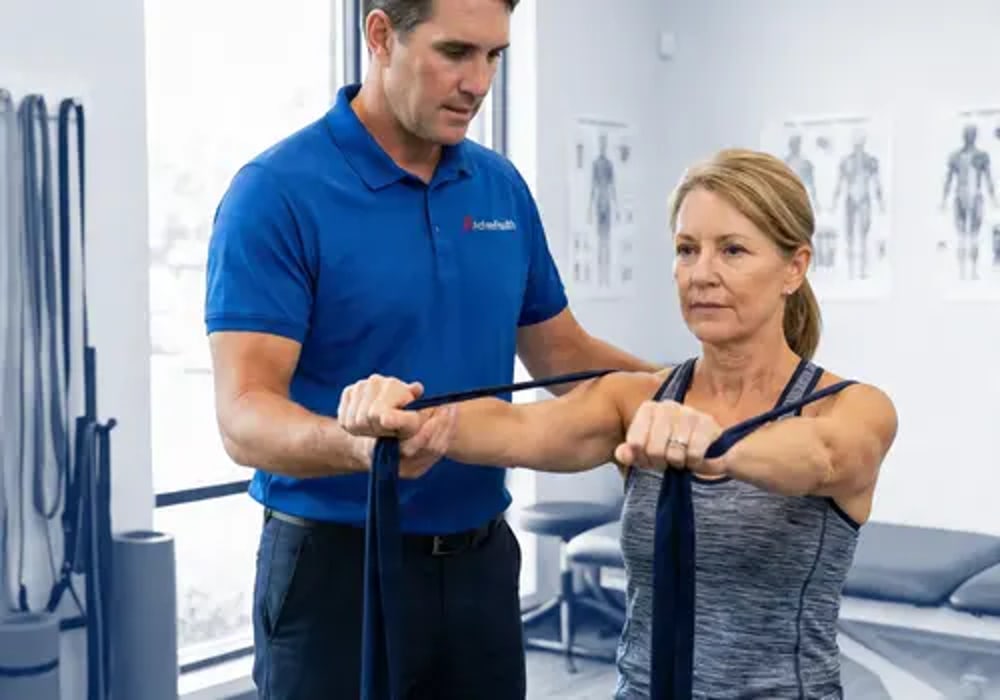
If you keep getting injured in the same place, the problem is usually not the tissue that hurts. Many patients arrive at Active Health after cycles of treatment, relief and reinjury that never got to why the pattern keeps repeating.
A Biomechanical Performance Lab is systematic, data-informed movement analysis. It identifies the specific faults in how your body moves, the joint restrictions, the asymmetries, the motor control deficits and the loading patterns that raise injury risk, cap performance and keep pain going after the original tissue damage has healed.
What comes out of it is a short, ordered list of what has to change and in what sequence, which then becomes the rehabilitation plan. You leave the appointment knowing what was measured, what it means and which finding is being treated first.
What a Biomechanical Performance Lab Involves
A Biomechanical Performance Lab is a structured movement assessment. It uses movement screening protocols, force analysis and functional testing to map joint mobility, side-to-side asymmetry, how load is distributed and where motor control breaks down. It is an analysis of movement rather than a panel of any kind, so there is no bloodwork attached to it.
The assessment looks across the whole chain instead of at the painful area. Knee pain during running may be produced by hip weakness and a stiff ankle. A shoulder that keeps failing in a throwing athlete often traces back to the thoracic spine and how the shoulder blade moves. Finding those connections is the point, and putting a number on each one is what lets corrections be sequenced instead of attempted all at once.
Those numbers have to be produced carefully to be worth anything. The StatPearls chapter on goniometry is direct that the same testing position has to be reproduced for successive measurements to be comparable, and equally direct that the profession has not settled how far a single measurement can be trusted on its own. That is why the lab is used to build and adjust a plan, not to hand anyone a risk score.
Conditions We Support With Biomechanical Assessment in Jacksonville
Assessment earns its place when the question has stopped being what hurts and started being why it keeps happening.
Whiplash Recovery
A collision loads the neck faster than the muscles can brace for it, and what is left behind is rarely obvious from symptoms alone. Testing the cervical spine and the segments around it identifies which parts of the neck's movement system the impact disrupted, which is what the corrective program is then built from.
Tech Neck and Postural Strain
Forward head position from screen work loads the neck and takes range off the shoulder, and the two travel together. Evaluating the whole postural chain rather than the sore segment produces a postural chain that has to be corrected as a whole instead of a list of stretches for the part that aches.
Mobility Restrictions
Stiffness that will not settle is easier to treat once it has been quantified and compared against the other side, because that is what separates a genuine restriction from pain and guarding. Start with restriction measured rather than estimated.
Chronic Fatigue
Fatigue is judged by feel, which makes a good week hard to tell from real change. Baseline testing of strength and walking capacity puts numbers that separate real progress from a good day on the record, and repeating them is also how we find out early that a plan is not being tolerated. Testing here is deliberately light and never a provocation.
What a Lab Assessment Looks Like
One appointment, then a plan you can read. Wear something you can move in, and bring your sport shoes if the movements will be sport-specific.
- History and the question. What keeps happening, at what threshold of activity or duration, and what has already been tried on it.
- Screening and testing. Movement screening protocols, functional testing and force analysis across the chain, with strength and range compared side to side and recorded so they can be repeated the same way later.
- The findings, explained. We walk you through what was found and what it means before any recommendation is made, including which findings we think matter least.
- Priorities and a program. Corrections are ordered by what is most likely to change the pattern, and the findings feed directly into the rehabilitation plan rather than sitting in a file.
- Retest. The same measures are repeated at set intervals to check that corrections are holding under increasing load. Results vary, and where they are not holding, the program changes early rather than at the end.
Sports Injury Prevention Screening
The same lab can run before anything is injured. For an athlete heading into a season, a prevention screen uses the movement screening, force analysis and side-to-side testing described above to find what is worth fixing now, such as a side producing less force or a joint losing control under load. It is then paired with conditioning aimed at exactly those findings.
The result is not a prediction. It shows where your movement is short.
Why Jacksonville Patients Choose Active Health for Movement Assessment
A lot of patients have been treated for years without their movement ever being properly assessed. Pain location and history alone often cannot explain why a symptom keeps returning at the same threshold, and the treatment that follows ends up aimed at the site of the complaint rather than at whatever keeps producing it.
What makes the assessment worth doing here is that it is the foundation of the plan rather than a service sold beside it. Correction priorities, therapeutic exercise selection, loading decisions, the sequencing of hands-on and acoustic work, and whether spinal decompression belongs in the plan at all, follow from what the testing found, inside the rehabilitation center the findings feed into. An assessment nobody acts on is an expensive report.
It is also worth being plain about the limits. A movement screen is not a prediction, a good score does not make anyone injury-proof, and a poor one does not mean an injury is coming. What the testing gives you is a specific, repeatable picture of where your movement is short, which is enough to build a program on. That is the standard the practice that has to act on what the assessment finds holds itself to. Movement testing is a physical medicine and rehabilitation tool rather than a performance product, so an assessment carried out inside a rehabilitation plan is usually covered, and we verify your benefits before you book.