
Tennis elbow is tendon pain on the outside of the elbow, and golfer's elbow is the same problem on the inside. Both build up from repeated gripping that wears the tendon where it attaches to bone. Active Health treats both in Jacksonville, FL with focused shockwave, PRP injections and forearm strengthening, and no referral is needed.
It may have started as a twinge when you lifted a gallon of milk or shook a hand. Now it shows up on the backhand, the first swing at the range, or the last hour of a day spent on a mouse or a wrench.
You have probably tried the strap, the ice and a few weeks off. The ache fades, then returns the first time you grip something hard, because rest does little for a tendon that has to grip again on Monday.
Our sports medicine team for elbow and forearm overuse starts the evaluation with where it hurts, outside or inside, and which grips and wrist movements set it off. Before you leave, you know which tendon is involved and what the plan is.
What Are Tennis Elbow and Golfer's Elbow?
Tennis elbow, or lateral epicondylitis, is pain where the forearm tendons that lift the wrist attach to the bony bump on the outside of the elbow. Golfer's elbow, or medial epicondylitis, affects the tendons on the inside, where the muscles that bend the wrist attach. Both are overuse problems that usually build without one clear injury.
Tennis Elbow: the Outside of the Elbow
The tendon most often involved belongs to a forearm muscle called the extensor carpi radialis brevis, which steadies the wrist when the elbow is straight. The American Society for Surgery of the Hand describes degeneration where that tendon anchors to the outer elbow, which makes gripping, lifting and grasping painful.
Golfer's Elbow: the Inside of the Elbow
The muscles that bend the wrist and turn the palm down start at the bony bump on the inner elbow. Long sessions with a club, or a poor grip, can irritate those tendons. Hand surgeons at ASSH list inner elbow pain that can be worse when lifting with the arm straight among its signs.
Symptoms of Tennis and Golfer's Elbow
Elbow tendon symptoms vary with which side is involved and how long the pain has been building. Look for these signs.
- Pain or burning on the outside of the elbow, over the bony bump
- Pain on the inside of the elbow, often right on the bony point
- Pain when you grip, lift, turn a key or shake hands
- Pain that travels from the elbow down the forearm toward the hand
- Weak grip, such as trouble holding a full mug or a racquet
- Tenderness when you press on the bony bump
- Pain that crept up over weeks or months with no single injury
When Elbow Pain Starts Somewhere Else
The American Academy of Orthopaedic Surgeons notes that other problems can produce pain in the same place, so the exam checks for them first.
- Arthritis in the elbow joint itself
- A herniated disc or arthritis in the neck, which can send pain down the arm
- A nerve squeezed as it passes the elbow
If one of these looks more likely, you hear that at the first visit.
What Causes Tennis and Golfer's Elbow?
Both conditions come from more load than the tendon can keep up with. These are the usual sources of that load.
Gripping Work in the Trades and the Kitchen
The AAOS names painters, plumbers and carpenters as especially prone to tennis elbow, and counts auto workers and cooks among those who get it more often. The common thread is hours of forceful gripping.
Racquet and Club Technique
The AAOS notes that a stiffer racquet, looser strings or a smaller head can ease forearm strain. On the golf side, long practice sessions and a poor grip or hand position irritate the inner elbow tendons.
A Sudden Jump in Load
A new job, a weekend of yard work or a jump from one range session a week to four can outpace the tendon. ASSH advises building up play gradually to avoid overuse injuries.
Age and Gradual Tendon Wear
Most people who develop tennis elbow are between 30 and 50. The AAOS describes the tendon rubbing against the bony bumps of the elbow as the arm bends and straightens, which can wear it down over time.
A Direct Blow to the Elbow
Less often, a knock starts it. ASSH notes that a direct blow can swell the tendon and lead to degeneration, leaving the elbow more open to overuse injury.
How We Treat Tennis and Golfer's Elbow in Jacksonville
Treatment starts by confirming which tendon is involved and ruling out the neck, the nerves and the joint. The plan then pairs focused shockwave at the painful tendon attachment with progressive forearm strengthening, and adds a PRP injection when the tendon has stayed painful despite that work.
Shockwave Therapy
OmniWave, a focused shockwave device, is the only shockwave the clinic uses. Each session delivers focused shockwave at the worn tendon attachment on the painful side of the elbow, with the aim of prompting a repair response and easing local pain.
Sessions take minutes and need no time off work. Some patients feel mild soreness for a day or two afterward.
PRP Therapy
PRP is considered when an elbow tendon has stayed painful for months despite a strengthening program you actually followed. A small sample of your blood is spun to concentrate the platelets, and a platelet-rich plasma injection at the elbow tendon places them where the tendon attaches.
ASSH calls PRP for tennis elbow a major focus of new research that offers some promise. It is not FDA-approved for tendon injury, it is generally self-pay, and response varies.
Therapeutic Exercise
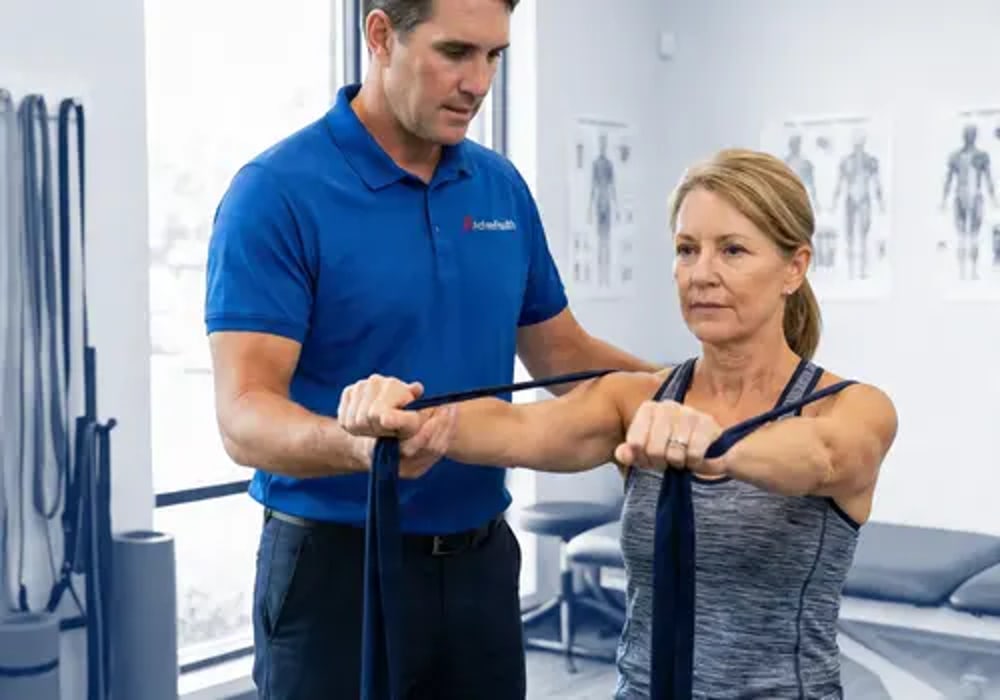
Strength is what lets the elbow hold up when you go back to the job or the court. The program uses progressive forearm and grip strengthening. It loads the wrist extensors for tennis elbow or the wrist flexors for golfer's elbow, starting light and building as the tendon allows.
It also covers what keeps loading the tendon, from your tool grip to your racquet setup or swing.
Elbow Tendon Treatment Options, Compared
Each of these options has a place. Surgery is not performed at Active Health.
| Option | When it makes sense | The trade-off |
|---|---|---|
| Shockwave, PRP and strengthening at Active Health | Pain that has outlasted weeks of rest and a strap, or returns with the activity. | It takes weeks to months, shockwave and PRP are often self-pay, and the home exercises are part of the treatment. |
| Rest, a strap and over-the-counter pain relief | A fresh flare in the first few weeks after a change in work, training or play. | Useful early, slow for an elbow that has hurt for months, and it does nothing to strengthen the forearm. |
| Cortisone (steroid) injection | Pain severe enough to block sleep or work, where short-term relief would let strengthening begin. | The AAOS advises using steroid injections very sparingly at the elbow, since repeated use can weaken the bone where the tendon attaches. |
| Elbow tendon surgery (not performed here) | Pain that is still disabling after 6 to 12 months of proper nonsurgical treatment. | The damaged tendon tissue is removed, return to sport usually takes 4 to 6 months, and some loss of strength is not uncommon. |
The AAOS reports that about 80 to 95 percent of tennis elbow patients do well without surgery. It also notes that many doctors still regard shockwave for tennis elbow as experimental, so it is never the whole plan here.
How Long Does Tennis or Golfer's Elbow Take to Heal?
Recovery runs in four phases, checked at each reassessment.
- Calm the tendonCut back the grips and wrist positions that provoke it, with a strap if it helps.
- Prompt repairA course of focused shockwave, with PRP considered if progress stalls.
- Rebuild the forearmWrist and grip strengthening that gets heavier as the tendon allows.
- Return to the work or the swingGrip, tool and technique changes, then a graded return to full load.
An OmniWave course is typically 6 to 12 sessions. After a PRP injection, expect soreness for two to five days and lighter use of the arm for one to two weeks before strengthening resumes.
ASSH notes that many tendon conditions take months to improve, not days or weeks. Your pace depends on how long it has hurt and how consistently the home exercises get done. Results vary.
Judge progress by what your grip can do. Carrying grocery bags or finishing a bucket of range balls with less pain than a month ago is progress, even if the elbow still aches.
Elbow Care in Jacksonville Since 2005
Active Health has treated sports and overuse injuries in Jacksonville since 2005, at 6500 Bowden Rd STE 200 in the Southpoint corridor, just off I-95 and J. Turner Butler Blvd. An elbow plan here draws on three parts of one practice: the sports medicine side for shockwave, the medical clinic for the injection decision, and physical therapy for the forearm strengthening.
A treated tendon still has to be loaded, and the loading has to fit what was done to it that week. Elbow care runs through one practice that runs the whole elbow plan, so you are not carrying notes between three offices.