
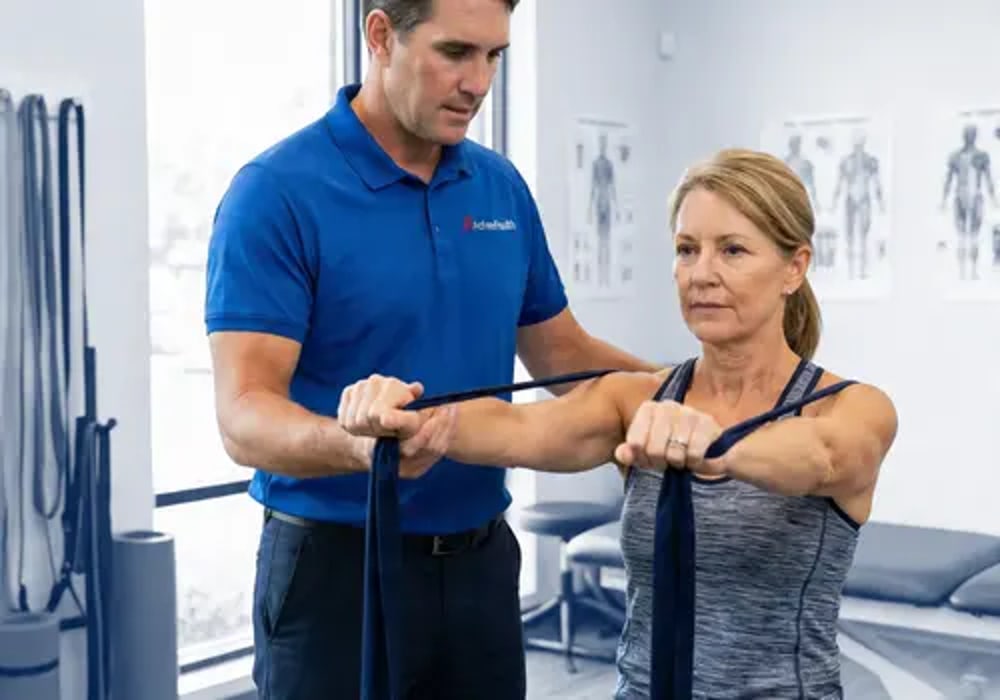
Tech neck is the neck pain, headache and upper back tightness produced by hours of forward head posture at a screen. The deep neck muscles that hold your head in neutral weaken, which makes the posture harder to hold, which weakens them further. Active Health treats it in Jacksonville, FL with postural rehabilitation, graded strengthening and workstation guidance.
You know the pattern even if you have never named it. The neck starts aching mid-afternoon, the headache arrives behind the eyes around four, and by the end of a working day your shoulders have crept up somewhere near your ears.
Most people treat it as the price of the job. It is really a loading problem with a straightforward mechanism, and mechanisms can be changed.
At the rehabilitation center at Bowden Road, a posture evaluation measures where your head actually sits and how long the deep neck muscles can hold it. You leave the first visit with a written plan and, usually, three things to change about your desk.
Understanding Tech Neck and Postural Strain
Tech neck is the cervical pain, headache, upper back tightness and shoulder tension produced by sustained forward head posture. It is a loading problem rather than a habit problem: the further the head sits ahead of the shoulders, the more work the neck muscles do simply to hold it there.
OSHA defines the neutral working position at a computer plainly, and the standard is that the head is level, forward facing, balanced and generally in line with the torso. Working outside that neutral, and staying outside it, is what OSHA links to musculoskeletal strain.
Sustained forward head posture is not only uncomfortable. It compresses the front of the cervical discs, lengthens the ligaments at the back, inhibits the deep cervical flexors, and rounds the mid-back into a compensation that spreads the load down the rest of the spine. The cycle then feeds itself: weakened deep flexors cannot hold a neutral head, so the head drifts further forward, which weakens them further. Breaking it takes structural correction and retraining rather than a reminder to sit up straight.
Common Symptoms of Tech Neck and Postural Strain
Most of it arrives by the end of a working day. These are the presentations we evaluate at Active Health.
- Persistent neck stiffness and aching, particularly after a long stretch of screen work
- Headaches starting at the base of the skull, the temples, or behind the eyes
- Mid and upper back pain, and aching between the shoulder blades
- Shoulder tightness, or reduced comfortable reach overhead
- Tingling or numbness in the arms, hands or fingers
- Jaw tension and discomfort at the temporomandibular joint
- Eye strain and difficulty focusing after sustained screen work
- Upper chest tightness and a sense of restricted deep breathing
- Low back pain that arrived as the upper body posture collapsed
What Drives Forward Head Posture
Five drivers account for most of what we see at Bowden Road, and they usually arrive stacked rather than alone.
Prolonged Desk and Computer Work
Hours of screen work with the head protracted and the mid-back flexed is the loading pattern behind most cases. Jacksonville's professional and government employment base makes occupational postural strain a routine clinical problem across the Deerwood and Southside corridors.
Phone and Tablet Use
Hours a day spent looking down at a phone add up to a large accumulated dose of sustained cervical flexion. It is the dominant driver in younger patients, and it compounds the occupational version in everyone else.
Weak Deep Cervical Flexors
The longus colli and longus capitis maintain the curve of the neck, and forward head posture progressively switches them off. Their weakness is both a consequence and a cause, which is why retraining them specifically is what breaks the loop.
A Rounded, Stiff Mid-Back
Thoracic rounding mechanically forces the neck into compensatory extension and protraction. Restoring mid-back mobility and extension is a prerequisite for cervical correction that holds, which is why a neck-only programme keeps unwinding.
A Previous Neck Injury
Prior whiplash or a cervical disc injury leaves residual laxity and altered control that make the neck more vulnerable to postural loading. It tends to make tech neck arrive earlier and settle slower.
How We Treat Tech Neck in Jacksonville
Treatment works on two fronts at once. Deep cervical flexor retraining and thoracic mobility restore the capacity to hold a neutral head position, while workstation changes remove the loading that produced the problem, since a posture rebuilt in the clinic will not survive a desk that undoes it daily.
Postural and Structural Rehabilitation
This is the core of the plan. Thoracic mobility work and cervical alignment correction restores the extension the mid-back has lost and addresses the structural change that sustained loading has produced, then movement retraining puts the corrected position back into the environments where it was originally lost.
Therapeutic Exercise
Correction has to be held by something. A graded program for the deep neck and mid-back muscles rebuilds endurance in the muscles that maintain a neutral head all day, working from short holds toward the sustained demand a working day actually makes. OSHA's own guidance is relevant here: it warns that staying in the same posture for prolonged periods is not healthy, so movement breaks are written into the program rather than suggested.
Spinal Decompression Therapy
Where forward head posture has narrowed a nerve opening and symptoms have started travelling into an arm, the segment has to be unloaded before retraining will be tolerated. Controlled traction that unloads an irritated cervical segment creates room at the nerve root across a course of sessions, alongside the strength work rather than instead of it.
Biomechanical Performance Labs
Posture is the condition most often judged by eye and least often measured. Measured forward head position and deep neck flexor endurance gives the plan real numbers, and repeating the same measurements at each phase is how you tell genuine correction from a good day.
Recovery and Realistic Timelines
Every plan moves through the same four phases, and you are told which one you are in at each reassessment.
- Measure the starting pointForward head position, mid-back extension and deep flexor endurance.
- Free the mid-backRestore the extension the neck is currently compensating for.
- Retrain the holdersDeep cervical flexors and scapular control, built for endurance.
- Fix the environmentScreen height, chair, phone habits and the breaks that keep it.
Meaningful improvement is usually noticeable within 4 to 6 weeks, and fuller structural correction commonly takes 12 to 16 weeks of consistent work. Results vary with how long the pattern has been in place, how much mid-back stiffness there is to begin with, and whether the workstation changes actually get made.
The honest measure is not how you look in a mirror at the end of a session. It is whether the afternoon headache has stopped arriving, and whether the neck is still comfortable at five o'clock.
Expert Care for Neck and Postural Strain in the Jacksonville Area
The Deerwood business corridor and the Southside professional districts hold thousands of Jacksonville office workers, healthcare staff and technology employees who spend most of a working day in exactly the position that produces this. San Jose and Ortega add a residential population that keeps going on a phone well into the evening.
What makes the difference is treating the desk as part of the case rather than as background. Posture work here runs inside a practice that treats the desk worker rather than only the neck, so the headaches, the shoulder and the low back that arrived with it are handled by the same team.